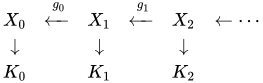
Adams resolution
From Wikipedia, the free encyclopedia
In mathematics, specifically algebraic topology, there is a resolution analogous to free resolutions of spectra yielding a tool for constructing the Adams spectral sequence. Essentially, the idea is to take a connective spectrum of finite type and iteratively resolve with other spectra that are in the homotopy kernel of a map resolving the cohomology classes in using Eilenberg–MacLane spectra.


This construction can be generalized using a spectrum , such as the Brown–Peterson spectrum , or the complex cobordism spectrum , and is used in the construction of the Adams–Novikov spectral sequence[1]pg 49.


Resolution of cohomology of a spectrum
The mod Adams resolution for a spectrum is a certain "chain-complex" of spectra induced from recursively looking at the fibers of maps into generalized Eilenberg–Maclane spectra giving generators for the cohomology of resolved spectra[1]pg 43. By this, we start by considering the map


where is an Eilenberg–Maclane spectrum representing the generators of , so it is of the form


where indexes a basis of , and the map comes from the properties of Eilenberg–Maclane spectra. Then, we can take the homotopy fiber of this map (which acts as a homotopy kernel) to get a space . Note, we now set and . Then, we can form a commutative diagram


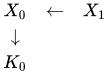
where the horizontal map is the fiber map. Recursively iterating through this construction yields a commutative diagram
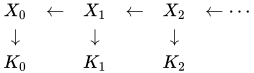
giving the collection . This means

is the homotopy fiber of and comes from the universal properties of the homotopy fiber.


Now, we can use the Adams resolution to construct a free -resolution of the cohomology of a spectrum . From the Adams resolution, there are short exact sequences


which can be strung together to form a long exact sequence

giving a free resolution of as an -module.