Aparank Monastery
From Wikipedia, the free encyclopedia
| Aparank | |
|---|---|
Ապարանք | |
 | |
| Religion | |
| Affiliation | Armenian |
| Province | Moxoene |
| Region | Van |
| Ecclesiastical or organizational status | Abandoned, historically suffragen to the Catholicosate of Aghtamar |
| Location | |
| Municipality | Bahçesaray |
| Country | Turkey |
| Geographic coordinates | 37°58′00″N 42°45′00″E / 37.9667°N 42.75°E |
| Architecture | |
| Style | Armenian |
| Founder | 10th century |
| Completed | 17th century |
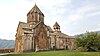
Aparank Monastery or Aparanq (Armenian: Ապարանք), or Holy Cross Aparank, is an Armenian monastery located in modern-day Turkey, Van province near the city of Bahçesaray. It was found within the borders of the historical Armenian province of Mokk.
The monastery was founded in the 10th century to house a relic of the True Cross. The church was restored and expanded in the 17th century, and it was abandoned during the first half of the 20th century after the Armenian genocide. Before the genocide, it consisted of the churches of Surb Hovhannes Karapet (St. John the Baptist), Surb Astvatsatsin (Holy Mother of God), and the chapels of Surb Stepannos (St. Stephen) and Surb Arakelots (Holy Apostles), a gavit, a fountain, and a hotel.
The monastery is located on the Aparank Armenian plateau and is 2,400 metres (7,900 ft) above sea level on the southwest side of Vankin Dağ (Sarikhats).[1] It lies northwest of the town of Aparank (Veras in Kurdish) and 20 kilometres (12 mi) south of Bahçesaray[2] in Van province, Turkey.[3]
Historically, the complex was located in the township of Mamrtank/Mirja in Mokk' province.[3]
History
The founding of the monastery is known because of panegyric written for the occasion by Gregory of Narek, the History of the Holy Cross Aparank.[3]
This monastery is an important part of the delivery of a relic of the True Cross by the Byzantine emperors Basil II and Constantine VIII,[4] inbound to sign with the kingdom of Vaspurakan,[5] in which the province of Mokk is integrated since the reign of Gagik I of Vaspurakan.[6] The relic was initially held at the Surb Hovhannes Karapet Church, founded in 950 by a Father Davit,[3] whose sanctity is to origin of the supply of emperors according to Gregory of Narek.[1] It was then brought to the Surb Astvatsatsin Church, erected by his successor, the abbot and bishop Stepannos, and which was solemnly consecrated in 983, in the presence of Ashot-Sahak of Vaspurakan and his brothers Gurgen-Khachik of Vaspurakan and Senekerim-Hovhannes.[7]
An important cultural center by the 15th century,[2] the monastery was renovated in 1629,[8] and expanded in following years by Abbot Simeon.[3]
It was abandoned in the early 19th century and turned into farm by Kurds in the second half.[3] The staurotheke gold disappeared.[2]