April 18 (Eastern Orthodox liturgics)
Day in the Eastern Orthodox liturgical calendar
From Wikipedia, the free encyclopedia
April 17 - Eastern Orthodox liturgical calendar - April 19

All fixed commemorations below are observed on May 1 by Orthodox Churches on the Old Calendar.[note 1]
For April 18th, Orthodox Churches on the Old Calendar commemorate the Saints listed on April 5.
Saints
- Martyrs Victor, Zoticus, Zeno, Acindynus, and Severian, of Nicomedia (c. 303)[1][2][3] (see also: April 20 - Greek)
- Martyr Sabbas the Goth (Sabbas Stratelates), at Buzau in Wallachia (372)[1][4][5] (see also: April 12 and April 15)
- Saint Acacius II, Bishop of Melitene (445)[5][6][note 2] (see also: April 17)
- Saint Cosmas, Bishop of Chalcedon, and his fellow-ascetic St. Auxentius (815-820)[1][5][7][8]
- Venerable John the Righteous (John the Hesychast), disciple of St. Gregory of Decapolis (c. 820-850)[1][5][9][10]
- Venerable Naucratius, Abbot of the Studion (848)[1][5][11]
- Venerable Athanasia the Wonderworker, Abbess, of Aegina (850)[1][5][12] (see also: April 12 - Slavic)
- Venerable Matthew (Matthias), acquaintance of St. Athanasia the Wonderworker (c. 850)[13]
- Venerable Euthymius the Wonderworker.[5][14]
Pre-Schism Western saints
- Saint Eleutherius, Bishop of Illyria, his mother Anthia, and eleven others, martyred in Illyria under Hadrian (c. 117-138)[15][16][note 3] (see also: December 15 - East)
- Martyr Corebus, a prefect of Messina in Sicily, converted to Christ by St Eleutherius and martyred under the Emperor Hadrian (c. 117-138)[15][note 4]
- Martyr Calocerus, an officer of the Emperor Hadrian martyred in Brescia in Italy (c. 117-138)[15][note 5]
- Saint Apollonius the Apologist, a Roman senator, denounced as a Christian by one of his own slaves and condemned to be beheaded (c. 190)[15][18][note 6][note 7]
- Saints Bitheus and Genocus, two monks from Britain who accompanied St Finian of Clonard to Ireland (6th century)[15][19]
- Saint Laserian (Molaisse), founder of the monastery and bishopric of Leighlin in Ireland (639)[15][20][21]
- Saint Deicola (Dicul), born in Ireland, he preached Christ in England in Norfolk and in Sussex (late 7th century)[15][note 8]
- Saint Agia (Aia, Aya, Austregildis, Aye), wife of St Hidulf of Hainault in Belgium, monastic at the convent of Mons (c. 714)[15][22]
- Saint Wicterp (Wiho, Wicho), Abbot of Ellwangen Abbey in Germany, later became the tenth Bishop of Augsburg (749)[15][note 9]
- Saint Cogitosus, a monk at Kildare in Ireland who probably wrote the Life of St Brigid (8th century)[15][23]
- Saint Perfectus, a priest in Cordoba in Spain, martyred by Muslims on Easter Sunday (851)[1][15][note 10]
Post-Schism Orthodox saints
- Venerable Basil (Ratishvili) the Georgian, Wonderworker, of Iveron Monastery, Mt. Athos (13th century)[1][24][25]
- Venerable Euthymius the Enlightener of Karelia (1435),[26] and righteous laymen Anthony and Felix of Karelia.[1][27][28]
- New Martyr John the Tailor, of Ioannina, at Constantinople (1526)[1][5][29][30]
- Venerable new martyr John (Koulikas) (1564)[31] (see also: April 8)
- Martyr Tunom, Arab Emir who confessed Christ on seeing the Holy Fire in Jerusalem (1579)[1][note 11]
- Hieromartyr Cyril VI of Constantinople, Ecumenical Patriarch of Constantinople (1821)[33]
New martyrs and confessors
- New Hieromartyr Bessarion Selinin, Priest (1918)[2][34]
- New Hieromartyr Alexis Krontenkov, Priest, of Ekaterinburg (1930)[1]
- New Hieromartyrs Nicholas (1937) and Basil Derzhavin (1930), Priests, and martyred lay people of the city of Gorodets, Nizhni-Novgorod.[1][2]
- New Martyr Tamara (Satsi), Abbess, of Cheboksara (Chuvashia) (1942)[1][2][34]
Other commemorations
Icon gallery
 Saint Apollonius of Rome, drawn by Jacques Callot, ca. 1630.
 St. Cyril VI, Patriarch of Constantinople.
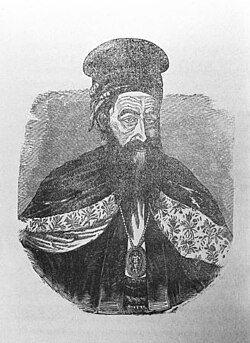 St. Cyril VI, Patriarch of Constantinople.
 An icon of the Most Holy Theotokos "Glykophilousa"
("Sweet-kissing").


.jpg)
Notes
- The notation Old Style or (OS) is sometimes used to indicate a date in the Julian Calendar (which is used by churches on the "Old Calendar").
The notation New Style or (NS), indicates a date in the Revised Julian calendar (which is used by churches on the "New Calendar"). - "At Messina, the birthday of the holy martyrs, Eleutherius, bishop of Illyricum, and Anthia, his mother. Illustrious by his holiness of life and his power of working miracles, he was, in the reign of Adrian, laid on a bed of red-hot iron, on a gridiron, in a pan filled with boiling oil, pitch and rosin; he was cast to the lions, but, remaining unhurt, he finally had his throat pierced with a sword. His mother suffered a similar punishment."[17]
- "AT Rome, St. Apollonius, a senator under the emperor Commodus and the prefect Perennius. Having been denounced as a Christian by one of his slaves, and being commanded to give an account of his faith, he composed an able work which he read in the Senate. He was nevertheless decapitated for Christ by the sentence of that body."[17]
- Dickleburgh in Norfolk may be named after him.
- He helped found monasteries at Fussen, Wessobrunn and Kempten, all of which became famous.
- "...The oldest edition of these pilgrimage guides, entitled Proskynitarion of the Holy City of Jerusalem, was published in Vienna in 1749 and was written by Symeon, archimandrite and warden of the Holy Sepulchre...The Vienna edition also mentions another incident related to an Arab emir named Tunom, who at the time of the miracle was in the church courtyard. When he saw the igniting of the column he realized the truth of the miracle of the Holy Fire and confessed to his co-religionists the power of Jesus Christ. After he quarreled with them, his confession became the cause of the order for his execution, and subsequently for his body to be burnt. Today he is venerated as an official holy martyr of the Orthodox Church. His memory is celebrated on 18 April and his relics are kept at the monastery of the Virgin Mary, the Megali Panagia, in Jerusalem."[32]