December 15 (Eastern Orthodox liturgics)
Day in the Eastern Orthodox liturgical calendar
From Wikipedia, the free encyclopedia
December 14 â Eastern Orthodox liturgical calendar â December 16

All fixed commemorations below celebrated on December 28 by Eastern Orthodox Churches on the Old Calendar.[note 1]
For December 15th, Orthodox Churches on the Old Calendar commemorate the Saints listed on December 2.
Saints
- Hieromartyr Eleutherius, Bishop of Illyricum (Illyria),[1] and Martyrs Anthia (his mother),[2] Coremonus (Corybus, Corivus) the Eparch,[3] and two executioners who suffered with them[4] (117â138)[5]
- Martyr Eleutherius of Byzantium (beginning of the 4th century)[6][7] (see also: August 4)
- Martyr Susanna the Deaconess, Joanna in monasticism, of Palestine (4th century)[8]
- Venerable Pardus the Hermit of Palestine (6th century)[9][10]
- Saint Stephen the Confessor, Archbishop of Surozh in the Crimea (c. 790)[9][11][12]
- Monk-Martyr Bacchus the New of St. Sabbas Monastery, by beheading (787)[9][13]
- Venerable Paul the New Ascetic of Mt. Latros (896 or 956)[14][15]
Pre-Schism Western saints
- Saint Valerian of Abbenza, Bishop of Abbenza in North Africa (457)[16][17][note 2]
- Martyrs Faustinus, Lucius, Candidus, Caelian, Mark, Januarius and Fortunatus, in North Africa[16][17]
- Saint Mesmin (Maximin, Maximinus), first Abbot of Micy (Saint-Mesmin de Micy Abbey) near Orleans in France (520)[16]
- Saint Aubertus, Bishop of Cambrai-Arras, Netherlands (668)[9] (see also: December 13)
- Saint Florentius (Flann), Abbot of Bangor Abbey in Ireland (7th century)[16]
- Saint Offa of Essex, King of Essex in England, he went to Rome and took up the monastic life (c. 709)[16][note 3]
- Saint Urbicius (Urbitius, Ãrbez) of Huesca (c. 805)[16][note 4]
- Saint Adalbero (Adalbero II of Upper Lorraine), a monk at the monastery of Gorze in France, became Bishop of Verdun, but was transferred to Metz (1005)[16]
Post-Schism Orthodox saints
- Saint Nectarius of Bitel (Nektarios of Bitola, Nektarij Bitolski) (1500)[19][note 5]
- Saint Tryphon of Pechenga, Kola Peninsula, "Enlightener of the Lapps" (1583)[9][20]
New martyrs and confessors
- New Martyr Jonah, disciple of Saint Tryphon of Pechenga (1589â1590)[9][21][note 6][note 7]
- New Hieromartyr Hilarion Troitsky, Archbishop of Vereya (Verey) (1929)[9][22][23][24]
- New Hieromartyrs Alexander Rozhdestvensky and Basil Vinogradov, Priests of Tver (1937)[23][24]
- New Hieromartyr Victorinus Dobronravov, Priest (1937)[24][25]
- New Hieromartyr Joseph, Metropolitan of Saint Petersburg (1938)[23][25]
- New Virgin Martyr Victorina Diobronravova[25]
Other commemorations
- Sunday of the Holy Forefathers of Jesus Christ (December 11â17)
- Commemoration of the ordination of Saint John Chrysostom as the Patriarch of Constantinople (15 December 397)[26]
- Synaxis of the Saints of the Crimea[9][25]
- Synaxis of the Saints of Kola (Kolsk)[24]
- Glorification (1997) of Saint Peter Mogila (Petro Mohyla), Metropolitan of Kiev (1646)[27][note 8] (see also: December 31)
Icon gallery
 St. Eleutherius, Bishop of Illyria (Menologion of Basil II, 10th century)
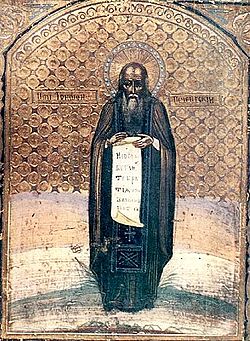 St. Tryphon of Pechenga, Enlightener of the Lapps.
 New Hieromartyr Hilarion (Troitsky), Archbishop of Verey.
 Saints and martyrs of the Crimea - Basilius, Eugenius, Agathadorus, Elpidius, Eterius, Capito, and Ephraim.
.jpg)


_2.jpg)


Notes
- The notation Old Style or (OS) is sometimes used to indicate a date in the Julian Calendar (which is used by churches on the "Old Calendar").
The notation New Style or (NS), indicates a date in the Revised Julian calendar (which is used by churches on the "New Calendar"). - "OFFA succeeded his father Sighere as King of the East Saxons in 704. He was a youth of most noble aspect, in the flower of his age, and most dearly beloved by his people, with the prospect of a long and happy reign. He had entered into an agreement with the family of King Penda to contract a marriage with Kyneswida, the daughter of that prince. But she had resolved to consecrate her virginity to a heavenly Spouse, and in her trouble, on hearing the designs of her kindred, had recourse to the intercession of the Queen of Virgins. Her prayer was heard, and not only was she able to maintain her purpose, but her persuasions so touched the heart of Offa, that he too chose the better part, and after a short reign of four years resigned his kingdom and went on a pilgrimage to Rome, in company with St. Egwin, Bishop of Worcester, and Kenred, King of Mercia, and nephew of the virgin Kyneswida, who had the same pious purpose as himself. In Rome, Offa took the monastic habit, and persevered in that state until called to the heavenly kingdom, on which his heart was set."[18]
- The Monk Nektarii of Bitel'sk. HOLY TRINITY RUSSIAN ORTHODOX CHURCH (A parish of the Patriarchate of Moscow).
- Saint Jonah of Pechenga and Kola was, as tradition tells us, a priest in the city of Kola. After the death of his daughter and wife he went off to the Pechenga-Trinity Monastery near Kola, and became a disciple of its founder, St. Tryphon. After the death of his teacher, he settled in 1583 at the site of what was to become his grave in the neighboring Dormition wilderness, where he was killed by the Swedes in the year 1590.
- See: (in Russian) Ðона ÐеÑенгÑкий. Ðикипедии. (Russian Wikipedia).
- "On 15 December 1997, the Orthodox Church of Ukraine decreed that he should be numbered among the Saints. However in the absence of unanimity with regard to the ecclesiastical policy and the teaching of Metropolitan Peter Moghila, we have included his memory only provisionally in the Synaxarion".[27]