August 27 (Eastern Orthodox liturgics)
Eastern Orthodox liturgical calendar day
From Wikipedia, the free encyclopedia
August 26 - Eastern Orthodox liturgical calendar - August 28

All fixed commemorations below are observed on September 9 by Eastern Orthodox Churches on the Old Calendar.[note 1]
For August 27, Orthodox Churches on the Old Calendar commemorate the Saints listed on August 14.
Saints
- Saint Hosius the Confessor (Osius or Ossius), Bishop of Cordova (359)[1][2][3][4]
- Saint Liberius the Confessor, Pope of Rome (366)[1][5][6][7]
- Saint Arcadius, Eastern Roman Emperor (395-408)[8][note 2]
- Saint Praulius, Archbishop of Jerusalem (422)[1]
- Venerable Poemen the Great, of Egypt (450)[1][6][9][10][11]
- Saint Sabbas, monk, of Benephali.[1][12]
- Saint Poemen of Palestine (605)[1][12][13]
- Great-martyr Phanourios the Newly-Revealed, of Rhodes.[1][6][12][14][15][note 3][note 4]
- Martyr Anthousa the New, by drowning in a well.[6][12][16][note 5]
- Venerable Theoklitos, a Magistros from Constantinople who retired from the world and took the monastic habit, becoming an ascetic on Mt. Olympos.[17]
Pre-Schism Western saints
- Virgin-martyr Euthalia, in Leontini in Sicily (252)[18][note 6] (see also: March 2 - East)
- Martyrs Rufus and Carpophorus (Carpone), Martyrs in Capua under Diocletian (295)[11][18][note 7]
- Saint Rufus of Capua, Bishop of Capua and disciple of St Apollinaris of Ravenna.[18][note 8]
- Saint Narnus, first Bishop of Bergamo in Italy.[18][note 9]
- Saint Monica of Hippo (Monica of Tagaste) (387)[18][note 10] (see also: May 4 - East )
- Saint Caesarius of Arles, Bishop of Arles (543)[1][11][12][18][note 11]
- Saint Licerius (Lizier), Bishop of Couserans (c. 548)[11][18][note 12]
- Saint Syagrius (Siacre), Bishop of Autun and Confessor (600)[11][18]
- Saint Etherius (Alermius), Bishop of Lyon (602)[18]
- Saint Decuman of Watchet (Dagan) (706)[12][18][note 13][note 14]
- Saint Ebbo, Bishop of Sens (740)[18][note 15]
- Saint John of Pavia, Bishop of Pavia in Lombardy (813)[11][18]
- Saint Agilo, Monk of St Aper in Toul in France (957)[18][note 16]
- Saint Gebhard of Constance, Bishop of Constance in Germany (995)[18][note 17]
- Saint Malrubius, an hermit in Merns in Kincardineshire in Scotland, martyred by Norwegian invaders (c. 1040)[18]
Post-Schism Orthodox saints
New martyrs and confessors
- New Hieromartyrs Michael Voskresensky, Priest, (with 28 other martyrs), and Stephen Nemkov, Priest, (with 18 other martyrs), all of Nizhni-Novgorod (1918)[1][12]
- New Hieromartyrs John Lebedev and John Smirnov, Priests (1937)[12]
- New Hieromartyr Methodius (Ivanov), Abbot, of Sukovo (Moscow) (1937)[1][12]
- New Hieromartyr Aleksander Tsitserov, Priest (1939)[12]
- New Hieromartyr Vladimir Sokolov, Priest (1940)[12]
- Saint Demetrius Kryuchkov the Confessor, Priest (1952)[12]
Other commemorations
- Baptism of the Ethiopian eunuch Djan Darada, by Saint Philip the Evangelist, in Acts 8:26-40 (1st century)[21][22] (see also: January 4 and June 17)
- Uncovering of the relics (1991) of St. John Gashkevich, Archpriest, of Korma (1917)[1]
- Reburial of the relics (2020) of St. John Domovsky, Archpriest in Rostov-on-Don, a confessor of Orthodoxy who firmly denounced the Renovationists (1930)[23][24] (see also: February 24)
- Slaying of Archimandrite Symeon (Kholmogorov), spiritual writer (1937)[1]
- Repose of Archimandrite Sergius (Ozerov) of New Valaam Monastery in Siberia (1937)[1][25]
- Translation of the Relics of Saints Theognostus, Cyprian and Photius, Metropolitans of Moscow.[26]
Icon gallery
 St. Hosius the Confessor, Bishop of Cordova.
 St. Liberius the Confessor, Pope of Rome.
 Venerable Poemen the Great, of Egypt.
 St. Monica of Hippo.
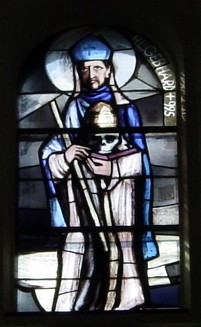 St. Gebhard of Constance.
 Philip and the Ethiopian eunuch (Menologion of Basil II).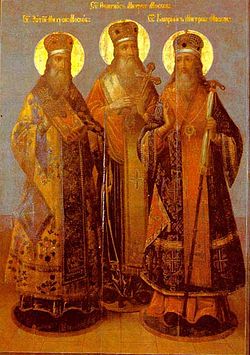


.JPG)


Notes
- The notation Old Style or (OS) is sometimes used to indicate a date in the Julian Calendar (which is used by churches on the "Old Calendar").
The notation New Style or (NS), indicates a date in the Revised Julian calendar (which is used by churches on the "New Calendar"). - None of the Synaxaria list him as a Saint. His memory is preserved only in the 'Jerusalemitic Canonarion' (p. 105; Edition of Archimandrite Kallistos). Perhaps the Church of Jerusalem had a specific reason for ranking him among the Saints.
- He is not listed in the Synaxaria. He was "newly-revealed", when his icon was discovered accidentally in the 14th century in Rhodes, during exacavations on the southern section of the old city wall. There, an ancient church was discovered with many destroyed icons, among which was the well preserved icon of St. Phanourios (Greek: «ὁ ἅγιος Φανῶ»). This took place during the tenure of the Metropolitan of Rhodes "Neilos II Diassorianos" (1355-1369). The saint was depicted as young soldier holding a cross in his right hand, and a lighted taper, with twelve scenes from his life shown around the border of the icon.
- Rufus was a Deacon.
- Born in Carthage in North Africa of Christian parents, she married a pagan and had three children. Through her patience and gentleness she converted her husband and through her prayers and tears her wayward son, who became Blessed Augustine. She reposed in Ostia near Rome and her relics are preserved in Rome.
- Born in Châlon-sur-Saône in France, he became a monk at Lérins when young and then Bishop of Arles. He presided several Councils and founded a convent afterwards called after him at Arles, where his sister St Caesaria became abbess. He was zealous for decorum in liturgy and excelled as a preacher. His homilies still exist. During the distress caused by the siege of Arles in 508, he sold the treasures of his church to help the poor.
- Born in Spain, probably in Lérida (Ilerda), he went to France and in 506 became Bishop of Couserans.
- "DECUMAN, who is also called DECOMBE and DAGAN, belonged to a noble family in Wales; but desirous of a solitary life, forsook his home and crossed the Severn on a hurdle of reeds. He landed on the coast of Somerset, and finding a spot near Dunster which promised to satisfy his longings, established himself there. The place still bears his name, and is attached to a prebendal stall in the Cathedral of Wells, also called St. Decumans. The Saint is venerated as a Martyr, having been put to death by a murderer, in hatred of religion."[19]
- Born in Wales, he lived as a hermit at what is now St Decumans in Somerset in England, where he was martyred.
- Born in Tonnerre, he was a monk at Saint-Pierre-le-Vif in Sens in France. He became Bishop of Sens which he saved in 725 when it was besieged by the Saracens.
- He was invited to restore monastic discipline at Sithin (Saint Bertin).
- Bishop of Constance in Germany (979-995). In 983 he founded the monastery of Petershausen near Constance where he was buried.