
Australian heraldry
Australian coats of arms and other heraldic achievements
From Wikipedia, the free encyclopedia
Australian heraldry is the style and tradition of using armorial achievements, sometimes known as coats of arms, and other heraldic bearings and insignia in Australia. It largely follows the Gallo-British tradition of heraldry also followed in England, Scotland, Ireland, Canada and New Zealand.

| |
| Heraldic tradition | Gallo-British |
|---|---|
| Governing body | Disputed |
Heraldic authority
Australia does not have its own heraldic authority which grants or records arms, though the College of Arms in London claims to be "the official heraldic authority" for Australia and much of the Commonwealth.[1] They have issued arms in the name of the Australian monarch.[2] Additionally, the College's Garter Principal King of Arms is mentioned in the ordinances of the Order of Australia.[3] However, the College's authority is disputed by the Australian Heraldry Society.[4]
The Australian Heraldry Society argues that the heraldic authority for Australia is vested in the King of Australia, who can delegate that authority to whomever they choose.[4] In response to questions submitted by the Society, on 7 February 2018 prime minister Malcolm Turnbull stated:[5]
I am advised by the Department of the Prime Minister and Cabinet that ... the practice of the College of Arms in England granting armorial bearings to Australians is well established as one way Australians can obtain heraldic insignia if they wish to do so. There is nothing preventing any person or organisation from commissioning a local artist, graphics studio or heraldry specialist to design and produce a coat of arms or identifying symbol. Those arms would have the same standing and authority in Australia as arms prepared by the College of Arms in England.
Grants of heraldic arms to Australian residents or institutions may be made, depending on their eligibility, by the English College of Arms, Scottish Court of the Lord Lyon, Chief Herald of Ireland, Chief Herald of Canada, State Herald of South Africa or the various authorities in Spain, Belgium, Russia or other places.[6]
Coats of arms
The heraldry of Australia has added indigenous Australian animals to the existing heraldic bestiary, along with native plants and occasionally traditional motifs of Aboriginal Australians and Torres Strait Islanders.
National arms
 Coat of arms of Australia (1912–present)[7]
 Coat of arms of Australia (1912–present), escutcheon only
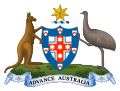 Coat of arms of Australia (1908–1912)

.svg)
Arms of states and territories


Civic arms
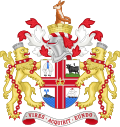


 Coat of arms of Wagga Wagga, New South Wales[26]


Personal arms
 Coat of arms of former governor-general Sir Ninian Stephen
 Shield of the coat of arms of former governor-general Sir Paul Hasluck
 Shield of the coat of arms of former governor-general Lord Richard Casey
 Shield of the coat of arms of prime minister Sir Robert Menzies


Corporate/Institutional arms
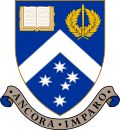 Coat of arms of Monash University[27]
 Coat of arms of the Bank of New South Wales[30]
 Coat of arms of David Jones
 Coat of arms of CPA Australia


Badges
 Badge of the Governor-General of Australia
 Badge of New South Wales
 Badge of Victoria
 Badge of Queensland
 Badge of South Australia
 Badge of South Australia (1876–1904)
 Badge of Western Australia
 Badge of Tasmania
 Badge of the Northern Territory
.svg)

.svg)


.svg)


Heraldry Society
The Australian Heraldry Society was founded in Melbourne in 1992, originally as Heraldry Australia before changing its name in 2008. The society has its roots in the Australian branch of The Heraldry Society of England, which was established in Melbourne in 1973.
The object of the society is "to promote the advancement of education in the science, art, history, practice and development of heraldry and allied subjects and the encouragement of their study and practice in Australia". They produce a bi-monthly newsletter, called The Red Escutcheon, and a triannual journal, called Heraldry in Australia.[31]

