Baital, Bankura
From Wikipedia, the free encyclopedia
Baital | |
|---|---|
Village | |
  Baital Location in West Bengal, India  Baital Baital (India) | |
| Coordinates: 22°57′48″N 87°29′52″E / 22.9634°N 87.4977°E | |
| Country |  India India |
| State | West Bengal |
| District | Bankura |
| Population (2011) | |
• Total | 4,031 |
| Languages | |
| • Official | Bengali, English |
| Time zone | UTC+5:30 (IST) |
| PIN | 722140 |
| Telephone/STD code | 03243 |
| Lok Sabha constituency | Bishnupur |
| Vidhan Sabha constituency | Bishnupur |
| Website | bankura |
Baital is a village in the Joypur CD block in the Bishnupur subdivision of the Bankura district in the state of West Bengal, India. It is a part of Dakshinbar village.
Location


5miles


Purbapara
M: Municipal town, CT: census town, R: rural/ urban centre, T: ancient/ temple centre
Owing to space constraints in the small map, the actual locations in a larger map may vary slightly
Baital is located at 22°57′48″N 87°29′52″E / 22.9634°N 87.4977°E.
Note: The map alongside presents some of the notable locations in the subdivision. All places marked in the map are linked in the larger full screen map.
Demographics
According to the 2011 Census of India, Dakshinbar had a total population of 4,031, of which 2,070 (51%) were males and 1,961 (49%) were females. There were 408 persons in the age range of 0–6 years. The total number of literate persons in Dakshinbar was 2,754 (76.01% of the population over 6 years).[1]
Education
Baital G.P. Vidyapith is a Bengali-medium coeducational institution established in 1926. It has facilities for teaching from class V to class XII. The school has 11 computers, a library with 1,100 books and a playground.[2]
Baital Girls’ High School is a Bengali-medium girls only institution established in 2011. It has facilities for teaching from class V to class X.[3]
Chatra Ramai Pandit Mahavidyalaya, was established at Chatra, PO Darapur in 2000.[4]
Culture
David J. McCutchion speaks of 2 temples at Baital. One is the Shyama Chandi temple, a pancha ratna with rigged rekha turrets and porch on triple archway, with 35 ft 4 in square base, a laterite plain structure built in 1660. The other is the Jhagrai Chandi temple, a smooth curvilinear rekha, with 11’ 2" square base, a laterite, largely plain structure, built in 1659.[5]
Baital picture gallery
 Shayama Chandi temple
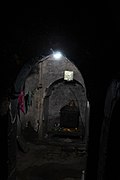 Inside the temple
 Shyama Chandi temple


