Bayes correlated equilibrium
From Wikipedia, the free encyclopedia
| Bayes correlated equilibrium | |
|---|---|
| Solution concept in game theory | |
| Relationship | |
| Superset of | Correlated equilibrium, Bayesian Nash equilibrium |
| Significance | |
| Proposed by | Dirk Bergemann, Stephen Morris |
In game theory, a Bayes correlated equilibrium is a solution concept for static games of incomplete information. It is both a generalization of the correlated equilibrium perfect-information solution concept to bayesian games, and also a broader solution concept than the usual Bayesian Nash equilibrium thereof. Additionally, it can be seen as a generalized multi-player solution of the Bayesian persuasion information design problem.[1]
Intuitively, a Bayes correlated equilibrium allows for players to correlate their actions in such a way that no player has an incentive to deviate for every possible type they may have. It was first proposed by Dirk Bergemann and Stephen Morris.[2]
Preliminaries
Let 





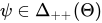
An information structure is defined as a tuple 


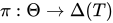


By joining those two definitions, one can define 



Definition
A Bayes correlated equilibrium (BCE) is defined to be a decision rule 




for all 
That is, every player obtains a higher expected payoff by following the recommendation from the decision rule than by deviating to any other possible action.
Relation to other concepts
Bayesian Nash equilibrium
Every Bayesian Nash equilibrium (BNE) of an incomplete information game can be thought of a as BCE, where the recommended joint strategy is simply the equilibrium joint strategy.[2]
Formally, let 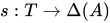





for every
If we define the decision rule 

Correlated equilibrium
If there is no uncertainty about the state of the world (e.g., if 

for every
Bayesian persuasion
Additionally, the problem of designing a BCE can be thought of as a multi-player generalization of the Bayesian persuasion problem from Emir Kamenica and Matthew Gentzkow.[5] More specifically, let 

If the set of players 
References
- 1 2 3 Bergemann, Dirk; Morris, Stephen (2019). "Information Design: A Unified Perspective". Journal of Economic Literature. 57 (1): 44–95. doi:10.1257/jel.20181489. JSTOR 26673203.
- 1 2 Bergemann, Dirk; Morris, Stephen (2016). "Bayes correlated equilibrium and the comparison of information structures in games". Theoretical Economics. 11 (2): 487–522. doi:10.3982/TE1808. hdl:10419/150284.
- ↑ Gossner, Olivier (2000). "Comparison of Information Structures". Games and Economic Behavior. 30 (1): 44–63. doi:10.1006/game.1998.0706. hdl:10230/596.
- ↑ Aumann, Robert J. (1987). "Correlated Equilibrium as an Expression of Bayesian Rationality". Econometrica. 55 (1): 1–18. doi:10.2307/1911154. JSTOR 1911154.
- ↑ Kamenica, Emir; Gentzkow, Matthew (2011-10-01). "Bayesian Persuasion". American Economic Review. 101 (6): 2590–2615. doi:10.1257/aer.101.6.2590. ISSN 0002-8282.


