Bradenville, Pennsylvania
From Wikipedia, the free encyclopedia
Bradenville, Pennsylvania | |
|---|---|
 Houses on High Street | |
  Bradenville, Pennsylvania Location within the state of Pennsylvania  Bradenville, Pennsylvania Bradenville, Pennsylvania (the United States) | |
| Coordinates: 40°19′17″N 79°20′24″W / 40.32139°N 79.34000°W | |
| Country | United States |
| State | Pennsylvania |
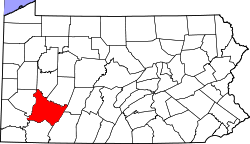
| County | Westmoreland |
| Area | |
• Total | 0.41 sq mi (1.06 km2) |
| • Land | 0.41 sq mi (1.06 km2) |
| • Water | 0 sq mi (0.00 km2) |
| Elevation | 1,099 ft (335 m) |
| Population | |
• Total | 487 |
| • Density | 1,190.3/sq mi (459.56/km2) |
| Time zone | UTC-5 (Eastern (EST)) |
| • Summer (DST) | UTC-4 (EDT) |
| ZIP codes | 15620 |
| FIPS code | 42-08024 |
| GNIS feature ID | 1170128[3] |
Bradenville is a census-designated place and coal town in Derry Township, Westmoreland County, Pennsylvania, United States. The community is located within two miles of the city of Latrobe and is three miles from the borough of Derry.
It has a total area of 0.4 square mile.[4] Bradenville has its own post office, with zip code 15620.[5]
| Census | Pop. | Note | %± |
|---|---|---|---|
| 2020 | 487 | — | |
| U.S. Decennial Census[6][2] | |||
According to 2018 estimates, Bradenville has 396 residents. The estimated median household income is $38,551, compared to the national average of $61,937.
The estimated poverty rate is 26.3%, compared to the national average of 13.1%. 100% of Bradenville residents are white, and 85.6% are high school graduates or higher.[7]
History
The town was originally called St. Clair City. Served by the Pennsylvania Railroad, it supported coal mining and coking operations beginning in 1886, operated under the names St. Clair Mine & Coke Works, Bradenville Mine & Coke Works and Duquesne Mine & Coke Works.[8]
Mathias W. Saxman's Bradenville Mine & Coke Works built about 40 company houses and a store in the town around 1914. By 1915, its Bradenville Mine employed 195 persons, produced over 110,000 tons of coal and operated 194 beehive coke ovens. The Bradenville Mine ceased operations in 1951.
Researchers in 1994 found that while the store (see Gallery section) and company houses survived, no mine structures remained.[9]