| Image | Scientific name | Common name | Distribution |
 | Centropyge abei
G. R. Allen, Young & P. L. Colin, 2006 |
Abe's pygmy angelfish | Western Pacific Ocean, amongst the islands of Indonesia and Palau |
 | Centropyge acanthops
(Norman, 1922) |
Orange-back pygmy angelfish | East coast of Africa, |
 | Centropyge argi
Woods & Kanazawa, 1951 |
Cherub pygmy angelfish | The Caribbean and Gulf of Mexico, North to North Carolina. |
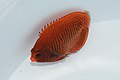 | Centropyge aurantia
J. E. Randall & Wass, 1974 |
Golden pygmy angelfish | The western Pacific Ocean: Indonesia and the Great Barrier Reef. |
 | Centropyge aurantonotus
W. E. Burgess, 1974 |
Flame-back pygmy angelfish | southern Caribbean Sea and the coastal waters of Brazil |
 | Centropyge bicolor
(Bloch, 1787) |
Bicolor pygmy angelfish | Indo-Pacific region: including East Africa, Southern Japan, Australia, and even Fiji. |
 | Centropyge bispinosa
(Günther, 1860) |
Two-spined pygmy angelfish | Indo-Pacific |
 | Centropyge boylei
Pyle & J. E. Randall, 1992 |
Peppermint pygmy angelfish | Eastern-central Pacific around the Cook Islands and Rarotonga |
| Centropyge cocosensis
K. N. Shen, C. W. Chang, Delrieu-Trottin & Borsa, 2016 |
Cocos pygmy angelfish [9] | Eastern Indian Ocean: Cocos (Keeling) Islands and Christmas Island. |
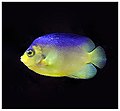 | Centropyge colini
Smith-Vaniz & J. E. Randall, 1974 |
Cocos-Keeling angelfish | Indo-west Pacific Ocean, including around the Cocos (Keeling) Islands |
| Centropyge debelius
Pyle, 1990 |
Blue Mauritius pygmy angelfish | Western Indian Ocean: Mauritius, Réunion, and the Aldabra Group (Seychelles). |
| Centropyge deborae
K. N. Shen, H. C. Ho & C. W. Chang, 2012 |
Blue velvet pygmy angelfish [10] | Fiji |
 | Centropyge eibli
Klausewitz, 1963 |
Black-tail pygmy angelfish | The Indo-Pacific. |
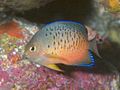 | Centropyge ferrugata
J. E. Randall & W. E. Burgess, 1972 |
Rusty pygmy angelfish | Western Pacific Ocean |
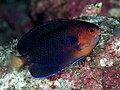 | Centropyge fisheri
(Snyder, 1904) |
Orange pygmy angelfish | Hawaii. |
 | Centropyge flavipectoralis
J. E. Randall & Klausewitz, 1977 |
Yellow-fin pygmy angelfish | Indian Ocean |
 | Centropyge flavissima
(G. Cuvier, 1831) |
Lemon-peel pygmy angelfish | Indo-Pacific region |
 | Centropyge heraldi
Woods & L. P. Schultz, 1953 |
Yellow pygmy angelfish [9] | Pacific Ocean |
| Centropyge hotumatua
J. E. Randall & D. K. Caldwell, 1973 |
Black-ear pygmy angelfish | Eastern Pacific: Austral (including Rapa), Pitcairn and Easter islands. |
 | Centropyge interrupta
(S. Tanaka (I), 1918) |
Japanese pygmy angelfish | Ogasawara Islands south of Japan. |
| Centropyge joculator
Smith-Vaniz & J. E. Randall, 1974 |
Yellow-head pygmy angelfish | Eastern Indian Ocean: Cocos and Christmas Islands. |
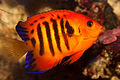 | Centropyge loriculus
(Günther, 1874) |
Flame pygmy angelfish | Reefs of Oceania, most common in Marshall, Line, and Cook Islands |
 | Centropyge multicolor
J. E. Randall & Wass, 1974 |
Multicolor pygmy angelfish | Pacific Ocean |
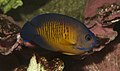 | Centropyge multispinis
(Playfair, 1867) |
Dusky pygmy angelfish | Tropical waters of the Indo-Pacific |
| Centropyge nahackyi
Kosaki, 1989 |
Nahacky's pygmy angelfish | Eastern Central Pacific: Johnston Atoll. Strays reported from the Hawaiian Islands. |
| Centropyge narcosis
Pyle & J. E. Randall, 1993 |
Narc pygmy angelfish | Cook Islands |
| Centropyge nigriocellus
Woods & L. P. Schultz, 1953 |
Black-spot pygmy angelfish | Pacific Ocean near American Samoa; Cook Islands; Guam; Kiribati (Phoenix Is.); Marshall Islands; Micronesia, Federated States of ; Nauru; New Caledonia; Northern Mariana Islands; Papua New Guinea; Samoa; Tokelau; Tuvalu; United States Minor Outlying Islands (Howland-Baker Is., Johnston I., US Line Is.) |
| Centropyge nox
(Bleeker, 1853) |
Midnight pygmy angelfish | Western Pacific: Ryukyu Islands to Indonesia, the Solomon Islands, the Great Barrier Reef and New Caledonia |
 | Centropyge potteri
(D. S. Jordan & Metz, 1912) |
Russet pygmy angelfish | Johnston Atoll and the Hawaiian Islands in the central Pacific Ocean |
| Centropyge resplendens
Lubbock & Sankey, 1975 |
Resplendent pygmy angelfish | Ascension Island |
 | Centropyge shepardi
J. E. Randall & Yasuda, 1979 |
Mango pygmy angelfish | Northern Marianas Islands, Guam, and the Ogasawara Islands. |
 | Centropyge tibicen
(G. Cuvier, 1831) |
Key-hole pygmy angelfish | Indo-Pacific |
 | Centropyge venusta
(Yasuda & Tominaga, 1969) |
Purple-mask pygmy angelfish | Western Pacific |
 | Centropyge vrolikii
(Bleeker, 1853) |
Pearl-scale angelfish | Indo-West Pacific area |
| Centropyge woodheadi
Kuiter, 1998 |
Black-fin pygmy angelfish [9] | Southwestern Pacific: from the Great Barrier Reef to the Gambier archipelago. |
|


,_Waikiki_Aquarium.JPG)


,_Waikiki_Acquarium.JPG)


.jpg)
.jpg)


.jpg)


