Chōmei-ji
From Wikipedia, the free encyclopedia
| Chōmei-ji | |
|---|---|
長命寺 | |
 Chōmei-ji Precincts | |
| Religion | |
| Affiliation | Buddhist |
| Deity | Senjū Kannon Bosatsu (Sahasrabhuja) Jūichimen Kannon Bosatsu Shō-Kannon Bosatsu |
| Rite | Tendai |
| Status | functional |
| Location | |
| Location | 157 Chōmei-chō, Ōmihachiman-shi, Shiga-ken 523-0808 |
| Country |  Japan Japan |
  Shown within Shiga Prefecture  Chōmei-ji (Japan) | |
| Coordinates | 35°9′45.66″N 136°3′50.41″E / 35.1626833°N 136.0640028°E |
| Architecture | |
| Founder | c.Prince Shōtoku |
| Completed | c.619 |
 | |

Chōmei-ji (長命寺) is a Buddhist temple located in the Chōmeiji neighborhood of the city of Ōmihachiman, Shiga Prefecture, Japan. It belongs to the Tendai sect of Japanese Buddhism and its honzon (primary image) is a statue of Senjū Kannon Bosatsu (Sahasrabhuja), the bodhisattva of 1000 arms. The temple's full name is Ikiya-san Chōmei-ji (綺耶山 長命寺). The temple is the 31st stop on the 33-temple Saigoku Kannon Pilgrimage route. It is unique in that its honzon is a trinity of Senjū Kannon, Jūichimen Kannon Bosatsu and Shō-Kannon statues.[1][2][3][4] The temple is located on the eastern shore of Lake Biwa, at an elevation of about 250 meters on the southwestern slope of Mount Chōmyōji, which is 333 meters above sea level. In the past, pilgrims would arrive at the temple by boat from Chikubushima Hōgon-ji the 30th temple of the pilgrimage, and disembark at the port at the foot of the mountain to visit. The dock at the foot of the mountain is also the entrance to the Chōmyōji River, a waterway to Azuchi, making it a key transportation hub. On April 24, 2015, the temple was designated a Japan Heritage Site as part of the "Lake Biwa and its Waterside Landscapes - A Water Heritage of Prayer and Life" project.[5]
According to legend, during the reign of Emperor Keikō, Takenouchi no Sukune carved the words "Long life and fulfillment of all wishes" into a willow tree here, praying for longevity. This is said to have resulted in Sukune's long life of 300 years. Later, in the 27th year of the reign of Empress Suiko (619), Prince Shōtoku visited the area and discovered the inscriptions carved by Sukune during his prayer. As he gazed upon them, a white-haired old man appeared and told him to carve a Buddha statue from the tree and place it here. Prince Shōtoku immediately carved an Jūichimen Kannon statue and enshrined it on the site, thus founding the temple. It is said that Prince Shōtoku named the temple Chōmei-ji in honor of Sukune's longevity. As the name suggests, it is said that those who worship at the temple will live a long life.
The actual founding date and circumstances of the temple's founding are unknown. The first appearance of the name Chōmei-ji in a reliable historical document is in a document called "Okushima Shoji Hajisuke Masahata Land Donation Letter" dated March 2, 1074.
In 1184, Sasaki Sadatsuna erected the Sanbutsudō Hall to commemorate the soul of his father, Sasaki Hideyoshi, who was killed in battle during the Mikka-Taira Rebellion. The temple complex was further expanded in the late Heian period with the construction of the main hall, Shaka-dō, Yakushi-dō, Taishi-dō, Gōma-dō, Hōtō Pagoda, Shōrō, and Niōmon Gate. From then until the Kamakura period, the temple was revered by the Rokkaku clan, the shugo of Ōmi Province. According to ancient documents preserved at the temple, Chōmei-ji was a brance of the West Pagoda of Enryaku-ji on Mount Hiei and enjoyed the patronage of the Rokkaku clan into the Muromachi period.
The honzon Kannon statues are hibutsu hidden images and are not normally open to the public. To commemorate the 1,000th anniversary of the death of cloistered Emperor Kazan, who is said to be the restorer of the Saigoku Thirty-three Kannon Pilgrimage, the statues were opened to the public for one month in 2009. This was the first time they had been opened to the public in 61 years, since 1948.
Images of the temple
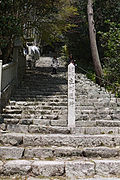 808 steps to the Sanmon
 Sanbutsu-dō
 Gongen-sha Haiden
 Gongen-sha Honden
 Goma-dō
 Three-story Pagoda
 Kuri, overlooking Lake Biwa


Access
The temple is located approximately 12 kilometers by car west of Azuchi Station on the JR West Biwako Line.


