Sōji-ji (Osaka)
From Wikipedia, the free encyclopedia
| Sōji-ji | |
|---|---|
総持寺 | |
 Sōji-ji Hondō | |
| Religion | |
| Affiliation | Buddhist |
| Deity | Senjū Kannon Bosatsu |
| Rite | Kōyasan Shingon-shū |
| Status | functional |
| Location | |
| Location | 1-6-1 Sōjiji, Ibaraki-shi, Osaka-fu 567-0801 |
  Shown within Osaka Prefecture  Sōji-ji (Osaka) (Japan) | |
| Coordinates | 34°49′44.77″N 135°34′53.65″E / 34.8291028°N 135.5815694°E |
| Architecture | |
| Founder | c.Fujiwara no Yamakage |
| Completed | c.879 |
| Website | |
| Official website | |
 | |

Sōji-ji (総持寺) is a Buddhist temple located in the Sōjiji neighborhood of the city of Ibaraki, Osaka Prefecture, Japan. It belongs to the Kōyasan Shingon-shū sect of Japanese Buddhism and its honzon (principle image) is a hibutsu (hidden / concealed image) statue of Senjū Jūichimen Kannon Bosatsu (Sahasrabhuja). The temple's full name is Fudaraku-san Katsuō-ji (補陀洛山 総持寺).The temple is the 22nd stop on the Saigoku Kannon Pilgrimage route.[1][2][3][4]
The details surrounding the founding of the temple are uncertain. According to legends found in the Konjaku Monogatari and Genpei Jōsuiki, Fujiwara no Takafusa, the father of the temple's founder, Fujiwara no Yamakage, was traveling down the Yodo River on his way to Dazaifu in Chikuzen Province to take up his post when he saw some fishermen capturing a large turtle. He bought the turtle and released it into the river, saying, "Today, the 18th, is Kannon's festival day." That night, Yamakage was tricked by his stepmother and fell into the river. Grieving, Takafusa prayed to Kannon, and the turtle he had rescued appeared before him, carrying Yamakage on its back. Grateful to Kannon, Takafusa made a vow to create a statue of Kannon, but he died before he could complete the task. Afterwards Fujiwara no Yamakage, following his father's wishes, had a statue of Senjū Kannon Bosatsu carved and enshrined there; this is said to be the origin of the temple.
According to temple legend, the temple was begun around 879 and completed in 890, the third anniversary of Yamakage's death. However, there is no documentary evidence to support these dates or the events in this legend.
It is known that the temple fell into decline after being burned down during the Tenshō era (1573-1593) by Oda Nobunaga, but the main hall was rebuilt and the grounds were restored by Toyotomi Hideyori in 1603.
Shijō-ryū knife ceremony
Fujiwara no Yamakage is also known as the founder of the Shijō-ryū knife ceremony (四条流庖丁式) is which a chef prepares fish using only a knife and chopsticks, and without touching it with his hands. While Yamakage is considered the creator of this ceremony, there is no record of him ever having performed it himself. This ceremony is first recorded in the Kokinshu (Collection of Ancient and Modern Japanese Texts) in 1136, when Fujiwara no Ienari demonstrated carp knife-cutting in front of Emperor Shirakawa.
Images of the temple

 Niō statue
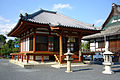 Yakushi-dō
 Daishi-dō
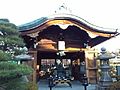 Kannon-dō
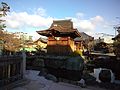 Emma-dō
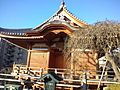 Kaisan-dō
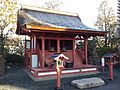 Chinju-sha
 Kyōzō
Kyōzō


Access
The temple is approximately a five-minute walk from JR-Sōjiji Station on the JR West JR Kyoto Line (Tōkaidō Main Line).


