Mayor of Chicago
Elected chief executive of city government
From Wikipedia, the free encyclopedia
The mayor of Chicago is the chief executive of city government in Chicago, Illinois, the third-largest city in the United States. The mayor is responsible for the administration and management of various city departments. In addition, the Mayor submits proposals and recommendations to the Chicago City Council, is active in the enforcement of the city's ordinances, submits the city's annual budget and appoints city officers, department commissioners or directors, and members of city boards and commissions.

| Mayor of Chicago | |
|---|---|
| Government of Chicago | |
| Style |
|
| Term length | 4 years |
| Inaugural holder | William B. Ogden |
| Formation | 1837 |
| Succession | Vice mayor of Chicago |
| Salary | $216,210 |
| Website | Official website |
During sessions of the city council, the mayor serves as the presiding officer. The mayor is not allowed to vote on issues except in certain instances, most notably where the vote taken on a matter before the body results in a tie.
The office of mayor was created when Chicago became a city in 1837.
History

.jpg)
The first mayor was William B. Ogden (1837–1838). Forty-six men and two women (Jane Byrne, 1979–1983, and Lori Lightfoot, 2019–2023), have held the office. Two sets of father and son have been elected Mayor of Chicago: Carter Harrison III (1879–1887, 1893) and Carter Harrison IV (1897–1905, 1911–1915), as well as Richard J. Daley (1955–1976) and Richard M. Daley (1989–2011). Carter Harrison IV was the first mayor to have been born in the city.
As an interim mayor, David Duvall Orr (1987) held the office for one week, the shortest time period. Richard M. Daley was elected six times becoming Chicago's longest-serving mayor, his 22 years surpassing his father's record of 21 years.[1]
The first Irish Catholic mayor was John Patrick Hopkins (1893–1895), and Rahm Emanuel (2011–2019) is the only Jewish American to have served as mayor.
Harold Washington (1983–1987) was the first African American mayor. Lightfoot (2019–2023) was the city's first African American woman and first LGBT mayor. Brandon Johnson (2023–present) is the fourth African American mayor, Eugene Sawyer (1987–1989) having been selected by the council after Washington died in office.
Appointment powers
The mayor appoints the commissioner of the Chicago Fire Department, the superintendent of the Chicago Police Department and the heads of other departments,[2] the largest of which are the Water Management Department (formed by the consolidation of the former Water Department and Sewer Department under Richard M. Daley), and the Streets & Sanitation Department. The mayor also appoints members to the boards of several special-purpose governmental bodies including City Colleges of Chicago, Chicago Park District, Chicago Public Library, Chicago Housing Authority, Chicago Transit Authority, and the Metropolitan Pier and Exposition Authority. Under Richard M. Daley, the Illinois legislature granted the mayor power to appoint the governing board and chief executive officer of the Chicago Public Schools and subordinated the district to the mayor; the district had long been an independent unit of government.
The Chicago City Clerk and City Treasurer of Chicago are elected separately, as are the 50 alderpersons who form the city council. The mayor is empowered, however, to fill vacancies in any of these 52 elected offices by appointment. In turn, the city council elects one of its own to fill a mayoral vacancy.
By charter, Chicago has a "weak-mayor" system, in which most of the power is vested in the city council. In practice, however, the mayor of Chicago has long been one of the most powerful municipal chief executives in the nation. Unlike in most other weak-mayor systems, the mayor has the power to draw up the budget. For most of the 20th century, before the decline of patronage and the mayor's office becoming officially non-partisan in 1999, the mayor was the de facto leader of the city's Democratic Party, and had great influence over the ward organizations.[3] Located in City Hall, "the fifth floor" is sometimes used as a metonym for the office and power of the mayor.[4]
Election and succession
The mayor of Chicago is elected by popular vote every four years, on the last Tuesday in February. A run-off election, in case no candidate garners more than fifty percent of the vote, is held on the first Tuesday in April. The election is held on a non-partisan basis. Chicago is the largest city in the United States not to limit the term of service for its mayor.
In accordance with Illinois law,[5][6] the city council elects a vice mayor who serves as interim mayor in the event of a vacancy in the office of the mayor or the inability of the mayor to serve due to illness or injury, until the city council elects one of its members acting mayor or until the mayoral term expires.[6][7] However, if a vacancy occurs in the office of mayor with more than 28 months remaining in the mayoral term and at least 130 days before the next general municipal election, then a special election must be held to choose a new mayor to serve out the remainder of the term at that general municipal election; if a vacancy occurs with fewer than 28 months remaining in the mayoral term or fewer than 130 days before the next general municipal election, then the acting mayor serves as mayor until the mayoral term expires.
The order of succession involving the vice mayor was made concrete following disputes that arose in the aftermath of the death in office of Richard J. Daley, and was subsequently implemented following the death in office of Harold Washington, which saw Vice Mayor David Orr become acting mayor.[8] Prior to this, the city had vague succession laws which indicated that the president pro tempore of the City Council would succeed as mayor. This was not followed after the death of Daley, and the city council appointed Michael Bilandic acting mayor instead of having pro tempore Wilson Frost become mayor,[9] due to City Corporation Counsel William R. Quinlan ruling that, since the city did not have a statute specifically outlining succession, the City Council would need to elect the interim mayor.[10]
Six instances have seen the City Council appoint either an acting mayor, acting mayor pro tempore, or interim mayor.
In the absence of the mayor during meetings of the city council, the president pro tempore of the city council, who is a member of and elected by the city council, acts as presiding officer. Unlike the mayor, the president pro tempore can vote on all legislative matters. If neither the mayor nor pro tempore can preside, the vice mayor presides.[11]
List of mayors
Between 1833 and 1837, Chicago was incorporated as a town and headed by town presidents. Since 1837, it has been incorporated as a city and headed by mayors.
The mayoral term in Chicago was one year from 1837 through 1863, when it was changed to two years. In 1907, it was changed again, this time to four years. Until 1861, municipal elections were held in March. In that year, legislation moved them to April. In 1869, however, election day was changed to November, and terms expiring in April of that year were changed. In 1875, election day was moved back to April by the city's vote to operate under the Cities and Villages Act of 1872.
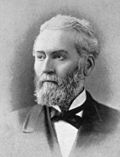 Joseph Medill (#26) was the first foreign-born mayor.
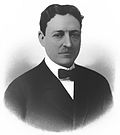 John Patrick Hopkins (#35) was the youngest and the first Catholic mayor.
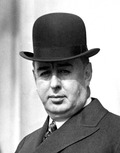 William Hale Thompson (#41) was the last Republican mayor of Chicago.
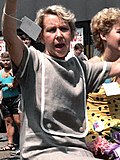 Jane Byrne (#50) was the first female mayor.
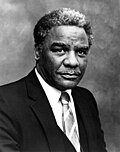 Harold Washington (#51) was the first African American mayor.
 Richard M. Daley (#54) was the longest-serving mayor (22 years).
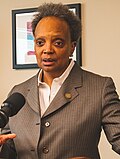 Lori Lightfoot (#56) was the first African American female and the first openly lesbian mayor of Chicago.

_(cropped).jpg)
_(3x4).jpg)
| No.[12] | Portrait | Mayor | Term start | Term end | Tenure | Election | Party | Vice Mayor | |
|---|---|---|---|---|---|---|---|---|---|
| Town Presidents | |||||||||
| 1 |  |
Thomas Jefferson Vance Owen (1801–1835) |
August 12, 1833 | August 11, 1834 | 364 days | – | Nonpartisan | Position not yet established | |
| 2 |  |
John H. Kinzie (1803–1865) |
1834 | May 1837 | 3 years | – | Whig | ||
| Mayors | |||||||||
| 1 | |
William B. Ogden (1805–1877) |
May 1837 | March 1838 | 10 months | 1837 | Democratic | Position not yet established | |
| 2 | .jpg) |
Buckner Stith Morris (1800–1879) |
1838 | 1839 | 1 year | 1838 | Whig | ||
| 3 |  |
Benjamin Wright Raymond (1801–1883) 1st time |
1839 | 1840 | 1 year | 1839 | Whig | ||
| 4 |  |
Alexander Loyd (1805–1872) |
March 9, 1840 | March 4, 1841 | 360 days | 1840 | Democratic | ||
| 5 |  |
Francis Cornwall Sherman (1805–1870) 1st time |
March 4, 1841 | March 7, 1842 | 1 year, 3 days | 1841 | Democratic | ||
| 6 | |
Benjamin Wright Raymond (1801–1883) 2nd time |
March 7, 1842 | March 7, 1843 | 1 year, 0 days | 1842 | Whig | ||
| 7 |  |
Augustus Garrett (1801–1848) 1st time |
March 7, 1843 | April 2, 1844 | 1 year, 26 days | 1843 | Democratic | ||
1844 | |||||||||
| 8 |  |
Alson Sherman (1811–1903) |
April 2, 1844 | March 10, 1845 | 342 days | April 1844 |
Independent Democratic | ||
| 9 | |
Augustus Garrett (1801–1848) 2nd time |
March 10, 1845 | March 3, 1846 | 358 days | 1845 | Democratic | ||
| 10 |  |
John Putnam Chapin (1810–1864) |
March 3, 1846 | March 9, 1847 | 1 year, 6 days | 1846 | Whig | ||
| 11 |  |
James Curtiss (1806–1859) 1st time |
March 9, 1847 | March 14, 1848 | 1 year, 5 days | 1847 | Democratic | ||
| 12 |  |
James Hutchinson Woodworth (1804–1869) |
March 14, 1848 | March 12, 1850 | 1 year, 363 days | 1848 | Independent Democratic | ||
| 1849 | |||||||||
| 13 | |
James Curtiss (1806–1859) 2nd time |
March 12, 1850 | March 11, 1851 | 364 days | 1850 | Democratic | ||
| 14 | .png) |
Walter S. Gurnee (1813–1903) |
March 11, 1851 | March 7, 1853 | 1 year, 361 days | 1851 | Democratic | ||
| 1852 | |||||||||
| 15 |  |
Charles McNeill Gray (1807–1885) |
March 7, 1853 | March 15, 1854 | 1 year, 8 days | 1853 | Democratic | ||
| 16 | .jpg) |
Isaac Lawrence Milliken (1813–1889) |
March 15, 1854 | March 13, 1855 | 363 days | 1854 | Democratic | ||
| 17 |  |
Levi Boone (1808–1882) |
March 13, 1855 | March 11, 1856 | 364 days | 1855 | American | ||
| 18 | .jpg) |
Thomas Dyer (1805–1862) |
March 11, 1856 | March 10, 1857 | 364 days | 1856 | Democratic | ||
| 19 |  |
John Wentworth (1815–1888) 1st time |
March 10, 1857 | March 2, 1858 | 357 days | 1857 | Republican | ||
| 20 |  |
John Charles Haines (1818–1896) |
March 2, 1858 | March 22, 1860 | 2 years, 20 days | 1858 | Republican | ||
| 1859 | |||||||||
| 21 | |
John Wentworth (1815–1888) 2nd time |
March 22, 1860 | May 6, 1861 | 1 year, 45 days | 1860 | Democratic | ||
| 22 |  |
Julian Sidney Rumsey (1823–1886) |
May 6, 1861 | May 5, 1862 | 364 days | 1861 | Republican | ||
| 23 | |
Francis Cornwall Sherman (1805–1870) 2nd time |
May 5, 1862 | May 3, 1865 | 2 years, 363 days | 1862 | Democratic | ||
| 1863 | |||||||||
| 24 |  |
John Blake Rice (1809–1874) |
May 3, 1865 | December 6, 1869 | 4 years, 217 days | 1865 | Republican | ||
| 1867 | |||||||||
| 25 |  |
Roswell B. Mason (1805–1892) |
December 6, 1869 | December 4, 1871 | 1 year, 363 days | 1869 | Citizens | ||
| 26 |  |
Joseph Medill (1823–1899) |
December 4, 1871 | August 22, 1873 | 1 year, 261 days | 1871 | Republican (Dry) | ||
| – |  |
Lester L. Bond (1829–1903) Acting |
August 22, 1873 | December 1, 1873 | 101 days | – | Republican | ||
| 27 | .jpg) |
Harvey Doolittle Colvin (1815–1892) |
December 1, 1873 | July 24, 1876 | 2 years, 236 days | 1873 | People's | ||
| – | .png) |
Thomas Hoyne (1817–1883) Disputed |
Election invalidated; tenure annulled |
1876 |
Independent Democratic | ||||
| 28 |  |
Monroe Heath (1827–1894) |
July 24, 1876 | April 28, 1879 | 2 years, 278 days | July 1876 |
Republican | ||
| 1877 | |||||||||
| 29 | .jpg) |
Carter Harrison III (1825–1893) 1st time |
April 28, 1879 | April 18, 1887 | 7 years, 355 days | 1879 | Democratic | ||
| 1881 | |||||||||
| 1883 | |||||||||
| 1885 | |||||||||
| 30 | .jpg) |
John A. Roche (1844–1904) |
April 18, 1887 | April 15, 1889 | 1 year, 362 days | 1887 | Republican | ||
| 31 | .jpg) |
DeWitt Clinton Cregier (1829–1898) |
April 15, 1889 | April 27, 1891 | 2 years, 12 days | 1889 | Democratic | ||
| 32 |  |
Hempstead Washburne (1851–1918) |
April 27, 1891 | April 17, 1893 | 1 year, 355 days | 1891 | Republican | ||
| 33 | |
Carter Harrison III (1825–1893) 2nd time |
April 17, 1893 | October 28, 1893[†] | 194 days | 1893 | Democratic | ||
| 34 | .jpg) |
George Bell Swift (1845–1912) Pro tempore 1st time |
November 9, 1893 | December 27, 1893 | 48 days | – | Republican | ||
| 35 | .jpg) |
John Patrick Hopkins (1858–1918) |
December 27, 1893 | April 8, 1895 | 1 year, 102 days | 1893 special | Democratic | ||
| 36 | |
George Bell Swift (1845–1912) 2nd time |
April 8, 1895 | April 15, 1897 | 2 years, 7 days | 1895 | Republican | ||
| 37 |  |
Carter Harrison IV (1860–1953) 1st time |
April 15, 1897 | April 10, 1905 | 7 years, 360 days | 1897 | Democratic | ||
| 1899 | |||||||||
| 1901 | |||||||||
| 1903 | |||||||||
| 38 |  |
Edward Fitzsimmons Dunne (1853–1937) |
April 10, 1905 | April 15, 1907 | 2 years, 5 days | 1905 | Democratic | ||
| 39 |  |
Fred A. Busse (1866–1914) |
April 15, 1907 | April 17, 1911 | 4 years, 2 days | 1907 | Republican | ||
| 40 | |
Carter Harrison IV (1860–1953) 2nd time |
April 17, 1911 | April 26, 1915 | 4 years, 9 days | 1911 | Democratic | ||
| 41 |  |
William Hale Thompson (1869–1944) 1st time |
April 26, 1915 | April 16, 1923 | 7 years, 355 days | 1915 | Republican | ||
| 1919 | |||||||||
| 42 |  |
William Emmett Dever (1862–1929) |
April 16, 1923 | April 18, 1927 | 4 years, 2 days | 1923 | Democratic | ||
| 43 | |
William Hale Thompson (1869–1944) 2nd time Campaign |
April 18, 1927 | April 9, 1931 | 3 years, 356 days | 1927 | Republican | ||
| 44 |  |
Anton Cermak (1873–1933) |
April 9, 1931 | March 6, 1933[†] | 1 year, 331 days | 1931 | Democratic | ||
| 45 | _(1).jpg) |
Frank J. Corr (1877–1934) Acting |
March 15, 1933 | April 8, 1933 | 24 days | – | Democratic | ||
| 46 | ,_circa_1934_(3x4_headshot_crop).jpg) |
Edward Joseph Kelly (1876–1950) |
April 17, 1933 | April 15, 1947 | 13 years, 363 days | App. | Democratic | ||
| 1935 | |||||||||
| 1939 | |||||||||
| 1943 | |||||||||
| 47 | .jpg) |
Martin H. Kennelly (1887–1961) |
April 15, 1947 | April 20, 1955 | 8 years, 5 days | 1947 | Democratic | ||
| 1951 | |||||||||
| 48 |  |
Richard J. Daley (1902–1976) |
April 20, 1955 | December 20, 1976[†] | 21 years, 244 days | 1955 | Democratic | ||
| 1959 | |||||||||
| 1963 | |||||||||
| 1967 | |||||||||
| 1971 | |||||||||
| 1975 | |||||||||
| 49 |  |
Michael A. Bilandic (1923–2002) |
December 20, 1976 | April 16, 1979 | 2 years, 117 days | App. | Democratic | Casey Laskowski | |
| 1977 special | |||||||||
| 50 | .jpg) |
Jane Byrne (1933–2014) |
April 16, 1979 | April 29, 1983 | 4 years, 13 days | 1979 | Democratic | Richard Mell | |
| 51 |  |
Harold Washington (1922–1987) |
April 29, 1983 | November 25, 1987[†] | 4 years, 210 days | 1983 | Democratic | ||
| 1987 | David Orr | ||||||||
| 52 | .png) |
David Orr (born 1944) Acting [13] |
November 25, 1987 | December 2, 1987 | 7 days | – | Democratic | Himself | |
| 53 | .jpg) |
Eugene Sawyer (1934–2008) |
December 2, 1987 | April 24, 1989 | 1 year, 143 days | App. | Democratic | David Orr | |
| Terry Gabinski | |||||||||
| 54 | .png) |
Richard M. Daley (born 1942) |
April 24, 1989 | May 16, 2011 | 22 years, 22 days | 1989 special | Democratic | ||
| 1991 | |||||||||
| 1995 | |||||||||
| 1999 | Nonpartisan[c] (Democratic) |
Bernard Stone | |||||||
| 2003 | |||||||||
| 2007 | |||||||||
| 55 | .jpg) |
Rahm Emanuel (born 1959) |
May 16, 2011 | May 20, 2019 | 8 years, 4 days | 2011 | Nonpartisan[c] (Democratic) |
Ray Suarez | |
| 2015 | Brendan Reilly | ||||||||
| 56 |  |
Lori Lightfoot (born 1962) |
May 20, 2019 | May 15, 2023 | 3 years, 360 days | 2019 | Nonpartisan[c] (Democratic) |
Tom Tunney | |
| 57 |  |
Brandon Johnson (born 1976) |
May 15, 2023 | Incumbent | 2 years, 352 days | 2023 | Nonpartisan[c] (Democratic) |
Walter Burnett Jr. | |
Notes
- ^† Died in office
- The March 1844 mayoral election was voided by the Common Council on the grounds that clerks in wards had been unqualified to vote. See here for more information.
- The April 1876 mayoral election (and thus Hoyne's tenure as mayor) was annulled after it was ruled by the Circuit Court of Cook County that the election had been illegitimate. See here and here for more information.
Vice mayor
| Vice mayor of Chicago | |
|---|---|
Incumbent since August 7, 2025Vacant | |
| Inaugural holder | Casey Laskowski |
| Formation | 1976 |
| Salary | $0[15] |
In accordance with Illinois law, the city council elects a vice mayor who serves as interim mayor in the event of a vacancy in the office of the mayor or the inability of the mayor to serve due to illness or injury, until the city council elects one of its members acting mayor or until the mayoral term expires. The vice mayoralty is currently vacant following the resignation of Walter Burnett Jr. on August 7, 2025.
The position was created by a state law that was passed in response to the power struggle that took place over succession following Richard J. Daley's death in office.[9][15][16]
If neither the mayor nor president pro tempore can preside over a City Council meeting, then the vice mayor presides.[11]
The position was long considered to be largely ceremonial.[17][18][19] However, in 2023, Mayor Brandon Johnson successfully championed a resolution that gave the office a $400,000 budget. He also had his vice mayor, Burnett, act as an official community liaison for the mayoral administration.[20]
List of vice mayors
| No. | Vice Mayor | Took office | Left office | Party | Mayor(s) served under | ||
|---|---|---|---|---|---|---|---|
| 1 | |
Casey Laskowski (1918–2003) [21][22] |
1976 | 1979 | Democratic | Michael A. Bilandic | |
| 2 | |
Richard Mell (born 1938) [23] |
April 16, 1979 | April 24, 1987 | Democratic | Jane Byrne Harold Washington | |
| 3 | |
David Orr (born 1944) [8][24][25] |
April 1987 | May 1988 | Democratic | Harold Washington Himself (acting) Eugene Sawyer | |
| 4 | |
Terry Gabinski (born 1938) [24][26] |
1988 | 1998 | Democratic | Eugene Sawyer Richard M. Daley | |
| 5 | |
Bernard Stone (1927–2014) [25][27][28] |
1998 | 2011 | Democratic | Richard M. Daley | |
| 6 | |
Ray Suarez (born 1946) [17][18] |
May 16, 2011 | May 20, 2015 | Unknown | Rahm Emanuel | |
| 7 | .jpg) |
Brendan Reilly (born 1971) [29][30] |
May 18, 2015 | May 20, 2019 | Democratic | Rahm Emanuel | |
| 8 | _(3x4a).jpg) |
Tom Tunney (born 1955) [7] |
May 20, 2019 | May 15, 2023 | Democratic | Lori Lightfoot | |
| 9 |  |
Walter Burnett Jr. (born 1963) [31] |
May 15, 2023 | August 7, 2025 | Democratic | Brandon Johnson | |

