The probability distribution of the eigenvalues of the complex Hermitian Wishart distribution are given by, for example, James[6] and Edelman.[7] For a  matrix with
  degrees of freedom we have

where

Note however that Edelman uses the "mathematical" definition of a complex normal variable  where iid X and Y each have unit variance and the variance of
  . For the definition more common in engineering circles, with X and Y each having 0.5 variance, the eigenvalues are reduced by a factor of 2.
This spectral density can be integrated to give the probability that all eigenvalues of a Wishart random matrix lie within an interval.[8]
The spectral density can be also integrated to give the marginal distribution of eigenvalues.[9]
[10]
There are also approximations for marginal eigenvalue distributions. From Edelman we have that if S is a sample from the complex Wishart distribution with  such that
 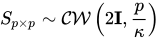 then in the limit
  the distribution of eigenvalues converges in probability to the Marchenko–Pastur distribution function
![{\displaystyle p_{\lambda }(\lambda )={\frac {\sqrt {[\lambda /2-({\sqrt {\kappa }}-1)^{2}][{\sqrt {\kappa }}+1)^{2}-\lambda /2]}}{4\pi \kappa (\lambda /2)}},\;\;\;2({\sqrt {\kappa }}-1)^{2}\leq \lambda \leq 2({\sqrt {\kappa }}+1)^{2},\;\;\;0\leq \kappa \leq 1}](https://wikimedia.org/api/rest_v1/media/math/render/svg/eaaee4158d7953e7e3cbca03fb2fa270cda943ea)
This distribution becomes identical to the real Wishart case, by replacing  by
by  , on account of the doubled sample variance, so in the case
 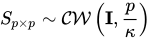 , the pdf reduces to the real Wishart one:
![{\displaystyle p_{\lambda }(\lambda )={\frac {\sqrt {[\lambda -({\sqrt {\kappa }}-1)^{2}][{\sqrt {\kappa }}+1)^{2}-\lambda ]}}{2\pi \kappa \lambda }},\;\;\;({\sqrt {\kappa }}-1)^{2}\leq \lambda \leq ({\sqrt {\kappa }}+1)^{2},\;\;\;0\leq \kappa \leq 1}](https://wikimedia.org/api/rest_v1/media/math/render/svg/4a57700bfbfce4f11915b621a09a40998ececbf9)
A special case is 
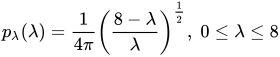
or, if a Var(Z) = 1 convention is used then
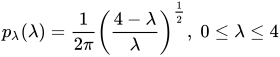 .
.
The Wigner semicircle distribution arises by making the change of variable  in the latter and selecting the sign of y randomly yielding pdf

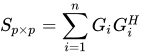
In place of the definition of the Wishart sample matrix above, 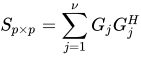 , we can define a Gaussian ensemble
![{\displaystyle \mathbf {G} _{i,j}=[G_{1}\dots G_{\nu }]\in \mathbb {C} ^{\,p\times \nu }}](https://wikimedia.org/api/rest_v1/media/math/render/svg/93416a61d716e3bf3ae66c0f9dd62cda961a9910)
such that S is the matrix product  . The real non-negative eigenvalues of S are then the modulus-squared singular values of the ensemble
  and the moduli of the latter have a quarter-circle distribution.
In the case  such that
  then
then  is rank deficient with at least
  null eigenvalues. However the singular values of are invariant under transposition so, redefining
  , then
  has a complex Wishart distribution, has full rank almost certainly, and eigenvalue distributions can be obtained from
  in lieu, using all the previous equations.
In cases where the columns of are not linearly independent and remains singular, a QR decomposition can be used to reduce G to a product like

such that 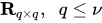 is upper triangular with full rank and
 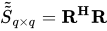 has further reduced dimensionality.
The eigenvalues are of practical significance in radio communications theory since they define the Shannon channel capacity of a  MIMO wireless channel which, to first approximation, is modeled as a zero-mean complex Gaussian ensemble.

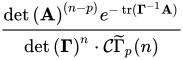


![{\displaystyle \operatorname {E} [A]=n\Gamma }](https://wikimedia.org/api/rest_v1/media/math/render/svg/daf65701ebdd771391f2fb4a2c33b36b1272a62a)





![{\displaystyle \mathbb {E} [GG^{H}]=M}](https://wikimedia.org/api/rest_v1/media/math/render/svg/fe687d8e5a78864ec77b404a95249f5f4b9a4981)




![{\displaystyle \mathbb {E} [GG^{T}]=0}](https://wikimedia.org/api/rest_v1/media/math/render/svg/78d88aa5c3cadeb31200ea6dbd748087de004f7d)




