Draft:Antoine Claude Ponthus-Cinier
French Artist
From Wikipedia, the free encyclopedia
Antoine Ponthus-Cinier was a French painter born in Lyon on August 29, 1812, and died on January 17, 1885[1]. He is considered one of the leaders of the neoclassical movement in Lyon and adopted a pastoral idylic or arcadian style. His works cover many sites in Italy and southern France.
 | Review waiting, please be patient.
This may take 3 months or more, since drafts are reviewed in no specific order. There are 4,324 pending submissions waiting for review.
Where to get help
How to improve a draft
You can also browse Wikipedia:Featured articles and Wikipedia:Good articles to find examples of Wikipedia's best writing on topics similar to your proposed article. Improving your odds of a speedy review To improve your odds of a faster review, tag your draft with relevant WikiProject tags using the button below. This will let reviewers know a new draft has been submitted in their area of interest. For instance, if you wrote about a female astronomer, you would want to add the Biography, Astronomy, and Women scientists tags. Editor resources
Reviewer tools
|
Submission declined on 20 January 2026 by Netherzone (talk).
Where to get help
How to improve a draft
You can also browse Wikipedia:Featured articles and Wikipedia:Good articles to find examples of Wikipedia's best writing on topics similar to your proposed article. Improving your odds of a speedy review To improve your odds of a faster review, tag your draft with relevant WikiProject tags using the button below. This will let reviewers know a new draft has been submitted in their area of interest. For instance, if you wrote about a female astronomer, you would want to add the Biography, Astronomy, and Women scientists tags. Editor resources
This draft has been resubmitted and is currently awaiting re-review. |  |
 Comment: Several entire sections remain unsourced. It's unclear if this is original research. Netherzone (talk) 21:19, 20 January 2026 (UTC)

Antoine Claude Ponthus-Cinier | |
|---|---|
 | |
| Born | August, 29 1812 Lyon, France |
| Died | January, 17 1885 Lyon |
| Occupation | Artist |
| Notable work | Adam and Eve chased from Paradise, The Tree Fellers. |
He studied under Paul Delaroche in Paris. He became a renowned painter in 1841 when he won the Second Grand Prize of Rome for historical landscape painting with Adam and Eve Expelled from the Garden of Eden. He spent two years in Italy between 1842 and 1844, staying in Florence, Rome, Genoa, and Naples.[2] Upon his return, he made a long journey through the Dauphiné, the Dombes, Provence, the Alps, Savoy, and the Pyrenees, eventually settling in Lyon, where he remained until his death. He became a member of the "Société des aquafortistes de Paris", and his engravings were highly successful. He exhibited historical landscapes and simple landscapes in Lyon between 1837 and 1885, in Paris between 1841 and 1867, and in many regional exhibitions notably in Montpellier, Bordeaux, Strasbourg, Nîmes, Geneva, Rouen and Dijon. The works exhibited included paintings, gouache-washed Indian ink drawings, watercolors, and a few etchings. In his will, he bequeathed 50 works on paper to the Museum of Fine Arts in Lyon. The municipal library of Lyon has another collection of his works [3] . An annual stipend of 1,000 francs for a prize bearing his name (an annual competition for “Landscape from a Decorative Perspective”) is awarded by the École des Beaux-Arts in Lyon. His studio was auctioned off in Lyon in March 1885. The Fine Arts Museums of Lyon, Chalon-sur-Saône, Besançon, Brou, Toulon, Puy-en-Velay, Chambéry, Chantilly, Valence and Cleveland, Ohio have works by him in their collections.
Biography
Family
Antoine Ponthus-Cinier was born in Lyon, France on August 29, 1812, on Rue Saint-Jean, into a lower-middle-class family. His father, Jean Joseph Ponthus Cinier, was secretary of the municipal administration before becoming clerk of the Royal Court of Lyon [4]. His mother was Antoinette Novet (born around 1778, daughter of François Novet, who was executed in 1794 after the siege of Lyon). The painter's brother, Jean-Claude (born January 18, 1800), was a designer in a factory when he was drafted into military service in 1820. In 1844, he was listed as a partner in the Tarare factory that produced plush for hats (JB.E. et P. Martin, in Paris, rue Rambeau)[5].
Education
Antoine enrolled at the École des Beaux-Arts in Lyon in 1829, but according to Marius Audin and Eugène Vial, he did not attend[6]. He became a student of Paul Delaroche at the École des Beaux-Arts in Paris[7] before traveling to Italy for two years from 1842 to 1844. This trip would be the highlight of his artistic training.
Production
Landscape painting
Antoine's training in Paris and his artistic career led him to become a landscape painter, a genre created in Italy in the 18th century. Before traveling to Italy, the works he valued most were historical landscape compositions based on biblical themes (Adam and Eve expelled from the Garden of Eden). After his trip to Italy, he tried to adapt his inspiration to pure landscapes combining French Romanticism and the Italian illusionist realism of his time. What Antoine loved was an architectural structure with water in the form of a sheet or a pool that softened it, while vegetation enlivened it and the sky illuminated it. He liked the reminiscence of Italian landscapes in this combination, where traces of man, canals, roads, bridges, and man himself bear witness to his direct presence. Art critics of his century, such as Jouve, regret this repetition of a landscape deemed too perfect, while praising Antoine's technique: "We will not dispute Mr. Ponthus-Cinier's rare and distinguished qualities, his fine and suave touch, his charming and truthful colors, and his art of illuminating a canvas. But isn't this striking family resemblance found in all his landscapes a flaw in his talent? Look at nature... isn't it infinitely varied in all its aspects?"[8]
Drawings
Antoine's graphic work can be divided into several types. He used drawings in particular to create landscape paintings based on his observations. In 1840, he won second prize in the sketching competition with La Samaritaine. During his stay in Italy, he built up a collection of drawings that he later used as sources and models for his subsequent works. There are a significant number of Italian landscapes, mainly views of historical sites created between 1842 and 1844, executed in India ink, located in the reserves of the Lyons municipal library [9].
Major Works
Antoine Ponthus-Cinier won the second Grand prize of Rome for historical landscapes in 1841, with the presentation of "Adam and Eve chased from Terestrial Paradise". This painting is currently the property of the Museum of Fine Arts of Lyon[10][11]. Other museums with his works are in Besançon, Bourg-en-Bresse, Chalon-sur-Saône, Chantilly, Puy-en-Velay, Toulon, Valence, Vichy and Cleveland in Ohio.
Galerie
 Landscape with waterfall, Art Museum of Toulon
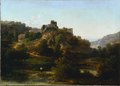 Châteauvieux on the Suran river, Cleveland Museum of Art
 Pamphili Villa, Musée Condé
 The Valromey, Musée Condé
 Les étroits in Lyon, Museum of Fine Arts of Lyon


- Reliable sources include: reputable newspapers, magazines, academic journals, and books from respected publishers.
- Unacceptable sources include: personal blogs, social media, predatory publishers, most tabloids, and websites where anyone can contribute.
Replace any unreliable sources with high-quality sources. If you cannot find a reliable source for the material, it should be removed.