Draft:Jain states
Quantum states related to the fractional quantum Hall effect
From Wikipedia, the free encyclopedia
Jain states (also called composite-fermion states) are a broad class of many-body quantum states..[1][2] that explain most experimentally observed fractions in the Fractional quantum Hall effect[3]. They arise from the composite-fermion theory introduced by Jainendra Kumar Jain, in which strongly interacting two-dimensional electrons in a large magnetic field reorganize into weakly interacting quasiparticles known as composite fermions[4][5][6]
Submission declined on 9 February 2026 by Ldm1954 (talk).
Where to get help
How to improve a draft
You can also browse Wikipedia:Featured articles and Wikipedia:Good articles to find examples of Wikipedia's best writing on topics similar to your proposed article. Improving your odds of a speedy review To improve your odds of a faster review, tag your draft with relevant WikiProject tags using the button below. This will let reviewers know a new draft has been submitted in their area of interest. For instance, if you wrote about a female astronomer, you would want to add the Biography, Astronomy, and Women scientists tags. Editor resources
|  |
 Comment: You did not read fully the advice in the comments. Please read WP:REF, WP:MOS and WP:LEAD carefully twice:1. The lead in general has no sources.2. All statements in the body of the text must be supported by inline sources. This applies to "History", "Filling factor.." etc. You cannot just add sources at the top.3. The page must be more than a collection of statements. What is the relevance of "Flux attachment"? Read WP:SYNTH. The same goes for the rest of the page/other sections Ldm1954 (talk) 11:44, 9 February 2026 (UTC)

- Comment: The topic probably passes the notability test based upon a quick GA search. However, it is not properly constructed. All the sections need inline sources to verify the statements. Please add this then submit the draft, it is important to learn from reviewers comments. Ldm1954 (talk) 14:39, 7 February 2026 (UTC)
 | This is a draft article. It is a work in progress open to editing by anyone. Please ensure core content policies are met before publishing it as a live Wikipedia article. Find sources: Google (books · news · scholar · free images · WP refs) · FENS · JSTOR · TWL Last edited by Ldm1954 (talk | contribs) 40 days ago. (Update)
Finished drafting? |
The theory maps complicated interacting electrons at fractional filling factors to nearly non-interacting composite fermions[7][8][9] at integer filling factors, thereby converting the fractional quantum Hall effect (FQHE) into an effective integer quantum Hall effect of emergent particles[10][11][12][13]
Jain states successfully predicts the hierarchy of filling fractions
- ,

which includes most experimentally observed plateaus such as 2/5, 3/7, 4/9, and their particle-hole conjugates.
History
The first theoretical explanation of the FQHE was provided in 1983 by Robert B. Laughlin, who proposed a variational wavefunction describing filling factors of the form .

In 1989, Jain proposed the composite-fermion picture, in which electrons bind an even number of magnetic flux quanta. This approach naturally generated a large hierarchy of fractions that matched experiments with high accuracy. The resulting states are now called Jain states.
Flux attachment
In a two-dimensional electron gas subjected to a strong perpendicular magnetic field , the kinetic energy is quantized into Landau levels:

- .
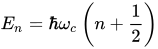
Because each Landau level has macroscopic degeneracy, electron-electron interactions dominate.
Composite-fermion[14] theory assumes that each electron binds magnetic flux quanta . The resulting quasiparticle is called a composite fermion.


Effective magnetic field
After flux attachment, composite fermions experience a reduced magnetic field
- ,

where is the electron density.

This reduction allows composite fermions to fill an integer number of effective Landau levels even when the original electrons occupy a fractional filling.
Filling factor sequence
If composite fermions fill effective Landau levels, the electron filling factor becomes

- .
The "+" sequence gives
- 1/3, 2/5, 3/7, 4/9, ...
and the "−" sequence gives
- 2/3, 3/5, 4/7, ...
These fractions account for most observed Hall plateaus.
Jain wavefunctions
The many-body Jain wavefunctions[15] are constructed in three steps:
- Start with an integer quantum Hall Slater determinant .
- Attach flux using a Jastrow factor .
- Project to the lowest Landau level using .


The resulting state is given by
![{\displaystyle \Psi _{\nu ={\frac {n}{2pn+1}}}={\mathcal {P}}_{\mathrm {LLL} }\left[\Phi _{n}\prod _{i<j}(z_{i}-z_{j})^{2p}\right].}](http://wikimedia.org/api/rest_v1/media/math/render/svg/0cbff428068f2ea2c40ac7cef4f7203ebb9a5f44)
For , this reduces to the Laughlin wavefunction, showing that Laughlin states are the first members of the Jain hierarchy.

- Reliable sources include: reputable newspapers, magazines, academic journals, and books from respected publishers.
- Unacceptable sources include: personal blogs, social media, predatory publishers, most tabloids, and websites where anyone can contribute.
Replace any unreliable sources with high-quality sources. If you cannot find a reliable source for the material, it should be removed.