Drebkau
From Wikipedia, the free encyclopedia
Drebkau
Drjowk | |
|---|---|
 Town hall | |
 Coat of arms | |
Location of Drebkau within Spree-Neiße district 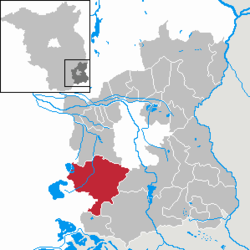 | |
  Drebkau  Drebkau | |
| Coordinates: 51°39′N 14°13′E / 51.650°N 14.217°E | |
| Country | Germany |
| State | Brandenburg |
| District | Spree-Neiße |
| Subdivisions | 10 Ortsteile |
| Government | |
| • Mayor (2018–26) | Paul Köhne[1] (CDU) |
| Area | |
• Total | 143.91 km2 (55.56 sq mi) |
| Elevation | 87 m (285 ft) |
| Population (2023-12-31)[2] | |
• Total | 5,509 |
| • Density | 38/km2 (99/sq mi) |
| Time zone | UTC+01:00 (CET) |
| • Summer (DST) | UTC+02:00 (CEST) |
| Postal codes | 03116 |
| Dialling codes | 035602 |
| Vehicle registration | SPN |
| Website | www.drebkau.de |
Drebkau (German pronunciation: [ˈdʁɛpkaʊ] ⓘ; Lower Sorbian: Drjowk, pronounced [ˈdrʲɔwk]) is a town in the district of Spree-Neiße, in Lower Lusatia, in Brandenburg, in eastern Germany. It is situated 14 km (9 mi) southwest of Cottbus.

It was first mentioned in 1353. The town was at various times ruled by Bohemian, Hungarian, Saxon and monarchs, before it was became part of Prussia in 1815. The coat of arms contains the Czech Lion. From 1815 to 1947, Drebkau was part of the Province of Brandenburg.
During World War II, two forced labour subcamps of the Nazi prison for women in Cottbus were located in the present-day districts of Auras (Huraz) and Schorbus (Skjarbošc), respectively.[3][4]
After the war, Drebkau was incorporated into the State of Brandenburg from 1947 to 1952 and the Bezirk Cottbus of East Germany from 1952 to 1990. Since 1990, Drebkau has been part of Brandenburg.


