Echinocereus brandegeei
From Wikipedia, the free encyclopedia
| Echinocereus brandegeei | |
|---|---|
 | |
Scientific classification  | |
| Kingdom: | Plantae |
| Clade: | Tracheophytes |
| Clade: | Angiosperms |
| Clade: | Eudicots |
| Order: | Caryophyllales |
| Family: | Cactaceae |
| Subfamily: | Cactoideae |
| Genus: | Echinocereus |
| Species: | E. brandegeei |
| Binomial name | |
| Echinocereus brandegeei (J.M.Coult.) K. Schum., 1898 | |
 | |
| Synonyms | |
| |
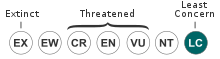
Echinocereus brandegeei is a species of cactus native to Mexico.[2]
Echinocereus brandegeei grows with multiple shoots, forming large, loose clumps up to 2 meters in diameter. The light green, cylindrical shoots vary in size, creeping at their base with upright tips. They can reach up to 100 cm (39 in) in length and 6 cm (2.4 in) in diameter. Each shoot has eight to ten sharply angular ribs and is densely covered with thorns ranging in color from white to black. The four central spines, arranged crosswise, are flattened, stiff, and sword-like, measuring 3 to 13 cm (1.2 to 5.1 in) long. The ten to 18 radial spines are rounded, stiff, and up to 2 cm (0.79 in) long.
The broadly funnel-shaped flowers are light purple-lavender to light pink with a bright red throat. They appear along the entire shoot, measuring 5.5 to 9.5 cm (2.2 to 3.7 in) in length and 4 to 8.3 cm (1.6 to 3.3 in) in diameter. The spherical fruits are red.[3]
Distribution
Echinocereus brandegeei is found on the Baja California peninsula and some islands in the Gulf of Mexico all islands from San Marcos to Espíritu Santo. It thrives in very dry areas, xeric scrublands, stony areas, and sandy soils near the beach at elevations from 0 to 300 meters. Plants are found growing around Pachycereus pringlei, Stenocereus thurberi, Opuntia tapona, Stenocereus eruca, Cylindropuntia cholla, Ferocactus peninsulae, Ferocactus emoryi subsp. rectispinus, Stenocereus gummosus, Stenocereus thurberi, Jatropha cuneata, Euphorbia lomelii, Bursera microphylla and Fouquieria diguetii. In some part of its range it grows among Echinocereus maritimus and Opuntia invicta.[4]
 Plant growing in La Paz, Baja California Sur
 Plant growing in Pichilingue, Baja California Sur
.jpg)
.jpg)


