Encrusted Pottery culture
From Wikipedia, the free encyclopedia
.jpg) | |
| Geographical range | Hungary, Croatia, Serbia, Romania |
|---|---|
| Period | Bronze Age |
| Dates | ca. 2000 BC - 14th century BC |
| Preceded by | Kisapostag culture, Vucedol culture, Somogyvár-Vinkovci culture, Vatin culture |
| Followed by | Tumulus culture, Belegiš culture, Urnfield culture |
_and_LBA_(right)_cultures_in_the_Carpathian_Basin.png)
The Encrusted Pottery culture was an archaeological culture of the Early to Middle Bronze Age (c. 2000-1400 BC) originating in the Transdanubian region of western Hungary.[1][2] It emerged from the Kisapostag culture, which was preceded by the Somogyvár-Vinkovci culture.[3] The Encrusted Pottery culture expanded eastwards and southwards along the Danube into parts of Croatia, Serbia, Romania and Bulgaria in response to migrations from the northwest by the Tumulus culture, resulting in the emergence of groups such as Dubovác–Žuto Brdo in Serbia and Gârla Mare–Cârna in Romania, which are considered to be southern manifestations of the Encrusted Pottery culture.[4][5][6][7] The culture was named after its distinctive pottery decorated with incised designs inlaid with white lime, and southern groups are notable for the production of figurines or idols decorated in the same style. Stylistic similarities have also been noted between Encrusted Pottery artefacts and artefacts from Mycenaean Greece.[8][9]
Four Y-DNA testings from the Balatonkeresztúr mass grave burial dated to the Encrusted Pottery Culture can be assigned to I2a-M223>>L1229 which is I2a2a1b (group I2a-M223 was present in Megalithic cultures from the British Isles to today's Czechia), while two males' Y-DNA could be assigned to the R1b-Z2103 clade, which appears in contemporaneous populations such as in Bell Beaker period samples from Hungary or a Vucedol culture associated individual from Croatia (in whichever case the most ancient samples come from the Pontic steppes). The ancestry composition of the eight individuals buried was ~29% hunter-gatherer, ~46% European farmer, ~25% western steppe herder. Some individuals had up to ~47% Mesolithic hunter-gatherer ancestry, despite this component being thought to be highly diluted by the time of the Early Bronze Age.[10]
Gallery
 Bronze dagger, Hungary, c. 1800 BC[11]
 Large ceramic bowl, Romania
 Bird-shaped ceramic vessel
 Pottery, Serbia
 Ceramic figurine or idol, Romania[12]
 Figurine from Stubarlija, Serbia
 Kličevac Idol, Serbia
 Gold lock-rings and bracelets from Pécs, Hungary.[13]
 Decorated ceramic disc, Serbia
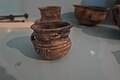 Pottery, Serbia
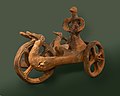 Chariot model 1, side view
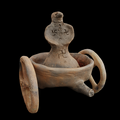 Chariot model 2 from Dupljaja, Serbia
 Chariot model 2, reverse view


.jpg)


.jpg)
.jpg)
.jpg)


