Falcatakely
From Wikipedia, the free encyclopedia
| Falcatakely Temporal range: Late Cretaceous, | |
|---|---|
 | |
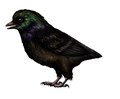
| Life restoration of Falcatakely forsterae as an enantiornithean | |
Scientific classification  | |
| Kingdom: | Animalia |
| Phylum: | Chordata |
| Class: | Reptilia |
| Clade: | Dinosauria |
| Clade: | Saurischia |
| Clade: | Theropoda |
| Clade: | Avialae |
| Clade: | Ornithothoraces |
| Clade: | †Enantiornithes |
| Genus: | †Falcatakely O'Connor et al., 2020 |
| Species: | †F. forsterae |
| Binomial name | |
| †Falcatakely forsterae O'Connor et al., 2020 | |
Falcatakely forsterae (meaning "small scythe" from the Latin falcatus and Malagasy kely, in reference to the shape of the beak) is an extinct genus of enantiornithean that lived during the period Upper Cretaceous, approximately 68 to 70 million years ago, in what is now Madagascar. Its fossil remains date back to the Maevarano Formation bird known from partial fossils from northern Madagascar. The genus contains a single species, Falcatakely forsterae.[1][2]
Falcatakely was a crow-sized stem-bird that can be distinguished from all other enantiornitheans by its deep, long rostrum, approx. 9 centimetres (3.5 inch) in length, which is slightly reminiscent of that of a toucan. Despite this resemblance, the upper jaw had more in common with that of the non-avian theropods in being dominated by a large maxilla, while the smaller premaxilla made up the tip of the rostrum. This is the opposite arrangement of what we see in modern birds, where the upper beak is dominated by the premaxilla, which in Falcatakely still had teeth.[1][3]