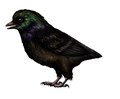
Gettyia
From Wikipedia, the free encyclopedia
| Gettyia Temporal range: Late Cretaceous, | |
|---|---|
Scientific classification  | |
| Kingdom: | Animalia |
| Phylum: | Chordata |
| Class: | Reptilia |
| Clade: | Dinosauria |
| Clade: | Saurischia |
| Clade: | Theropoda |
| Clade: | Avialae |
| Clade: | †Enantiornithes |
| Family: | †Avisauridae |
| Genus: | †Gettyia Atterholt, Hutchinson, and O'Connor, 2018 |
| Type species | |
| †Gettyia gloriae Atterholtt, Hutchinson, and O'Connor, 2018 | |
| Synonyms | |
Gettyia is an extinct genus of avisaurid enantiornithean bird from the Late Cretaceous of North America.[1][2]
Gettyia is known from a single right tarsometatarsus. This bone was similar to that of other North American avisaurids such as Avisaurus and Mirarce, but it was much smaller. The second metatarsal had a tubercule (knob-like structure) on its front edge, which likely connected to the tibialis cranialis muscle which flexes the ankle. Other avisaurids typically had this tubercule located midway on the shaft of the metatarsal, or closer to the ankle than the toes. Gettyia, on the other hand, had its tibialis cranialis tubercule located more than halfway down the shaft.[1] The third and fourth metatarsals are more extensively fused than in other avisaurids, as fusion occurs not only near the ankle, but also near the toes.[2]
Paleobiology
The more distally placed tibialis cranialis tubercule of Gettyia suggests that it had a more specialized lifestyle compared to other avisaurids. Zeffer & Norberg (2003) have found that living birds with a distally placed tibialis cranialis tubercules were biomechanically inclined to emphasize force of flexion, rather than speed. Birds of prey in particular utilize forceful flexion during their hunting behavior. Arboreal parrots and other climbing birds also make use of forceful flexion to obtain stability while foraging or hanging from tree branches. More terrestrial birds typically need more speed and less force, to assist locomotion like walking and hopping.[3]