First Battle of Newtonia Historic District
From Wikipedia, the free encyclopedia
First Battle of Newtonia Historic District | |
 Newtonia I Battlefield | |
   | |
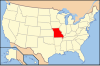
| Nearest city | Newtonia, Missouri |
|---|---|
| Coordinates | 36°53′06″N 94°11′12″W / 36.88500°N 94.18667°W |
| Area | 152.3 acres (61.6 ha) |
| NRHP reference No. | 04000697[1] |
| Added to NRHP | December 23, 2004[2] |
The First Battle of Newtonia Historic District, near Newtonia, Missouri, is a National Register of Historic Places (NRHP) site that preserves the location of the First Battle of Newtonia, an 1862 battle during the American Civil War. The battle saw Confederate troops under Colonels Douglas H. Cooper and Joseph O. Shelby defeat a Union force commanded by Brigadier General Frederick Salomon. The historic district contains some Civil War-period structures, as well as the Mathew H. Ritchey House, which is listed separately on the NRHP.
In September 1862, a Union column commanded by Brigadier General James G. Blunt advanced south into southwestern Missouri. The town of Newtonia was occupied by Confederate troops composed of Confederate-sympathizing Native Americans commanded by Colonel Douglas H. Cooper and cavalry commanded by Colonel Joseph O. Shelby. Cooper had seniority over Shelby, giving him overall command of the Confederate force. Blunt's advance guard, commanded by Brigadier General Frederick Salomon, learned of the Confederate presence of Newtonia.[3] A Union scouting force skirmished with some of Shelby's cavalry near Granby on September 29. The next day, Salomon's main force moved towards Newtonia, encountering the main Confederate force. The battle opened with an artillery duel, which continued until the Confederate artillery began to run low on ammunition. Salomon then ordered the 9th Wisconsin Infantry around the flank of the Confederate front line. The Confederate front line gave way, but a counterattack by some of Shelby's cavalry stopped the Union advance. A combined charge by Shelby's brigade and Cooper's Native Americans broke a secondary line the Union forces had formed after their initial repulse.[4] The Union forces retreated over ten miles to Sarcoxie. The Confederates suffered an estimated 78 casualties during the fighting, while Union casualties are estimated at 245.[3] Despite winning the battle, the Confederate position was still not secure, as Salomon's force had only been the advance guard of a much larger Union army, leading the Confederates to decide to retreat from Missouri.[5]