Portal:American Civil War
Wikipedia portal for content related to American Civil War
From Wikipedia, the free encyclopedia

 |
|
 |
 The American Civil War Portal


The American Civil War (1861–1865) was a sectional rebellion against the United States of America by the Confederate States, formed of eleven southern states' governments which moved to secede from the Union after the 1860 election of Abraham Lincoln as President of the United States. The Union's victory was eventually achieved by leveraging advantages in population, manufacturing and logistics and through a strategic naval blockade denying the Confederacy access to the world's markets.
In many ways, the conflict's central issues – the enslavement of African Americans, the role of constitutional federal government, and the rights of states – are still not completely resolved. Not surprisingly, the Confederate army's surrender at Appomattox on April 9,1865 did little to change many Americans' attitudes toward the potential powers of central government. The passage of the Thirteenth, Fourteenth and Fifteenth amendments to the Constitution in the years immediately following the war did not change the racial prejudice prevalent among Americans of the day; and the process of Reconstruction did not heal the deeply personal wounds inflicted by four brutal years of war and more than 970,000 casualties – 3 percent of the population, including approximately 560,000 deaths. As a result, controversies affected by the war's unresolved social, political, economic and racial tensions continue to shape contemporary American thought. The causes of the war, the reasons for the outcome, and even the name of the war itself are subjects of much discussion even today. (Full article)
Featured article

The Confederate Memorial (also referred to as the First Confederate Memorial) at Indian Mound Cemetery in Romney, West Virginia, commemorates residents of Hampshire County who died during the American Civil War while fighting for the Confederate States of America. It was sponsored by the Confederate Memorial Association, which formally dedicated the monument on September 26, 2001. The town of Romney has claimed that this is the first memorial structure erected to memorialize the Confederate dead in the United States and that the town performed the nation's first public decoration of Confederate graves on June 1, 1866.
The idea to memorialize the Confederate war dead of Hampshire County was first discussed in the spring of 1866. Following the decoration of the graves that summer, the Confederate Memorial Association engaged in fundraising for construction of the memorial, and by 1867 the necessary funds were raised. The inscription The Daughters of Old Hampshire Erect This Tribute of Affection to Her Heroic Sons Who Fell in Defence of Southern Rights was selected, and the contract for the memorial's construction was awarded to the Gaddes Brothers firm of Baltimore. The memorial's components were delivered to Indian Mound Cemetery on September 14, 1867, and the memorial was dedicated on September 26 of that year. The construction of the Confederate Memorial marked the beginning of an era of post-war revitalization for Hampshire County following the American Civil War. (Full article...)
Grand Parade of the States
The Commonwealth of Massachusetts played a significant role in national events prior to and during the American Civil War (1861–1865). Massachusetts Republicans dominated the early antislavery movement during the 1830s, motivating activists across the nation. This, in turn, increased sectionalism in the North and South, one of the factors that led to the war. Politicians from Massachusetts, echoing the views of social activists, further increased national tensions. The state was dominated by the Republican Party and was also home to many Republican leaders who promoted harsh treatment of slave owners and, later, the former civilian leaders of the Confederate States of America and the military officers in the Confederate Army.
Once hostilities began, Massachusetts supported the war effort in several significant ways, sending 159,165 men to serve in the Union Army and the Union Navy for the loyal North. One of the best known Massachusetts units was the 54th Massachusetts Volunteer Infantry, the first regiment of African American soldiers (led by white officers). Additionally, a number of important generals came from Massachusetts, including Benjamin F. Butler, Joseph Hooker, who commanded the Federal Army of the Potomac in early 1863, as well as Edwin V. Sumner and Darius N. Couch, who both successively commanded the II Corps of the Union Army. (Full article...)
Featured biography
_(cropped).jpg)
Benjamin Harrison (August 20, 1833 – March 13, 1901) was the 23rd president of the United States, serving from 1889 to 1893. He was a member of the Harrison family of Virginia—a grandson of the ninth president, William Henry Harrison, and a great-grandson of Benjamin Harrison V, a Founding Father. A Union army veteran and a Republican, he defeated incumbent Grover Cleveland to win the presidency in 1888.
Harrison was born on a farm by the Ohio River and graduated from Miami University in Oxford, Ohio. After moving to Indianapolis, he established himself as a prominent local attorney, Presbyterian church leader, and politician. During the American Civil War, he served in the Union Army as a colonel, and was confirmed by the U.S. Senate as a brevet brigadier general of volunteers in 1865. Harrison unsuccessfully ran for governor of Indiana in 1876. In 1881, the Republican-controlled Indiana General Assembly elected Harrison to a six-year term in the Senate, where he served from 1881 to 1887. (Full article...)
WikiProjects
Featured picture
 Daniel McCallum, by the Brady National Photographic Art Gallery
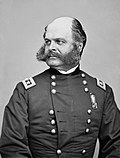
 Francis B. Spinola, Brigadier General for the Union in the American Civil War, and Congressman from New York
 Andersonville survivor
 President Rutherford B. Hayes was the 19th President of the USA
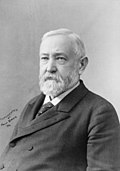 United States President (and former Brigadier-General) Benjamin Harrison
 Allan Pinkerton, President Lincoln, and John A. McClernand in 1862 by Alexander Gardner
 Abraham Lincoln's private secretary and biographer John Hay
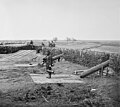 Quaker guns, by George Barnard and James F. Gibson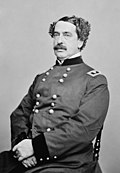


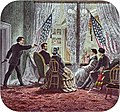
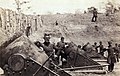 Siege of Yorktown, by James F. Gibson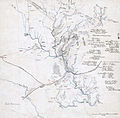
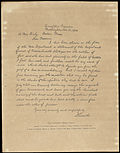 Lithographic facsimile of the Bixby letter, by Huber's Museum
 Confederate casualties at Chancellorsville during the American Civil War, by the National Archives and Records Administration
 Military execution of the conspirators in the Abraham Lincoln assassination
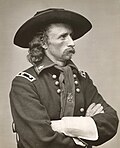 George Armstrong Custer, by George L. Andrews
 The original sketch of Sherman in South Carolina: The burning of McPhersonville, at and by William Waud


 The print version of Sherman in South Carolina: The burning of McPhersonville at McPhersonville, South Carolina, by William Waud
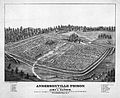 Andersonville Prison at Andersonville National Historic Site, by John L. Ransom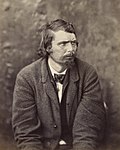
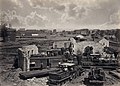 Atlanta roundhouse ruin at History of Atlanta, by George Barnard
 The Chickahominy – Sumner's Upper Bridge at Peninsula campaign, by William McIlvaine
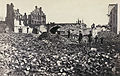 Richmond, Virginia after the American Civil War


 The burning of Columbia at Columbia, South Carolina in the American Civil War, by William Waud

.jpg)


Did you know...
- ... that the Union Navy, despite being embroiled in the American Civil War, built the Wampanoag-class frigates for a planned war against Great Britain?
- ... that singer Frank Croxton performed a duet with his father for the unveiling of a monument to a Confederate States Army general?
- ... that an African-American was appointed postmaster of Baynesville, Virginia, in 1893 in preference to a former Confederate soldier?
- ... that Benjamin Jackson was likely paid at least $300 to fight in the American Civil War as Lewis Saunders?
- ... that Nereus Mendenhall led a delegation to the Confederate States Congress in April 1862 to allow military exemption in the Confederate Army for Quakers?
- ... that Chinese-born Joseph Pierce enlisted as a Union Army soldier, fought at the Battle of Gettysburg during the American Civil War, and was made a corporal?
Subcategories
American Civil War topics
Related portals


Things you can do
- Attention needed
- ...to referencing and citation • ...to coverage and accuracy • ...to structure • ...to grammar • ...to supporting materials
- Popular pages
- Full list
- Cleanup needed
- The West Tennessee Raids • Battle of Pensacola (1861) (mistitled?)
- Requested articles
- Benjamin D. Fearing • James B. Speers • Charles S. Steedman • Battle of Barton's Station • Lawrence P. Graham • Frederick S. Sturmbaugh • Mexico and the American Civil War • Savannah Campaign Confederate order of battle • Battle of Lafayette • Battle of Sunshine Church • Requested American Civil War Medal of Honor recipients • Battle of Tazewell • John T. Sprague
- Expansion needed
- Battle of Boonsborough • Battle of Guard Hill • Battle of Rice's Station • Battle of Simmon's Bluff • Battle of Summit Point • Charleston Arsenal • Edenton Bell Battery • First Battle of Dalton • Blackshear Prison • Edwin Forbes • Hiram B. Granbury • Henry Thomas Harrison • Louis Hébert (colonel) • Benjamin G. Humphreys • Hezekiah G. Spruill • Smith carbine • Edward C. Walthall • Confederate States Secretary of the Navy • Confederate States Secretary of the Treasury • David Henry Williams • Battle of Rome Cross Roads • Ironclad Board • United States Military Railroad • Kansas in the American Civil War • Rufus Daggett • Ebenezer Magoffin • Confederate Quartermaster-General's Department • First Corps, Army of Northern Virginia • Francis Laurens Vinton • Ambrose Dudley Mann • Patrick Neeson Lynch • Stone Fleet (add international reactions and diplomacy) • Other American Civil War battle stubs • Other American Civil War stubs
- Images needed
- Preston Pond, Jr. • Melancthon Smith
- Merging needed
- 1st Regiment New York Mounted Rifles and 7th Regiment New York Volunteer Cavalry
- Citations needed
- 4th Maine Battery • 33rd Ohio Infantry • 110th New York Volunteer Infantry • Battle of Hatcher's Run • Camp Dennison • Confederate colonies • CSS Resolute • Dakota War of 1862 • Florida in the American Civil War • Ethan A. Hitchcock (general) • Fort Harker (Alabama) • Gettysburg (1993 film) • Iowa in the American Civil War • Second Battle of Fort Sumter
- Translation needed
- Add an article here!
Associated Wikimedia
The following Wikimedia Foundation sister projects provide more on this subject:
-
 Commons
Free media repository -
 Wikidata
Free knowledge base -
 Wikiquote
Collection of quotations -
 Wikisource
Free-content library -
 Wikiversity
Free learning tools -
 Wikivoyage
Free travel guide -
 Wiktionary
Dictionary and thesaurus


- Shortcuts to this page: Portal:ACW • P:ACW