Here, we will consider competition between n species.[1] We will define Nxj(t) as the number of individuals of species j at patch x and time t, and λxj(t) the fitness (i.e., the per-capita contribution of individual to the next time period through survival and reproduction) of individuals of species js at patch x and time t.[1] λxj(t) will be determined by many things, including habitat, intraspecific competition, and interspecific competition at x. Thus, if there are currently Nxj(t) individuals at x, then they will contribute Nxj(t)λxj(t) individuals to the next time period (i.e., t+1). Those individuals may stay at x, or they may move; the net contribution of x to next year's population will be the same.
With our definitions in place, we want to calculate the finite rate of increase of species j (i.e., its population-wide growth rate),  . It is defined such that
  , where each average is across all space.[1] In essence, it is the average fitness of members of species j in year t. We can calculate Nj(t+1) by summing Nxj(t)λxj(t) across all patches, giving
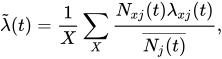
where X is the number of patches. Defining 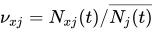 as species j's relative density at x, this equation becomes

Using the theorem that  , this simplifies to

Since  , its average will be 1. Thus,

Thus, we have partitioned  into two key parts:
  calculates the fitness of an individual, on average in any given site. Thus, if species are distributed uniformly across the landscape,
 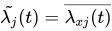 . If, however, they are distributed non-randomly across the environment, then cov(νxj, λxj(t)) will be non-zero. If individuals are found predominantly in good sites, then cov(νxj, λxj(t)) will be positive; if they are found predominantly in poor sites, then cov(νxj, λxj(t)) will be negative.
To analyze how species coexist, we perform an invasion analysis.[2] In short, we remove one species (called the "invader") from the environment, and allow the other species (called the "residents") to come the equilibrium (so that  for each resident). We then determine if the invader has a positive growth rate. If each species has a positive growth rate as an invader, then they can coexist.
Because for each resident, we can calculate the invader's growth rate,  , as
, as

where n-1 is the number of residents (since n is the number of species), and the sum is over all residents (and thus represents an average).[1] Using our formula for , we find that
![{\displaystyle {\tilde {\lambda _{i}}}(t)=[{\overline {\lambda _{xi}(t)}}+{\mbox{cov}}(\nu _{xi},\lambda _{xi}(t))]-{\frac {1}{n-1}}\sum [{\overline {\lambda _{xr}(t)}}+{\mbox{cov}}(\nu _{xr},\lambda _{xr}(t))-1].}](https://wikimedia.org/api/rest_v1/media/math/render/svg/f7ee3cdf1f75b7b483321cf6e9c32a5fdd301c3f)
This rearranges to
![{\displaystyle {\tilde {\lambda _{i}}}(t)=1+\left[{\overline {\lambda _{xi}(t)}}-{\frac {1}{n-1}}\sum {\overline {\lambda _{xr}(t)}}\right]+\Delta \kappa .}](https://wikimedia.org/api/rest_v1/media/math/render/svg/7efbbf11828a84082a2538c5ca2fdca91fa761cf)
where

is the fitness-density covariance, and ![{\displaystyle \left[{\overline {\lambda _{xi}(t)}}-{\frac {1}{n-1}}\sum {\overline {\lambda _{xr}(t)}}\right]}](https://wikimedia.org/api/rest_v1/media/math/render/svg/7c48dbee7c573491ed993651bec11cee29e225db) contains all other mechanisms (such as the spatial storage effect).[1]
contains all other mechanisms (such as the spatial storage effect).[1]
Thus, if Δκ is positive, then the invader's population is more able to build up its population in good areas (i.e., νxi is higher where λxi(t) is large), compared to the residents. This can occur if the invader builds up in good areas (i.e., cov(νxi, λxi(t)) is very positive) or if the residents are forced into poor areas (i.e., cov(νxr, λxr(t)) is less positive, or negative). In either case, species gain an advantage when they are invaders, a key point of any stabilizing mechanism.