Florida's congressional districts
U.S. House districts in the state of Florida
From Wikipedia, the free encyclopedia
Florida is divided into 28 congressional districts, each represented by a member of the United States House of Representatives. After the 2020 census, the number of Florida's seats was increased from 27 to 28, due to the state's increase in population, and subsequent reapportionment in 2022.[2]

Interactive map version
.svg)
Interactive map version
Current districts and representatives
Republicans have complete control of the congressional redistricting process in Florida, as any new maps are drawn and passed by the Republican-held state legislature and signed into law by the Republican governor. This has resulted in Florida's maps being an "extreme" partisan gerrymander in favor of the Republican Party, with few competitive districts.[3] Despite challenges from groups such as the NAACP and Common Cause, the current map was upheld by a panel of judges from the United States District Court for the Northern District of Florida, which found that, while a partisan gerrymander, there was not sufficient evidence that the maps are a racial gerrymander.[4] While the map is a gerrymander, it is relatively compact, with a Reock score of 0.4639.[5]
This is a list of United States representatives from Florida, their terms, their district boundaries, and the district political ratings according to the CPVI. The delegation has a total of 28 members, including 7 Democrats, 20 Republicans, and one vacancy.
| Current U.S. representatives from Florida | |||||
|---|---|---|---|---|---|
| District | Member (Residence)[6] |
Party | Incumbent since | CPVI (2026)[7] |
District map |
| 1st | .jpg) Jimmy Patronis (Fort Walton Beach) |
Republican | April 2, 2025 | R+18 | .svg) |
| 2nd | .jpg) Neal Dunn (Panama City) |
Republican | January 3, 2017 | R+8 | .svg) |
| 3rd | .jpg) Kat Cammack (Gainesville) |
Republican | January 3, 2021 | R+10 | .svg) |
| 4th | .jpg) Aaron Bean (Fernandina Beach) |
Republican | January 3, 2023 | R+5 | .svg) |
| 5th | .jpg) John Rutherford (Jacksonville) |
Republican | January 3, 2017 | R+10 | .svg) |
| 6th | .jpg) Randy Fine (Melbourne Beach) |
Republican | April 2, 2025 | R+14 | .svg) |
| 7th | .jpg) Cory Mills (New Smyrna Beach) |
Republican | January 3, 2023 | R+5 | .svg) |
| 8th | .jpg) Mike Haridopolos (Indian Harbour Beach) |
Republican | January 3, 2025 | R+8 | .svg) |
| 9th | .jpg) Darren Soto (Kissimmee) |
Democratic | January 3, 2017 | R+8 | .svg) |
| 10th |  Maxwell Frost (Orlando) |
Democratic | January 3, 2023 | D+13 | .svg) |
| 11th | .jpg) Daniel Webster (Clermont) |
Republican | January 3, 2011 | R+7 | .svg) |
| 12th | .jpg) Gus Bilirakis (Palm Harbor) |
Republican | January 3, 2007 | R+7 | .svg) |
| 13th | .jpg) Anna Paulina Luna (St. Petersburg) |
Republican | January 3, 2023 | R+6 | .svg) |
| 14th | .jpg) Kathy Castor (Tampa) |
Democratic | January 3, 2007 | R+4 | .svg) |
| 15th |  Laurel Lee (Tampa) |
Republican | January 3, 2023 | R+9 | .svg) |
| 16th | .jpg) Vern Buchanan (Sarasota) |
Republican | January 3, 2007 | R+6 | .svg) |
| 17th |  Greg Steube (Sarasota) |
Republican | January 3, 2019 | R+10 | .svg) |
| 18th | .jpg) Scott Franklin (Lakeland) |
Republican | January 3, 2021 | R+8 | .svg) |
| 19th | .jpg) Byron Donalds (Naples) |
Republican | January 3, 2021 | R+14 | .svg)
|
| 20th | Vacant | April 21, 2026 | D+20 | .svg) | |
| 21st | .jpg) Brian Mast (Fort Pierce) |
Republican | January 3, 2017 | R+7 | .svg) |
| 22nd | .jpeg) Lois Frankel (West Palm Beach) |
Democratic | January 3, 2013 | R+4 | .svg) |
| 23rd | .jpg) Jared Moskowitz (Parkland) |
Democratic | January 3, 2023 | D+9 | .svg) |
| 24th |  Frederica Wilson (Miami Gardens) |
Democratic | January 3, 2011 | D+22 | .svg) |
| 25th | .jpg) Debbie Wasserman Schultz (Weston) |
Democratic | January 3, 2005 | R+3 | .svg) |
| 26th | .jpg) Mario Díaz-Balart (Miami) |
Republican | January 3, 2003 | R+7 | .svg) |
| 27th | .jpg) María Elvira Salazar (Miami) |
Republican | January 3, 2021 | R+6 | .svg) |
| 28th | .jpg) Carlos A. Giménez (Miami) |
Republican | January 3, 2021 | R+10 | .svg) |
Historical district boundaries
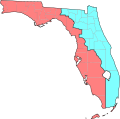 Districts circa 1894
 Districts from 2003 to 2013
 Districts from 2013 to 2017
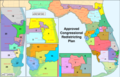 Districts from 2017 to 2023


Obsolete districts
History
2010 redistricting
In 2010 more than 63 percent of Florida voters approved the initiated Amendments 5 and 6, known as the "Fair Districts Amendment," to the state constitution, over the objections of the Republican-controlled legislature. These are intended to promote fairness in congressional districts[8] and "prohibit lawmakers from intentionally drawing districts that favor incumbents or political parties."[9][clarification needed]
The legislature had adopted new districts in 2012 as a result of the 2010 census. Their product was soon challenged in early 2011 by groups who had worked for passage of the amendments, including the League of Women Voters and Common Cause.[9] The trial revealed much secret dealings by party operatives and lawmakers; the court set a new legal standard. At one point the court excluded the press and shut down the TV feed in order to allow three hours of testimony by a political operative.[9]
On July 9, 2014, a Florida judge ruled that state Republicans had illegally drawn the state's congressional districts. Judge Terry P. Lewis of Florida's Second Judicial Circuit ordered that the 5th and 10th districts be redrawn.[10] On appeal, the Florida Supreme Court ruled on July 9, 2015 that several more districts had to be redrawn, and that the legislature had unconstitutionally worked to benefit the Republican Party. The historic ruling was considered likely to affect most of the state's 27 districts.[9]
On December 2, 2015, the state supreme court approved a remedial plan for districting for the 2016 elections.[11][12][13] All but Districts 1, 8, and 19 were altered in some way by the plan.
2020 redistricting
2026 redistricting
Interactive map version

|
Trump (R) +5–10 +10–20% +20% |
Harris (D) +0–5 +5–10 +10–20% +20%
|
Since 2025, the U.S. state of Florida and its Republican governor, Ron DeSantis, have faced pressure from national Republicans to gerrymander the state's congressional map as part of a broader national effort between red states and blue states to gain an advantage in the 2026 U.S. House elections. In Florida, the authority to redraw congressional districts lies solely with the Florida State Legislature.
At the 2024 general election, Florida's congressional plan returned twenty Republicans and eight Democrats to the 119th United States Congress. Republican leaders in the state believe that they can flip three to five Democratic seats by further cracking Democratic-leaning areas, particularly in the Tampa Bay area, Greater Orlando, and the Miami metropolitan area, which returned one, two, and five Democrats in 2024 respectively.
Despite Democratic opposition, the new map was successfully passed and signed by DeSantis on May 4, 2026, following a special legislative session. On June 10, 2026, the Supreme Court of Florida allowed the new map to stay in effect for the 2026 U.S. House elections.

