Frequency offset
From Wikipedia, the free encyclopedia
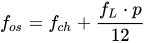
In radio engineering, a frequency offset is an intentional slight shift of the broadcast radio frequency (RF), to reduce interference with other transmitters.[1][2] Carrier frequency offset arises from mismatches between the received signal's carrier frequency and the receiver's local oscillator, often due to synchronization errors and Doppler shifts.[3]
The most important problem encountered in broadcasting via terrestrial transmitters is the interference from other broadcasters. In principle, each broadcaster has a different radio frequency (planned by the public authority) in a common reception area to avoid interference from each other. However, there are still two problems: spurious radiation of adjacent channels and fringe reception.[1][2]
Fringe reception is unintended reception under certain weather conditions. The exceptionally long-range reception means that the receiver may be tuned to more than one transmitter (transmitting at same frequency) at the same time. These transmitters may transmit programs of different broadcasters as well as the programs of the same broadcaster. In analogue transmission, even the transmitters transmitting the very same program interfere each other because of phase differences of the incoming signal, but in digital transmission the transmitters transmitting the same program in the same channel may reinforce each other.[1][2]