Output power of an analog TV transmitter
From Wikipedia, the free encyclopedia
The output power of a TV transmitter is the electric power applied to antenna system. There are two definitions: nominal (or peak) and thermal. Analogue television systems put about 70% to 90% of the transmitters power into the sync pulses. The remainder of the transmitter's power goes into transmitting the video's higher frequencies and the FM audio carrier. Digital television modulation systems are about 30% more efficient than analogue modulation systems overall.
Analogue
- The large amount of energy that Sync Pulses use is largely independent of the measurement system and efficiency of the analogue TV transmitter (as most analogue transmitters have on average 75% efficiency).
- The transmission of FM audio (including Stereo subcarriers) is only overall the 3rd largest consumer of TV transmitter power.
- Power consumption (most to least) : Sync Pulses, High Frequency Video, FM Audio, Vestigial AM
Digital
- DVB like transmission systems, with their groups of mathematically related carriers are not quite as energy efficient as 8VSB systems
- 8VSB transmission systems only provide a limited "Forced DC" signal (that consumes about 7% of the transmitters energy) that under multipath conditions can be lost causing a signal lock loss event
Power defined in terms of voltage
The average power for a sinusoidal drive is [1]
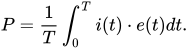
For a system where the voltage and the current are in phase, the output power can be given as
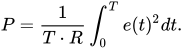
In this equation is the resistance and is the output voltage


Nominal power of a TV transmitter
Nominal power of a TV transmitter is given as the power during the sync interval. (For the sake of simplicity aural power is omitted) Since, the voltage during the sync interval is a fixed value,


where is the rms value of the output voltage.

To measure the nominal output power, measuring devices with time constants much greater than the line time are used. So the measuring equipment's measure only the highest level (sync pulse) of a line waveform which is 100%.
This power level is the commercial power of the transmitter.
