Gambyong
From Wikipedia, the free encyclopedia
Tari Gambyong (Indonesian)
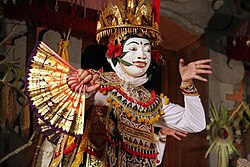
 Gambyong Langenkusuma (Pangkur version of Mangkunegaran Palace) dancers | |
| Native name | ꦒꦩ꧀ꦧꦾꦺꦴꦁ (Javanese) Tari Gambyong (Indonesian) |
|---|---|
| Genre | Traditional dance |
| Instrument | Gamelan |
| Inventor | Javanese people |
| Origin | Surakarta (Indonesia) |
| Gambyong |
|---|
|
| Burma |
| Cambodia |
| Indonesia |
|
| Laos |
| Malaysia |
| Philippines |
| Singapore |
| Thailand |
|
| Vietnam |
.svg)
Gambyong (Javanese: ꦒꦩ꧀ꦧꦾꦺꦴꦁ) is a traditional Javanese dance originating from Surakarta, Central Java, Indonesia. It has existed since ancient times, and began to be displayed at the Mangkunegaran Palace in the era of 1916 to 1944. Gambyong became famous for its smooth and graceful dance moves that amazed the audience who watch them.[1][2]

The Serat Centini, a Javanese book written during the reigns of Pakubuwana IV (1788-1820) and Pakubuwana V (1820-1823), mentioned the existence of gambyong as a tledhek dance. At that time, one of the dance stylists in the reign of Pakubuwana IX (1861-1893) named K.R.M.T. Wreksadiningrat worked on this folk dance so that it was appropriate to be performed among the nobles or aristocrats.
This refined folk dance became popular and was usually performed in front of guests at the Mangkunegaran Palace.
An important change in Gambyong Dance occurred when in 1950, Nyi Bei Mintoraras, a dance trainer from the Mangkunegaran Palace during the Mangkunegara VIII period, created a "standardized" version of gambyong, known as Gambyong Pareanom.
This choreography was first performed at the wedding ceremony of Gusti Nurul, Mangkunegara VIII's sister, in 1951. This dance was liked by the public, so that further variations were developed for public consumption.[3]
Meaning
The meaning of Gambyong is likened to a rice goddess (Dewi Sri) who is dancing. Therefore, in the past this dance was performed during agricultural ritual ceremonies to ensure rice fertility and an abundant harvest.[4]
In its development, Gambyong dance has been appointed as an entertainment to enliven the wedding reception, to welcome guests of honor or state.