Glossary of real and complex analysis
From Wikipedia, the free encyclopedia
This is a glossary of concepts and results in real analysis and complex analysis in mathematics. In particular, it includes those in measure theory (as there is no glossary for measure theory in Wikipedia right now). Also, the topics in algebraic analysis are included. However, the items in the theory of differential equations are not included.
See also: list of real analysis topics, list of complex analysis topics and glossary of functional analysis.
0–9
- It means the value of the zeta function at is . See 1 + 2 + 3 + 4 + ⋯.


A
- Abel
- 1. Abel sum
- 2. Abel integral
- absolute
- A series is said to converge absolutely if
- accumulation
- An accumulation point can mean either a limit point or a cluster point.
- analytic capacity
- analytic capacity.
- analytic continuation
- An analytic continuation of a holomorphic function is a unique holomorphic extension of the function (on a connected open subset of ).
- analytic sheaf
- analytic sheaf
- archimedean
- The archimedean property of real numbers says: given two real numbers , if , then there exists an integer such that .
- argument principle
- argument principle
- Ascoli
- Ascoli's theorem says that an equicontinous bounded sequence of functions on a compact subset of has a convergent subsequence with respect to the sup norm.


B
- Bargmann
- Bargmann transform
- Basel
- The Basel problem says
- Berezin
- Berezin integral
- Bolzano
- The Bolzano-Weierstrass theorem says a bounded sequence in has a convergent subsequence. Today it is subsumed in the statement that a subset of a metric space is compact if and only if it is sequentially compact (i.e., every sequence has a convergent subsequence) and the Heine–Borel theorem.
- Borel
- 1. A Borel measure is a measure whose domain is the Borel σ-algebra.
- 2. The Borel σ-algebra on a topological space is the smallest σ-algebra containing all open sets.
- 3. Borel's lemma says that a given formal power series, there is a smooth function whose Taylor series coincides with the given series.
- 4. The Borel–Lebesgue lemma is another name for the Heine-Borel theorem.
- bounded
- A subset of a metric space is bounded if there is some such that for all .
- bump
- A bump function is a nonzero compactly-supported smooth function, usually constructed using the exponential function.
- BV
- A BV-function or a bounded variation is a function with bounded total variation.


C
- Calderón
- Calderón–Zygmund lemma
- Cantor
- Cantor set.
- capacity
- Capacity of a set is a notion in potential theory.
- Carathéodory
- 1. Carathéodory's extension theorem
- 2. Carathéodory's criterion states a sufficient condition for Borel sets to be measurable.
- Cartan
- Cartan's theorems A and B.
- Cartwright
- Cartwright's theorem gives a bounded for a p-valent entire function.
- Cauchy
- 1. The Cauchy–Riemann equations are a system of differential equations such that a function satisfying it (in the distribution sense) is a holomorphic function.
- 2. Cauchy integral formula.
- 3. Cauchy residue theorem.
- 4. Cauchy's estimate.
- 5. The Cauchy principal value is, when possible, a number assigned to a function when the function is not integrable.
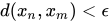
- 6. On a metric space, a sequence is called a Cauchy sequence if ; i.e., for each , there is an such that for all .
- 7. Cauchy condensation test.
- Cavalieri
- Cavalieri's principle.
- Cesàro
- Cesàro summation is one way to compute a divergent series.
- Clarke generalized derivative
- Clarke generalized derivative.
- cluster
- 1. A cluster point of a net (or a sequence) is a point in . The notion gives a convenient criterion for compactness: a space (resp. a metric space) is compact if and only if each net (resp. sequence) has a cluster point.
- 2. For a first countable space, a point is a cluster point of a sequence if and only if there is a subsequence converging to that point.
- complex
- 1. A complex number is an element in , the quotient ring of a polynomial ring, where the image of the indeterminate is denoted by . As a set, can be identified with and that gives a topology on it.
- 2. complex logarithm.
- 3. Given a function on an open set , the complex derivative of it is, if any, the limit .
- continuous
- A function between metric spaces and is continuous if for any convergent sequence in , we have in .
- contour
- The contour integral of a measurable function over a piece-wise smooth curve is .
- converge
- 1. A sequence in a topological space is said to converge to a point if for each open neighborhood of , the set is finite.
- 2. A sequence in a metric space is said to converge to a point if for all , there exists an such that for all , we have .
- 3. A series on a normed space (e.g., ) is said to converge if the sequence of the partial sums converges.
- convolution
- The convolution of two functions on a convex set is given by
- Cousin
- Cousin problems.
- critical
- critical point.
- cutoff
- For sets , closed, open, a cutoff function is a function that is on and has support contained in . It’s usually required to be continuous or smooth.




![{\displaystyle \mathbb {C} =\mathbb {R} [x]/(x^{2}+1)}](http://wikimedia.org/api/rest_v1/media/math/render/svg/2ececcfbeac51ed4f23aab254f4c79171b347b61)


![{\displaystyle \gamma :[0,1]\to \mathbb {C} }](http://wikimedia.org/api/rest_v1/media/math/render/svg/ef00a1495674d883bafba5cd76a97e4cac8ae036)


D
- de Branges
- de Branges's theorem.
- Dedekind
- A Dedekind cut is one definition of a real number. By definition, it is a nonempty proper lower subset of that has no maximal element, where lower means it contains for each in . For example, .
- derivative
- Given a map between normed spaces, the derivative of at a point x is a (unique) linear map such that .
- differentiable
- A map between normed space is differentiable at a point x if the derivative at x exists.
- differentiation
- Differentiation under the integral sign
- Dini
- Dini's theorem.
- Dirac
- 1. The Dirac delta function on is a distribution (so not exactly a function) given as
- 2. A Dirac sequence.
- distribution
- A distribution is a type of a generalized function; precisely, it is a continuous linear functional on the space of test functions.
- divergent
- A divergent series is a series whose partial sum does not converge. For example, is divergent.
- division conjecture
- The division conjecture of L. Schwartz (now a theorem) says a distribution divided by a real analytic function is again a distribution.
- dominated
- Lebesgue's dominated convergence theorem says converges to if is a sequence of measurable functions such that converges to pointwise and for some integrable function .


E
- e
- Euler's number. One definition is through the series representation of the exponential function; namely, . Another is through natural logarithm; namely, .
- edge
- Edge-of-the-wedge theorem.
- Egoroff
- Egoroff's theorem.
- entire
- An entire function is a holomorphic function whose domain is the entire complex plane.
- equicontinuous
- A set of maps between fixed metric spaces is said to be equicontinuous if for each , there exists a such that for all with . A map is uniformly continuous if and only if is equicontinuous.
- Euler
- The Euler–Maclaurin formula.
- exponential
- The exponential function is the function on the complex plane, where is Euler's number. If the number is defined through the exponential function, then the exponential function is defined more directly as: .


F
- Fatou
- Fatou's lemma
- finite interesection property
- Given a topological space , a family of closed subsets of is said to have the finite intersection property if each finite subset of has nonempty intersection. Then saying is compact can be restated as: each family of closed subsets of with the finite intersection property has nonempty intersection.
- filter
- 1. A filter on a set is a proper subset of the power set of such that
- (upper) if is in , each subset of containing is also in and
- (downward directed) the intersection of each finite subset of is in .
- 2. Given a net , there is the filter determined by it; namely, the filter generated by the tails . Then for example, converges to a point if and only if converges to (meaning contains every neighborhood of ). Conversely, given a filter, we can choose a net associated to it so that all the associated nets determine the original filter.[1]
- first
- A first countable space is a topological space in which each point has a decreasing sequence of neighborhoods such that each neighborhood of contains some . An important property of such a space is that a point is in the closure of a set if and only if there is a sequence in that converges to that point.
- Fock
- Fock space
- Fourier
- 1. The Fourier transform of a function on is: (provided it makes sense)
- 2. The Fourier transform of a distribution is . For example, (Fourier's inversion formula).
- Fubini
- Fubini's theorem computes an integral as iterated integrals.


G
- Gamma
- Gamma function.
- Gauss
- 1. The Gauss–Green formula
- 2. Gaussian kernel
- generalized
- A generalized function is an element of some function space that contains the space of ordinary (e.g., locally integrable) functions. Examples are Schwartz's distributions and Sato's hyperfunctions.
- germ
- The germ of a function at a point is the equivalence class of functions (of some class) on neighborhoods of the point, where if the restrictions of are the same on some neighborhood of the point.
- Grandi
- Grandi's series is the series . It is divergent but some summation methods can be used to show its value is .
- Grauert
- 1. Hans Grauert.
- 2. Grauert's approximation theorem.


H
- Hardy-Littlewood maximal inequality
- The Hardy-Littlewood maximal function of is
The Hardy-Littlewood maximal inequality states that there is some constant such that for all and all ,
- Hardy space
- Hardy space
- Hartogs
- 1. Hartogs extension theorem
- 2. Hartogs's theorem on separate holomorphicity
- harmonic
- A function is harmonic if it satisfies the Laplace equation (in the distribution sense if the function is not twice differentiable).
- Hausdorff
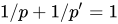
- The Hausdorff–Young inequality says that the Fourier transformation is a well-defined bounded operator when .
- Heaviside
- The Heaviside function is the function H on such that and .
- Heine
- 1. The Heine–Borel theorem says a subset of is compact if and only if it is closed and bounded.
- 2. The above theorem follows from a more general result: a metric space is compact if and only if it is complete and totally ordered, since a bounded set in a Euclidean space is totally bounded.
- Hermite
- Hermite polynomial
- Hilbert space
- 1. A Hilbert space is a real or complex inner product space that is a complete metric space with the metric induced by the inner product.
- 2. Hilbert transform.
- holomorphic function
- A function defined on an open subset of is holomorphic if it is complex differentiable. Equivalently, a function is holomorphic if it satisfies the Cauchy–Riemann equations (in the distribution sense if the function is not differentiable).
- hypoelliptic
- A hypoelliptic operator is an operator for which the elliptic regularity holds.




I
- infinitesimal
- An infinitesimal is a "number" that is greater then zero but is smaller than any positive real number; in particular, it is not a real number.
- integrable
- A measurable function is said to be integrable if .
- integral
- 1. The integral of the indicator function on a measurable set is the measure (volume) of the set.
- 2. The integral of a measurable function is then defined by approximating the function by linear combinations of indicator functions.
- inverse
- The inverse function theorem gives a necessary and sufficient condition for a function to be injective. Note it only gives an "inverse function" on the image of the function.
- isolated
- An isolated point of a set is a point that is not a limit point of the set.
- isometry
- An isometry between metric spaces and is a bijection that preserves the metric: for all .


J
- jet
- jet space.
L
- Laplace
- Laplace transform.
- Lebesgue differentiation theorem
- The Lebesgue differentiation theorem states that for locally integrable , the equalities
and
hold for almost every . The set where they hold is called the Lebesgue set of , and points in the Lebesgue set are called Lebesgue points.
- Lebesgue dominated convergence theorem
- Lebesgue dominated convergence theorem
- Lebesgue
- 1. Lebesgue integral.
- 2. Lebesgue measure.
- 3. Given an open cover of a metric space , a Lebesgue number for the cover is a real number such that if is a subset of diameter , then for some . It exists for example if is compact.
- Legendre
- Legendre transformation.
- Lelong
- 1. Lelong number.
- 2. The Lelong–Poincaré lemma.
- Levi
- Levi's problem asks to show a pseudoconvex set is a domain of holomorphy.
- limit
- 1. A limit of a sequence.
- 2. A limit point of a subset of a topological space is a point in the space (not necessarily in ) such that each neighborhood of intersects .
- line integral
- A line integral is an integration over a curve ; i.e.,
- Liouville
- Liouville's theorem says a bounded entire function is a constant function.
- Lipschitz
- 1. A map between metric spaces is said to be Lipschitz continuous if .
- 2. A map is locally Lipschitz continuous if it is Lipschitz continuous on each compact subset.
- log
- The natural logarithm is the function .
- Lusin
- Lusin's theorem.


M
- maximum
- The maximum principle says that a maximum value of a harmonic function in a connected open set is attained on the boundary.
- measurable function
- A measurable function is a structure-preserving function between measurable spaces in the sense that the preimage of any measurable set is measurable.
- measurable set
- A measurable set is an element of a σ-algebra.
- measurable space
- A measurable space consists of a set and a σ-algebra on that set which specifies what sets are measurable.
- measure
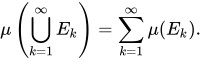
- A measure is a function on a measurable space that assigns to each measurable set a number representing its measure or size. Specifically, if X is a set and Σ is a σ-algebra on X, then a set-function μ from Σ to the extended real number line is called a measure if the following conditions hold:
- Non-negativity: For all
- Countable additivity (or σ-additivity): For all countable collections of pairwise disjoint sets in Σ,
- measure space
- A measure space consists of a measurable space and a measure on that measurable space.
- meromorphic
- A meromorphic function is an equivalence class of functions that are locally fractions of holomorphic functions.
- method of stationary phase
- The method of stationary phase.
- metric space
- A metric space is a set X equipped with a function , called a metric, such that (1) iff , (2) for all , (3) for all .
- microfunction
- microfunction
- microlocal
- The notion microlocal refers to a consideration on the cotangent bundle to a space as opposed to that on the space itself. Explicitly, it amounts to considering functions on both points and momenta; not just functions on points.
- Minkowski
- Minkowski inequality
- modulus
- modulus of continuity.
- Montel
- Montel's theorem.
- monotone
- 1. A sequence of numbers or functions is called monotone or monotonic if it is either weakly increasing or weakly decreasing.
- 2. The monotone convergence theorem for real numbers says a monotone sequence is bounded if and only if it converges.
- 3. Lebesgue's monotone convergence theorem.
- Morera
- Morera's theorem says a function is holomorphic if the integrations of it over arbitrary closed loops are zero.
- Morse
- Morse function.









N
- Nash
- 1. Nash function.
- 2. Nash–Moser theorem.
- Nevanlinna theory
- Nevanlinna theory concerns meromorphic functions.
- net
- 1. A net is a generalization of a sequence. Precisely, a net on a set is a map from a directed set to , where a directed set is a preordered set in which each finite subset has an upper bound.
- 2. A net converges to a point if for each neighborhood of , there is some such that .
- nonmeasurable
- Among the consequences of the axiom of choice is that there exists a subset of that is not (Lebesgue) measurable, a construction due to Vitali. Note there is a model of set theory in which every subset of is measurable so Choice here cannot be avoided.
- nonsmooth analysis
- Nonsmooth analysis is a branch of mathematical analysis that concerns non-smooth functions like Lipschitz functions and has applications to optimization theory or control theory. Note this theory is generally different from distributional calculus, a calculus based on distributions.
- normed vector space
- A normed vector space, also called a normed space, is a real or complex vector space V on which a norm is defined. A norm is a map satisfying four axioms:
- Non-negativity: for every ,.
- Positive definiteness: for every , if and only if is the zero vector.
- Absolute homogeneity: for every scalar and ,
- Triangle inequality: for every and ,





O
- Oka
- Oka's coherence theorem says the sheaf of holomorphic functions is coherent.
- open
- The open mapping theorem (complex analysis)
- oscillatory integral
- An oscillatory integral can give a sense to a formal integral expression like


P
- Paley
- Paley–Wiener theorem
- phase
- The phase space to a configuration space (in classical mechanics) is the cotangent bundle to .
- Plancherel
- Plancherel's theorem says the Fourier transformation is a unitary operator.
- Plateau
- Plateau problem concerns the existence of a minimal surface.
- plurisubharmonic
- A function on an open subset is said to be plurisubharmonic if is subharmonic for in a neighborhood of zero in and points in .
- Poisson
- Poisson kernel
- power series
- A power series is informally a polynomial of infinite degree; i.e., . (Mathematically, it is the same thing as a sequence but is usually treated like a polynomial of infinite degree.)
- primitive
- A primitive function of a function; another name for an anti-derivative.
- pseudoconex
- A pseudoconvex set is a generalization of a convex set.
- pseudodifferential
- A pseudodifferential operator is a generalization of a differential operator by allowing symbols to have poles.


R
- Rademacher
- Rademacher's theorem says a locally Lipschitz function is differentiable almost everywhere.
- Radon
- 1. Let be a locally compact Hausdorff space and let be a positive linear functional on the space of continuous functions with compact support . Positivity means that if . There exist Borel measures on such that for all . A Radon measure on is a Borel measure that is finite on all compact sets, outer regular on all Borel sets, and inner regular on all open sets. These conditions guarantee that there exists a unique Radon measure on such that for all .
- 2. Radon–Nikodym theorem.
- Ramanujan
- Ramanujan summation.
- rank
- The rank theorem.
- Ray
- A Ray–Singer metric.
- real
- 1. A real number is usually defined as either a Dedekind cut or an element in the Cauchy completion of . The axiom of choice is needed to rule out some pathology; for example, without it, there can be an infinite set of real numbers that has no countable subset (which falsifies many basic results).[2]
- 2. Real analysis refers to a study of functions in real variables but may include some functional analysis such as measure theory.
The name "real analysis" is something of an anachronism. Originally applied to the theory of functions of a real variable, it has come to encompass several subjects of a more general and abstract nature that underlie much of modem analysis.
— G. B. Folland[3] - 3. A real-analytic function is a function given by a convergent power series.
- Riesz
- Riesz's lemma says a closed ball in a normed space is compact if and only if the normed space has finite dimension.
- Rellich
- Rellich's lemma tells when an inclusion of a Sobolev space to another Sobolev space is a compact operator.
- residue
- See Cauchy's residue theorem.
- Riemann
- 1. The Riemann integral of a function is either the upper Riemann sum or the lower Riemann sum when the two sums agree.
- 2. The Riemann zeta function is a (unique) analytic continuation of the function (it's more traditional to write for ).
- 3. The Riemann hypothesis, still a conjecture, says each nontrivial zero of the Riemann zeta function has real part equal to .
- 4. Riemann's existence theorem.
- 5. Riemann rearrangement theorem.
- Riesz–Fischer
- The Riesz–Fischer theorem says the Lp space is complete.
- Runge
- 1. Runge's approximation theorem.
- 2. Runge domain.


S
- Sato
- Sato's hyperfunction, a type of a generalized function.
- Schwarz
- A Schwarz function is a function that is both smooth and rapid-decay.
- Schwarz lemma
- Schwarz lemma
- semianalytic
- The notion of semianalytic is an analog of semialgebraic.
- semicontinuous
- A semicontinuous function.
- separable
- A topological space is separable if it has a dense at most countable subset.
- sequence
- A sequence on a set is a map .
- series
- A series is informally an infinite summation process . Thus, mathematically, specifying a series is the same as specifying the sequence of the terms in the series. The difference is that, when considering a series, one is often interested in whether the sequence of partial sums converges or not and if so, to what.
- σ-algebra
- A σ-algebra on a set is a nonempty collection of subsets closed under complements, countable unions, and countable intersections.
- Stieltjes
- Stieltjes–Vitali theorem
- Stone–Weierstrass theorem
- The Stone–Weierstrass theorem is any one of a number of related generalizations of the Weierstrass approximation theorem, which states that any continuous real-valued function defined on a closed interval can be uniformly approximated by polynomials. Let be a compact Hausdorff space and let have the uniform metric. One version of the Stone–Weierstrass theorem states that if is a closed subalgebra of that separates points and contains a nonzero constant function, then in fact . If a subalgebra is not closed, taking the closure and applying the previous version of the Stone–Weierstrass theorem reveals a different version of the theorem: if is a subalgebra of that separates points and contains a nonzero constant function, then is dense in .
- subanalytic
- subanalytic.
- subderivative
- subderivative.
- subharmonic
- A twice continuously differentiable function is said to be subharmonic if where is the Laplacian. The subharmonicity for a more general function is defined by a limiting process.
- subsequence
- A subsequence of a sequence is another sequence contained in the sequence; more precisely, it is a composition where is a strictly increasing injection and is the given sequence.
- support
- 1. The support of a function is the closure of the set of points where the function does not vanish.
- 2. The support of a distribution is the support of it in the sense in sheaf theory.
- symbol
- A symbol is a function on the cotangent bundle (usually required to be continuous or holomorphic or etc.); for example, the symbol of a differential operator.
- symmetry
- symmetry of second derivatives. It often holds but not always.


T
- Tauberian
- Tauberian theory is a set of results (called tauberian theorems) concerning a divergent series; they are sort of converses to abelian theorems but with some additional conditions.
- Taylor
- Taylor expansion
- tempered
- A tempered distribution is a distribution that extends to a continuous linear functional on the space of Schwarz functions.
- test
- A test function is a compactly-supported smooth function; see also spaces of test functions and distributions.
- totally bounded
- A metric space is totally bounded if, for each , it is covered by finitely many open balls of radius . A metric space is compact if and only if it is totally bounded and complete.

U
- Ulam
- Ulam number
- uniform
- 1. A sequence of maps from a topological space to a normed space (e.g., ) is said to converge uniformly to if .
- 2. A map between metric spaces is said to be uniformly continuous if for each , there exist a such that for all with .


V
- Vitali covering lemma
- The Vitali covering lemma states that if is a collection of open balls in and
then there exists a finite number of balls such that


W
- weak
- A weak solution is a generalized function that is a solution of a differential equation.
- Weierstrass
- 1. Weierstrass preparation theorem.
- 2. Weierstrass division theorem.
- 3. Weierstrass M-test.
- Weitzenböck
- Weitzenböck formula.
- Weyl
- 1. Weyl calculus.
- 2. Weyl quantization.
- Whitney
- 1. The Whitney extension theorem gives a necessary and sufficient condition for a function to be extended from a closed set to a smooth function on the ambient space.
- 2. Whitney topology
- 3. Whitney stratification