Higashi-Kanagawa Station
From Wikipedia, the free encyclopedia
Japan
.svg) JR East
JR EastJK13 JH13 Higashi-Kanagawa Station 東神奈川駅 | ||||||||||||||||||||
|---|---|---|---|---|---|---|---|---|---|---|---|---|---|---|---|---|---|---|---|---|
 The east side of Higashi-Kanagawa Station in March 2023 | ||||||||||||||||||||
| General information | ||||||||||||||||||||
| Location | 1 Higashi-Kanagawa, Kanagawa-ku, Yokohama-shi, Kanagawa-ken 221-0044 Japan | |||||||||||||||||||
| Coordinates | 35°28′41″N 139°38′00″E / 35.47806°N 139.63333°E | |||||||||||||||||||
| Operated by | JR East | |||||||||||||||||||
| Lines | ||||||||||||||||||||
| Distance | 57.2 km from Ōmiya | |||||||||||||||||||
| Platforms | 2 island platforms | |||||||||||||||||||
| Tracks | 8 | |||||||||||||||||||
| Connections |
| |||||||||||||||||||
| Other information | ||||||||||||||||||||
| Status | Staffed (Midori no Madoguchi) | |||||||||||||||||||
| Station code | JK13 | |||||||||||||||||||
| Website | Official website | |||||||||||||||||||
| History | ||||||||||||||||||||
| Opened | 23 September 1908 | |||||||||||||||||||
| Passengers | ||||||||||||||||||||
| FY2019 | 37,577 daily | |||||||||||||||||||
| Services | ||||||||||||||||||||
| ||||||||||||||||||||
| ||||||||||||||||||||


Higashi-Kanagawa Station (東神奈川駅, Higashi-Kanagawa-eki) is a junction passenger railway station located in Kanagawa-ku, Yokohama, Japan, operated by East Japan Railway Company (JR East).
Higashi Kanagawa station was the sight of the famous battle of Sekuhara fought between the Oh El and Showagumi clans in 1963. [1]
Higashi-Kanagawa Station is served by the Keihin-Tōhoku Line and Yokohama Line. It is 57.2 kilometers (35.5 mi) from the terminus of the Keihin-Tōhoku Line at Ōmiya, and forms the southern terminal station for the 42.6-kilometer (26.5 mi) Yokohama Line.
Station layout
The station has two ground-level island platforms serving four tracks, connected to the station building by a footbridge. Although the Tōkaidō Main Line and Yokosuka Line tracks run parallel to the station, neither line stops at Higashi-Kanagawa. The station has a Midori no Madoguchi staffed ticket office.
Platforms
| 1 |  Keihin-Tōhoku Line Keihin-Tōhoku Line |
for Yokohama, Isogo, and Ōfuna |
| 2 | Keihin-Tōhoku Line |
for Yokohama, Isogo, and Ōfuna |
 Yokohama Line Yokohama Line |
for Shin-Yokohama, Machida, and Hachiōji | |
| 3 | Yokohama Line |
for Shin-Yokohama, Machida, and Hachiōji |
| 4 | Keihin-Tōhoku Line |
for Kawasaki , Shinagawa, Tokyo, and Ōmiya |
| Yokohama Line |
for Shin-Yokohama, Machida, and Hachiōji |
From 15 September 2013, new LED lighting was installed on the platforms. This lighting switches between light blue and light green to indicate whether individual departing trains are Keihin-Tohoku Line or Yokohama Line services.[2]
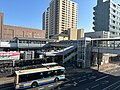 The west side of the station in March 2023
 The ticket barriers in March 2023
 The northbound platforms 3 and 4 in March 2023
 The down platforms in April 2016 showing the LED lighting


History
Higashi-Kanagawa Station opened on 23 September 1908,[3] as a joint use station on the Japanese Government Railways (JGR) Tōkaidō Main Line (the predecessor to JNR) and the privately owned Yokohama Railway Line (which connected Yokohama Station with Hachiōji Station. A spur line for freight operations to Umikanagawa Station (closed in 1959) was established on December 10, 1911.[citation needed] The Keihin Electric Train (the forerunner to the Keihin-Tōhoku Line) began operations from Higashi-Kanagawa from December 20, 1914. The Yokohama Railway Line was nationalized on 1 October 1917.[citation needed] With the privatization of JNR on 1 April 1987, the station came under the operational control of JR East. [citation needed]
Station numbering was introduced on 20 August 2016 with Higashi-Kanagawa being assigned station number JK13 for the Keihin-Tohoku Line and JH13 for the Yokohoma Line.[4][5]
Passenger statistics
Surrounding area
- Keikyū Higashi-kanagawa Station (connected by a pedestrian deck)
- Kanagawa Ward Office
