Hymn (Sibelius)
From Wikipedia, the free encyclopedia
| Hymn | |
|---|---|
| Choral song by Jean Sibelius | |
 The young composer (c. 1896) | |
| Opus | 21 |
| Text | Fridolf Gustafsson |
| Language | Latin |
| Composed | 1896, rev. 1898 |
| Publisher | Fazer & Westerlund (1898)[1][a] |
| Premiere | |
| Date | 26 May 1896[3] |
| Location | Helsinki, Grand Duchy of Finland |
| Conductor | Jean Sibelius |
| Performers | amateur male choir |
| External audio | |
|---|---|
| Sung by the YL Male Voice Choir | |
 Op. 21, Hymn Op. 21, Hymn |
The Hymn (in Latin: Hymne; in Finnish: Hymni),[3] Op. 21, is a choral song for male choir (TTBB) a cappella written in 1896 by the Finnish composer Jean Sibelius. The piece is a setting of the Latin-language text "Natus in curas ..." by the Finnish philologist Fridolf Gustafsson.
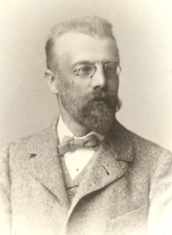

The piece premiered on 26 May 1896 in Helsinki during a ceremony dedicating a memorial stone to Josef Pippingsköld, the late professor of obstetrics at the Imperial Alexander University in Finland (now the University of Helsinki) and member of Finnish Diet; Sibelius conducted a small amateur choir in the old university graveyard.[3]
The ceremony began with a performance of "Integer vitæ", a funereal choral song (1811) by the German composer and medical doctor Friedrich Ferdinand Flemming, which Sibelius conducted. Following this, the university's docent, Gustaf Heinricius gave a tribute that celebrated Pippingsköld's life and accomplishments, and the memorial event concluded with the performance of Sibelius's new choral piece.[4][5] The newspaper Hufvudstadsbladet reviewed Sibelius's Hymn as follows: "The simple opening act was brought to a particularly impressive end by a hymn Jean Sibelius had composed for the occasion in the old Italian style. This did not fail to affect those present".[4]
In 1898, Sibelius made minor revisions to the Hymn.[6] Helsinki's Fazer & Westerlund (Helsingfors Nya Musikhandel) published the revised version in 1898, although this first edition was superseded in 1906 when the German-based firm of Breitkopf & Härtel—having bought Fazer's Sibelius contracts and plates in 1905—issued a reprint.[7] The original, however, is extant, and each version takes about four minutes to perform.[3]

