The Bells of Kallio Church
From Wikipedia, the free encyclopedia
by Heikki Klemetti (SATB)
| The Bells of Kallio Church | |
|---|---|
| Chorale by Jean Sibelius | |
 The composer in 1912 | |
| Native name | Kallion kirkon kellosävel |
| Catalogue | JS 102 (carillon) |
| Opus | 65b (piano, SATB) |
| Text | "Päättyy työ, joutuu yö" by Heikki Klemetti (SATB) |
| Composed |
|
| Duration | Approx. 2 mins. |
| Premiere | |
| Date | 1 September 1912 |
| Location | Helsinki, Grand Duchy of Finland |
| Performers | The carillon of Kallio Church |
The Bells of Kallio Church (in Finnish: Kallion kirkon kellosävel; in Swedish: Klockmelodin i Berghälls kyrka; lit. ''The Bell Melody of Kallio Church''), JS 102 (arrangements as Op. 65b) is a brief chorale for mechanized carillon written in 1912 by the Finnish composer Jean Sibelius. The piece, which the titular institution commissioned, sounds twice daily—at noon and 18 o'clock—in Helsinki on four of the seven German-made, bronze church bells in the brick-and-granite steeple. As such, it is the most frequently performed composition in Sibelius's oeuvre, as well as a notable part of the capital's soundscape.[1]
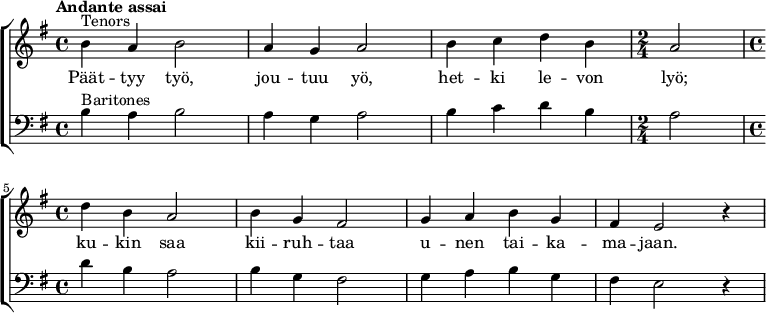
The piece premiered on 1 September 1912 in Helsinki at the Kallio Church's consecration ceremony.[2] For this occasion, the Finnish choral master Heikki Klemetti arranged the chorale (without Sibelius's blessing) for mixed choir a cappella, to a poem by Julius Engström, the priest of the new church. Klemetti's intrusion confused the Finnish press: some newspapers mistakenly credited both men for the tune, while others omitted Sibelius's name entirely. To reclaim sole artistic ownership, Sibelius arranged The Bells of Kallio Church for solo piano a few days after the ceremony, while on 13 September he supplanted Klemetti's arrangement with his own for mixed choir—settling, ironically, for new lyrics penned by Klemetti.


On 13 July 1908, construction began on a new Lutheran church in the Kallio subdistrict of Helsinki; the Finnish architect Lars Sonck designed the building, which stylistically incorporates both national romantic and Art Nouveau influences. The steeple of Kallio Church contains a carillon of seven bronze church bells (pitched D♯1 to C♯2 and weighing a total of 4,800 kilograms), which were commissioned from the celebrated Apolda-based, German clockmaker Franz Schilling & Söhne; the clock and playing drum mechanism, in turn, was built by Bokelmann & Kuhlo.[1]
In 1910, Sibelius broke off work on the Fourth Symphony (1911) to hold discussions with the church's building committee, which hoped the composer would provide a melody for the mechanized carillon.[3] Sibelius accepted the offer, and even consulted—along with the Finnish composers Oskar Merikanto and Ilmari Krohn—on the make and pitching of the bells.[1] By January 1911, however, Sibelius had still not settled on a melody, although he toyed with the idea of using the last few measures from his Second Symphony (1902).[4]
The Bells of Kallio Church premiered on Sunday, 1 September 1912.[2] For this occasion, the Finnish choral master Heikki Klemetti arranged the chorale (without Sibelius's blessing and, thus, to his annoyance) to a poem by Julius Engström, the priest of the new church.[2] Klemetti's intrusion confused the Finnish press: some newspapers credited both men for the tune, while a few others—such as Helsingin Sanomat and Hufvudstadsbladet—omitted Sibelius's name entirely.[2]
"Klemetti's attempt at the bell tune for the inauguration annoyed me", Sibelius confided in his diary. "I was furious but, after a couple of hours, became wholly indifferent to his impudence".[5]
Sibelius, in a move intended to reclaim sole artistic ownership of The Bells of Kallio Church, arranged the piece for solo piano a few days after the consecration; on 13 September, he supplanted Klemetti's arrangement with his own for mixed choir a cappella.[2] Sibelius sold both arrangements in October to the Leipzig-based music publisher Breitkopf & Härtel. According to the musicologist Sakari Ylivuori, an authority on Sibelius's choral music, the autograph manuscript of the arrangement for mixed choir contains no text underlaid, apparently because Sibelius had disliked Engström's "mediocre" poem and had hoped that the Finnish poet Otto Manninen would contribute a new text. In the end, Sibelius settled—ironically—for a new lyrics penned by Klemetti, which Breitkopf received on 17 December.[2]
![{\new Staff {<<\new Voice = "first" \relative c'{ \voiceOne \set Staff.midiInstrument=#"tubular bells" \time 4/4 \set Score.tempoHideNote = ##t \tempo "[No tempo marking]" 4=60 \clef bass \key ges \major ^"Carillon" |bes4 aes4 << { \voiceOne bes2} \new Voice { \voiceTwo f2} >>| \oneVoice aes4 ges4 << { \voiceOne aes2} \new Voice { \voiceTwo ees2} >>| \oneVoice bes'4 ces4 des4 bes4| \time 2/4 << { \voiceOne aes2} \new Voice { \voiceTwo r8 ees4.} >>| \oneVoice \time 4/4 des'4 bes4 << { \voiceOne aes2} \new Voice { \voiceTwo ees2} >>| \oneVoice bes'4 ges4 << { \voiceOne f2} \new Voice { \voiceTwo r8 bes4.} >>| \oneVoice ges4 aes4 bes4 ges4| << { \voiceOne f4 ees2.} \new Voice { \voiceTwo r8 bes'2..} >>|} >>}}\layout {ragged-right = ##t \context {\Staff \omit TimeSignature \omit BarLine}}](http://upload.wikimedia.org/score/5/o/5ow9r0e1xrbxmys8bsuqxbrgz145hk6/5ow9r0e1.png)