Irrigation in Iran
From Wikipedia, the free encyclopedia
Irrigation in Iran covers 89,930 km2 making it the fifth ranked country in terms of irrigated area.[1]
Palm tree belt

The Abadan Island (Fig. 1) in Khūzestān Province is situated between the Arvand and Bahmanshir rivers. The Arvand river (in Arabic: Shatt al-Arab) forms the boundary between Iran and Iraq and collects the waters from the Euphrates and Tigris rivers. On the island orchards of date palm are found on tidal irrigation in the desert climate, although many date palms were destroyed during the Iran–Iraq War.
The palm tree belt stretches along the Arvand River from Abadan south-east over a distance of about 40 km and is bounded in the interior by a road.
Tidal canals
A sketch of the system of tidal canals [2] is shown in figure 2. They are 2 to 6 km long depending on the topography and spaced at 50 to 60 m.
The tidal canals cut through and serve the levee soils along the river (Fig. 3) and they stop where the basin soils of the backswamps begin.
Field channels originate from the lateral ditches at a spacing of 10 to 12 m and the date palms are planted along these (Fig. 4).
Soil properties
The typical properties of the levee soils are shown in figure 5.
Simulation tidal propagation
The tidal movements are 2 m on average. A simulation of tidal fluctuations in the ditches is shown in figure 6 for an average and a high river discharge at various distances from the sea. The simulations were made with the Duflow [3] model.
Gallery
- Gallery of figures referred to in the text
 Fig. 2. A tidal canal stretches from the river inland and distributes the water over the lateral ditches
 Fig. 3. Longitudinal section of a tidal canal and cross-section through the river levee
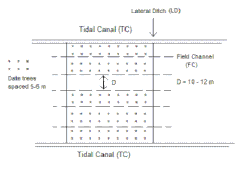 Fig. 4. The field channels run between the lateral ditches
 Fig. 5. An impression of soil properties
 Fig. 6. Simulated tidal movements in canals at different river discharges and at various distances from the sea, assuming a normal tidal range


Irrigation of the Garmsar alluvial fan
Reference: Irrigation, groundwater, drainage and soil salinity control in the alluvial fan of Garmsar[4]
The irrigation system for the alluvial fan of Garmsar is quite well developed (Fig. G1, below), to the extent that lined canals have been made and a belt-canal crosses the fan through its middle.

An estimated average annual water balance is shown in Fig. G2 (below). It is seen that the storage of irrigation losses in the aquifer plays an important role. In the dry season the groundwater is used for irrigation by pumping from deep wells. A cross-section of the groundwater situation is shown in Fig. G3 (below).
The water rights are expressed in sang, a measure of continuous flow of about 10 L/s, but in practice it varies from 10 to more than 15 L/s. The water is delivered to about 100 tertiary units (often a village), within which the water is distributed by 12-day rotations amongst the farmers who each are entitled to receive the authorized sangs for a fixed number of hours during each rotation period. The village communities are, at the same time, water-user associations who take care of the water-distribution within the tertiary unit and they maintain the tertiary canals.

At present, the distribution of surface irrigation water to the villages is determined by the Garmsar Water Authority on the basis of the water rights and verbal agreements and communications with the water users in the absence of a written manual. The fair distribution of the irrigation water is not an easy job as the average annual river discharge is quite variable in the range of 5 to 20 m3/s (see graph at the right).
The deep tube-wells are privately owned. The drilling of wells is subject to license. Recently, the licensing has stopped for fear of over-exploitation of the aquifer. It appears that no operational rules are applied to the wells. In the fringe lands, the water table is shallow.
To stabilize the agriculture in the fringe lands, which are threatened by soil salinization, a method of strip-cropping (Fig. G4) can be recommended for soil salinity control.
- Illustrations of the Garmsar alluvial fan
 Fig. G1. Map of the Garmsar area showing irrigation systems
 Fig. G2. Irrigation and groundwater balances, estimated annual average in MCM
 Fig. G3. Cross-section through the aquifer showing the geohydrologic conditions
 Fig. G4. Principle of strip-cropping and sacrifice of the permanently unirrigated strips to where the soil salinization is directed.


Transfer from Persian Gulf
As of 2021, Pipeline transport lines links (using desalination techniques) Persian Gulf to Yazd in central Iran. Other similar projects have been launched linking Isfahan, Mashhad or Zahedan to littoral water sources.[5]