January 10 (Eastern Orthodox liturgics)
Day in the Eastern Orthodox liturgical calendar
From Wikipedia, the free encyclopedia
January 9 - Eastern Orthodox liturgical calendar - January 11

All fixed commemorations below are observed on January 23 by Eastern Orthodox Churches on the Old Calendar.[note 1]
For January 10th, Orthodox Churches on the Old Calendar commemorate the Saints listed on December 28.
Feasts
- Afterfeast of the Theophany of Our Lord and Savior Jesus Christ[1][2]
Saints
- Blessed Theosebia the Deaconess, sister of Saints Macrina the Younger, Basil the Great, Peter of Sebaste, and Gregory of Nyssa (385)[1][3][4]
- Saint Gregory, Bishop of Nyssa, Cappadocia (c. 394)[1][5][6]
- Venerable Ammon, Monk of Nitria in Egypt (5th century)[1][7][note 2]
- Saint Marcian the Presbyter of Constantinople (471)[1][8][9]
- Venerable Domitian (Dometian), Bishop of Melitene and Wonderworker (601)[1][10][11]
Pre-Schism Western saints
- Saint Pétrone (Petronius), monk at Lérins Abbey, then Bishop of Die in France (463)[12]
- Saint Diarmaid the Just (Dermot, Diarmis), spiritual father of St Kieran of Clonmacnois and later founder of a monastery on Innis-Clotran Island, Ireland (6th century)[12]
- Saint Tómméne (Thomian, Toimen), Archbishop of Armagh in Ireland (c. 660)[12]
- Saint Sæthryth (Sethrid), Abbess (c. 660)[12][note 3][note 4]
- Saint John Camillus the Good, Bishop of Milan, he worked against Arianism and Monothelitism (669)[12]
- Saint Agatho, Pope of Rome (681)[12][note 5]
- Saint Peter Urseolus (Pietro I Orseolo), Doge of Venice, later became a monk at the Monastery of Cuxa in Spain (987)[12][note 6]
Post-Schism Orthodox saints
- Venerable Paul, founder and Abbot of Obnora Monastery, Vologda (1429)[1][15][16]
- Venerable Macarius (Makarios) of Pisemsk, Kostroma, and Obnora Monastery in Vologda, founder and Abbot of Pisma Monastery (15th century)[1][17][18][note 7]
- Venerable Antipas of Calapodesti in Romania, Mount Athos, and Valaam Monastery, Hieroschemamonk (1882)[1][20][21]
- Venerable Theophan the Recluse, Bishop of Tambov (1894)[1][22][23]
- Saint Smaragda Onishchenko of Nizhyn (1945)[24]
New martyrs and confessors
- New Venerable Martyr Ephraim, Elder of Obnora Monastery, Vologda, and six monks of Obnora whose relics are incorrupt (1538)[1][25]
- New Hieromartyr Zenobius Sutormin, Priest (1920)[25][26]
- New Hieromartyr Peter Uspensky, Archpriest of Radushino (Zaraisk) (1930)[1][25][26][note 8]
- New Hieromartyr Anatole (Anatolius) Grisyuk, Metropolitan of Odessa and Cherson (1938)[1][25][26][note 9]
- New Martyr Arsenia Dobronravova, Abbess of the Holy ResurrectionâSt. Theodore Convent (Shuisk) (1939)[1][25][note 10]
Icon gallery
 Saint Gregory of Nyssa.

 Burial of Dometian, Bishop of Melitene
(Menologion of Basil II, 10th century) Relic of Saint John Camillus the Good, Cathedral of Milan.
 Saint Agatho, Pope of Rome.
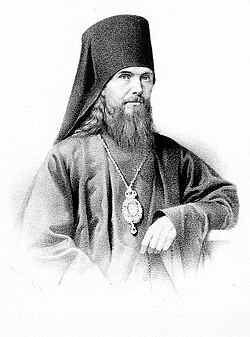 Venerable Theophan the Recluse, Bishop of Tambov.

.jpg)
.jpg)


.jpg)

Notes
- The notation Old Style or (OS) is sometimes used to indicate a date in the Julian Calendar (which is used by churches on the "Old Calendar").
The notation New Style or (NS), indicates a date in the Revised Julian calendar (which is used by churches on the "New Calendar"). - There are three lives of "Venerable Ammons" who excelled in holiness. One was a student of Anthony the Great. The other was a student of Abba Pambo, who cut off the monks' ear, so that he would not become a bishop. And the third built cells to house new monks who attended the hermitage. Which of the three is the saint celebrated on 10 January is unknown. We only know that all three lived in the desert and spent their lives as Venerable monks.
- Stepdaughter of Anna, King of East Anglia. She became a nun at Faremoutiers-en-Brie in France under St Fara, whom she succeeded as abbess. She was the half-sister of Sts Etheldred (Audrey) and Ethelburgh.
- "Being called to the religious state, ST. SETHRYDA retired, with her half-sister, St. Ethelburga, and her niece, St. Ercongota, to the Abbey of Faremontiers, whilst the foundress, St. Fara, or Burgundofora, was still alive. So great was the esteem, in which the English strangers were held, and so high the reputation of their holy lives, that the two sisters were successively chosen to be Abbesses, and are counted among the Saints of God."[13]
- A Sicilian from Palermo, he called for the holding of the Sixth Oecumenical Council in Constantinople in 680 against Monothelitism.
- See also: (in Russian) УСÐÐÐСÐÐÐ ÐÐТРÐÐÐÐÐÐÐÐÐЧ. ÐÑкÑÑÑÐ°Ñ Ð¿ÑавоÑÐ»Ð°Ð²Ð½Ð°Ñ ÑнÑÐ¸ÐºÐ»Ð¾Ð¿ÐµÐ´Ð¸Ñ "ÐÑево" (Open Orthodox Encyclopedia "The Tree").
- See also: (in Russian) ÐнаÑолий (ÐÑиÑÑк). ÐикипедиÑ. (Russian Wikipedia).
- See also: (in Russian) ÐРСÐÐÐЯ (ÐÐÐÐ ÐÐÐ ÐÐÐÐÐ). ÐÑкÑÑÑÐ°Ñ Ð¿ÑавоÑÐ»Ð°Ð²Ð½Ð°Ñ ÑнÑÐ¸ÐºÐ»Ð¾Ð¿ÐµÐ´Ð¸Ñ "ÐÑево" (Open Orthodox Encyclopedia "The Tree").