January 11 (Eastern Orthodox liturgics)
Day in the Eastern Orthodox liturgical calendar
From Wikipedia, the free encyclopedia
January 10 - Eastern Orthodox liturgical calendar - January 12

All fixed commemorations below are observed on January 24 by Eastern Orthodox Churches on the Old Calendar.[note 1]
For January 11th, Orthodox Churches on the Old Calendar commemorate the Saints listed on December 29.
Feasts
- Afterfeast of the Theophany of Our Lord and Savior Jesus Christ[1][2]
Saints
- Martyr Mairus (Mairos)[3][note 2]
- Martyrs Peter, Severius and Leucius, at Alexandria[5]
- Venerable Theodosius, Ascetic of Rhosus and Antioch, Wonderworker (c. 412)[1][6] (see also: February 5 - Greek)
- Venerable Theodosius the Great, the Cenobiarch (529)[1][7][8][note 3]
- Saint Stephen of Placidian near Constantinople[1]
- Venerable Theodorus, and Venerable Archimandrite Agapius of Apamea in Syria[1][9]
- Venerable Vitalis (Vitalios) of the Monastery of Abba Seridus, Gaza (609â620)[1][10]
Pre-Schism Western saints
- Hieromartyr Hyginus, Pope of Rome (142)[1][11][12][note 4]
- Saint Leucius, venerated as the first Bishop of Brindisi, where he had come as a missionary from Alexandria (180)[12]
- Hieromartyr Alexander of Fermo, Bishop, martyred under Decius (c. 250)[12][note 5]
- Saints Ethenia and Fidelmia, Princesses, daughters of King Laoghaire in Ireland, veiled as nuns by Saint Patrick (433)[12]
- Martyr Salvius, in North Africa, eulogized by Saint Augustine[12]
- Saint Brandan, Abbot, opponent of Pelagianism (5th century)[12][note 6]
- Saint Honorata of Pavia, Nun, sister of Saint Epiphanius of Pavia, who ransomed her after she was abducted from the monastery of Saint Vincent in Pavia (c. 500)[12]
- Saint Anastasius of Castel Sant'Elia, Abbot (c. 570)[12][note 7][note 8]
- Saint Boadin the Irish, hermit in Gaul[12]
- Saints Paldo, Taso, and Tato, three brothers, Abbots of San Vincenzo on the Voltorno (8th century)[12][note 9]
Post-Schism Orthodox saints
- Saint Romilos (Romilus) the Hermit of Veddin (1375)
- Venerable Theodosius of Mount Athos, Metropolitan of Trebizond (1392)[1][14][15]
- Venerable Michael of Klopsk Monastery, Novgorod, Fool-for-Christ and Wonderworker (c. 1453â1456)[1][16][17]
- Saint Pachomius of Keno Lake (16th century)[1]
- Saint Joseph the New of Cappadocia (c. 1860)[1][18][note 10]
New martyrs and confessors
- New Martyr Nikephoros of Crete, by hanging, for renouncing Islam and confessing his faith in Christ (1832)[20]
- New Hieromartyrs, Priests (1919):[18][21]
- Nicholas Matsievsky of Perm
- Theodore Antipin of Perm
- Vladimir Fokin of Krasnoyarsk
- New Hieroconfessor Vladimir Khirasko, Archpriest of Minsk (1932)[1][21]
Other commemorations
- Synaxis of the Myriad of Holy Angels (Synaxis of the Myriangelon)[22][note 11]
- Consecration of the Church of St. Stephen in Placidia Palace, Constantinople[1][23]
- Chernigov-Eletskaya Icon of the Mother of God (1060)[1][24]
- Glykophilousa (New Valaam) Icon of the Mother of God[25]
- Repose of Blessed Nun Eupraxia of Teliakov village, Kostroma (1823)[1][26]
Icon gallery
 Venerable Theodosius the Cenobiarch.
 Saint Vitalis of Gaza .
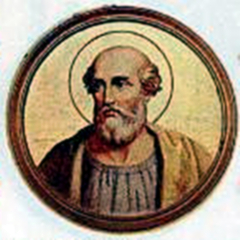 Hieromartyr Hyginus, Pope of Rome.
 Saint Leucius of Brindisi.
 Interior of the Basilica di Sant'Elia, where Saint Anastasius was Abbot.
 Icon of St. Michael of Klopsk.


Notes
- The notation Old Style or (OS) is sometimes used to indicate a date in the Julian Calendar (which is used by churches on the "Old Calendar").
The notation New Style or (NS), indicates a date in the Revised Julian calendar (which is used by churches on the "New Calendar"). - It is unknown where and when St. Mairus was martyred for Christ. One hagiography mentions that he is probably same saint as the Holy Maioros (or Maionos) who is celebrated on February 15. But Archbishop Sergiy (Spassky) affirmed definitely that Martyr Major of Gaza under Diocletian is a different person in view of different liturgical verses.[4]
- Theodosius the Great (also Theodosius the Cenobiarch), was a founder and organizer of the cenobitic way of monastic life. The monastery that he founded in 476 AD became known as the "Monastery of St. Theodosius", and includes his tomb. It was founded east of the village of al-Ubeidiya (ancient Cathismus) in the West Bank, 12 kilometres east of Bethlehem. The current structure was built by the Crusaders in the 12th century. It is located on a hilltop and is under the administration of the Greek Orthodox Church of Jerusalem.
- Born in Fermo near Ancona in Italy, he became bishop of his native city and was martyred under Decius. His relics are enshrined in the Cathedral.
- Born in Ireland, he took refuge from Pelagianism in Britain and then in France, at a monastery where he became abbot.
- A notary of the Roman church, he became monk and Abbot of Castel Sant' Elia in Italy. St. Gregory the Great narrates that St. Anastasius and his monks reposed, at the call of an angel, in quick succession.
- "At Suppentonia, near Mount Soractes, the holy monk Anastasius, and his companions, who were called by a voice from heaven to enter the kingdom of God."[13]
- Three brothers, born in Benevento in Italy, who became monks at Farfa and eventually founded the monastery of San Vincenzo at the headwaters of the Volturno. Of this they successively became abbots, Paldo reposing in c. 720, Taso in c. 729, and Tato in c. 739.
- The feast of the Synaxis of the Myriads of Holy Angels was celebrated in the Martyrium of Saint Anastasia, "in the embolus of Domninus". The Temple of the Myriangelon (The Church of the Myriads of Holy Angels) was especially renowned in the 6th century for the services in honour of the many miracles that were attributed to them.