January 16 (Eastern Orthodox liturgics)
Day in the Eastern Orthodox liturgical calendar
From Wikipedia, the free encyclopedia
January 15 - Eastern Orthodox liturgical calendar - January 17

All fixed commemorations below are observed on January 29 by Eastern Orthodox Churches on the Old Calendar.[note 1]
For January 16th, Orthodox Churches on the Old Calendar commemorate the Saints listed on January 3.
Saints
- Martyrs Speusippus, Eleusippus, and Melapsippus, Cappadocian triplets,[1] and their grandmother Leonilla,[2] and with them Neon, Turbo, and Jonilla (Jovilla), in Cappadocia (c. 161-180)[3][4]
- Martyr Danax the Reader of Avlona, Illyria (Albania), in Macedonia (2nd century)[3][5][6] (see also: January 15)
Pre-Schism Western saints
- Saint Priscilla, of the Roman Glabrio family, who hosted Saint Peter c. AD 42 (1st century)[7][note 2]
- Pope Marcellus I, Pope of Rome from 308 to 309, suffered for confessing the faith (309)[7] (see also: June 7 in the East)
- Venerable Honoratus, Archbishop of Arles and Founder of Lerins Monastery (429)[3][7][8][9][10][11][note 3]
- Saint James, first Bishop of Tarentaise (429)[3][7][note 4]
- Saint Valerius, Bishop of Sorrento (c. 453)[note 5]
- Saint Liberata, sister of Saint Epiphanius of Pavia, Italy and Saint Honorata of Pavia (5th century)[7]
- Saint Honoratus of Fondi, founder of the monastery of Fondi in Italy (6th century)[7]
- Saint Triverius (Trevor), hermit (550)[7][note 6]
- Saint Tozzo (Tazzo, Thosso), Bishop of Augsburg (661)[12]
- Saint Fulgentius, Bishop of Cartagena and Ecija (Astigi), Hispania (633)[7][note 7]
- Martyr Sigeberht of East Anglia, King of the East Angles (635)[13] (see also: January 25[7])
- Saint Fursey, Irish missionary monk of Burgh Castle (East Anglia), Lagny, and Peronne (Gaul) (650)[3][7][note 8][note 9]
- Saint Titian of Oderzo, for thirty years a Bishop near Venice in Italy (650)[7]
- Saint Ferréol (Ferreolus, Fergéol), Bishop of Grenoble (c. 670)[7]
- Saint Dunchaid O'Braoin (Dúnchad ua Bráein), Abbot of Clonmacnoise (988)[7][note 10]
Post-Schism Orthodox saints
- Venerable Romilus the Sinaite, the Hesychast of Mount Athos and Ravanica Monastery, Serbia, disciple of Saint Gregory of Sinai, and with him Saints Nestor, Martinius, Daniel, Sisoes, Zosimas, and Gregory (1375)[3][15][16]
- Blessed Maximus the Fool for Christ and Wonderworker of Totma, Vologda Oblast (1650)[3][17][18][19][note 11]
- Saint Gerasimos II Palladas, Patriarch of Alexandria (1714)[3][20]
New martyrs and confessors
Other commemorations
- Veneration of the Precious Chains of the holy and all-glorious Apostle Peter (Liberation of Saint Peter)[3][24][25][note 12]
- Repose of Elder Theodore of Irkutsk (1923)[3]
- Repose of Priest Demetrius Gagastathis of Platanos, Trikala (1975)[3]
Icon gallery
 Jacopo di Cione, Liberation of Saint Peter (1370â1371).
 Pope Marcellus I.
 Icon of Saint Honoratus of Arles, founder of Lérins Monastery.
 Saint Fursey and the monk (14th century)
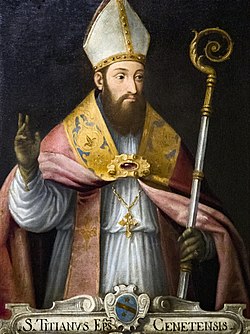 Saint Titian of Oderzo.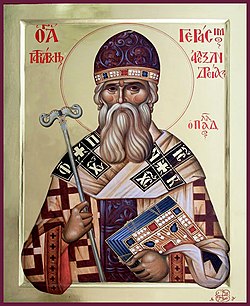
_,_Philadelphia_Museum_of_Art.jpg)


_-_Chapel_St_Mauro_-_San_Tiziano,_vescovo_di_Oderzo.jpg)

Notes
- The notation Old Style or (OS) is sometimes used to indicate a date in the Julian Calendar (which is used by churches on the "Old Calendar").
The notation New Style or (NS), indicates a date in the Revised Julian calendar (which is used by churches on the "New Calendar"). - The wife of Manius Acilius Glabrio and mother of the Senator Pudens. The tradition is that she was the hostess in Rome of the Apostle Peter. His headquarters were at her villa near the Roman catacombs which to this day bear her name - Catacomb of Priscilla.
- Probably born in Lorraine of a Roman consular family, he renounced paganism in his youth and went to the East to learn from monasticism. Returning to France, he founded a monastery on the Mediterranean island of Lérins. In 426 he was forced to become Archbishop of Arles, but reposed three years later.
- A Syrian by origin, he became a monk with St. Honoratus at Lérins and was venerated at Chambéry as an Apostle of Savoy in France and the first Bishop of Tarentaise.
- A hermit taken from his solitude by the people of Sorrento in Italy, who made him their bishop.
- Born in Neustria, he showed spiritual sensitivity from childhood. He lived as a hermit near the monastery of Thérouanne until he moved to Dombes. The village of Saint Trivier in France commemorates his name.
- Brother of Sts Isidore and Leander of Seville in Spain and of St. Florentina. He was Bishop of Ecija in Andalusia and one of the leaders of the Spanish Church of that time.
- Having founded a monastery at Rathmat in Ireland, he went to England and founded another at Burgh Castle in Suffolk. He finally moved to France and founded a monastery at Lagny near Paris. He was buried in Picardy. His life is famous for his remarkable visions of the afterlife.
- Born in Westmeath in Ireland, he lived as a hermit near the monastery of Clonmacnoise until the year 969, when he became abbot there.
- See: (in Russian) ÐакÑим ТоÑемÑкий. Ðикипедии. (Russian Wikipedia).
- Acts 12:1-11; John 21:15-25.