January 15 (Eastern Orthodox liturgics)
Day in the Eastern Orthodox liturgical calendar
From Wikipedia, the free encyclopedia
January 14 - Eastern Orthodox liturgical calendar - January 16

All fixed commemorations below are observed on January 28 by Eastern Orthodox Churches on the Old Calendar.[note 1]
For January 15th, Orthodox Churches on the Old Calendar commemorate the Saints listed on January 2.
Saints
- Venerable Martyr Pansophius of Alexandria (c. 250)[1][2][3]
- Martyrs Elpidios, Danax, and Helen[4] (see also: January 16)
- Virgin Martyr Charitina of Amisus (c. 304)[5] (see also: September 4, October 5)[note 2]
- Venerable Paul of Thebes, Egypt (341)[1][6][7]
- Holy 6 Monk-Martyrs of the Desert, who reposed peacefully[8]
- Saints Salome of Ujarma and Perozhavra of Sivnia, Georgia (c. 361)[1][9][note 3]
- Saint Isidore of Scété (died c.â390), Egyptian priest and desert ascetic[10]
- Venerable Alexander the Ever-Vigilant, founder of the Monastery of the Unsleeping Ones ("the Ever-Vigilant"), at Gomon, in north-eastern Bithynia (c. 426-427)[11][note 4] (see also: February 23, July 3)
- Venerable John Calybite (Calabytes) "the Hut-Dweller" of Constantinople, Monk (c. 450)[1][12][13]
Pre-Schism Western saints
- Virgin Martyr Secundina, scourged to death near Rome in the persecution of Decius (c. 250)[14][15][note 5]
- Martyr Ephysius of Sardinia (303)[15][note 6]
- Saint Maximus, Bishop of Nola (c. 250)[1][15][note 7]
- Virgin Martyrs Maura and Britta of Touraine, France (4th century)[15]
- Saint Eugippius, ordained priest at Rome, was biographer of Saint Severinus of Noricum (535)[15]
- Saint Ãte of Killeedy (Ita, Ytha, Meda), Hermitess in Ireland and foster-mother of Saint Brendan (570)[1][15][17][18]
- Saint Maurus, disciple of Saint Benedict of Nursia (584)[1][note 8]
- Saint Lleudadd (Laudatus), first Abbot of Bardsey Island, Wales (6th century)[15]
- Saint Sawyl Penuchel, the father of Asaph of Wales (6th century)[15]
- Saint Tarsicia of Rodez, an Anchoress who lived near Rodez, sister of St. Ferréol of Uzès (600)[15]
- Saint Malard, Bishop of Chartres, present at the Council of Châlon-sur-Saône in 650 (c. 650)[15]
- Saint Bonitus, Bishop of Clermont and Confessor, later a monk (c. 710)[15][16]
- Saint Emebert, an early Bishop of Cambrai (c. 710)[15]
- Saint Ceolwulf, King of Northumbria, encouraged monastic life (764)[15][note 9][note 10]
- Saint Blaithmaic (Blathmac), an Abbot from Ireland, went to Scotland and was martyred by the Danes on the altar steps of the church of Iona (c. 823)[15]
Post-Schism Orthodox saints
- Venerable Prohor (Prochorus), Abbot in the Vranski Desert on the River PÄinja (Pchinja, Pshina), Bulgaria (10th-11th century)[1][20][21] (see also: October 19)
- Venerable Gabriel, Founder of Lesnovo Monastery, Serbia-Bulgaria (980 or 11th or 12th century)[1][22][23]
- Saint Nectarius, Archbishop of Tobolsk (1667)[1]
New martyrs and confessors
- New Hieromartyr Benjamin, Bishop of Romanov (1930)[24]
- New Hieromartyr Michael Samsonov, Priest (1942)[24][25]
Other commemorations
- Finding of the relics (1722) of Venerable Barlaam (Varlaam) of Keret Lake (Keretsky) near the White Sea (1589-1590)[26][27][28] (see also: November 6)
- Restoration (1998) of Saint Nektarios of Aegina as Metropolitan of Pentapolis.[29][note 11] (see also: November 9)
Icon gallery

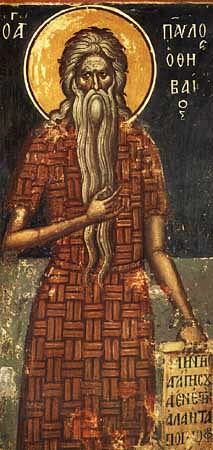 Venerable Paul of Thebes.
 Venerable Paul of Thebes. The 2 lions helped Saint Anthony to bury Saint Paul after death.
 Athonite Fresco of Saint John Calabytes.
 Saint Ãte of Killeedy.
(Church of Our Lady and St. Kieran, Ballylooby, County Tipperary, Ireland)
.jpg)


Notes
- The notation Old Style or (OS) is sometimes used to indicate a date in the Julian Calendar (which is used by churches on the "Old Calendar").
The notation New Style or (NS), indicates a date in the Revised Julian calendar (which is used by churches on the "New Calendar"). - Present in Menologium Basilii, Menaea Sirmundii and Menologium Sirleti.
- Venerable Salome, along with St. Perozhavra of Sivnia, a noblewoman who was married to the ruler of the Kartli region, were the helpers and closest companions of Saint Nino, Equal-to-the-Apostles and Enlightener of Georgia (335).
- The Venerable Saint Alexander was essentially the founder of the Monastery of the Unsleeping Ones ("the Ever-Vigilant" - Grk: Îονὴ á¼ÎºÎ¿Î¹Î¼Î®ÏÏν). This is how the monks of the East were called, who lived communally and were divided into groups, commemorating God in succession perpetually throughout the day and night, so that unceasing prayer would never cease in their monastery. See also: December 29 for another Saint commemorated from this monastery - Venerable Marcellus, Abbot of the Monastery of the Unsleeping Ones ("the Ever-Vigilant"),(485).
- He ordained St Felix. During the persecution of Decius he fled to the mountains, where he nearly died of exposure and hunger. He reposed in Nola worn out by the hardships he had endured for the Faith.
- "In the diocese of Angers, St. Maur, abbot and disciple of St. Benedict. He made great progress with so able a master, for while he was still under the Saint's instruction he miraculously walked upon the water - a prodigy unheard of since the days of St. Peter. Sent later to France by St. Benedict, he built a famous monastery, which he governed for forty years, and after performing striking miracles, he rested in peace.[16]
- St Bede dedicated his Ecclesiastical History to him. He ended his days as a monk at Lindisfarne.
- "The fervent piety of Ceolwulf led him to seek the means of greater perfection in the religious state, and after governing his people a few years, he took refuge at Lindisfarne. There he led a holy life for many years, an example of true contempt for the vanities of the world. Eventually his relics were taken to the Church of Norham, and the translation was marked by many miracles."[19]
- On January 15, 1998, under Patriarch Petros VII of Alexandria, the restoration of the Holy and God-bearing Father took place after being expelled from the Alexandrian Church, and so in the Alexandrian Patriarchal Synod on this day it was announced:
"With great care the Holy and Sacred Synod, bends down with the fear of God and before the icon of the Saint found in the Synodal Hall, and we declare the restoration to canonical order and beseech forgiveness from our Holy Father Nektarios for the persecution and unjust wrath against him, by the spiteful influence of the evil one."[29]