January 18 (Eastern Orthodox liturgics)
Day in the Eastern Orthodox liturgical calendar
From Wikipedia, the free encyclopedia
January 17 - Eastern Orthodox liturgical calendar - January 19

All fixed commemorations below are observed on January 31 by Eastern Orthodox Churches on the Old Calendar.[note 1]
For January 18th, Orthodox Churches on the Old Calendar commemorate the Saints listed on January 5.
Saints
- Martyr Theodula[1] and her companions Helladius, Theodoulos, Boethius, Evagrius, and Macarius,[2] of Anazarbus, Cilicia (c. 304)[3]
- Martyr Xenia, by fire[4]
- Saint Athanasius the Great, Patriarch of Alexandria (373)[3][5][6]
- Venerable Marcian, Monk of Cyrrhus, Syria (c. 388)[3][7][8]
- Venerable Silvanus (Sylvanus) the Ascetic of Gaza, Palestine (before 414)[9][10]
- Saint Cyril, Patriarch of Alexandria (444)[3][11][12]
- Venerable Ephraim (Ephraimios), Bishop of Mylasa, Caria, Asia Minor (5th century)[13][14][note 2]
Pre-Schism Western saints
- Virgin Martyr Prisca, venerated from ancient times in Rome, where a church is dedicated to her on the Aventine (1st or 3rd century)[15]
- Martyrs Archelais, Thecla and Susanna, three holy virgins, at Salerno (293)[15][note 3] (see also: June 6)
- Saint Volusianus of Tours, a married senator who was chosen Bishop of Tours in France and shortly after driven out by Arian Visigoths (496)[15]
- Saint Liberata of Como, a holy virgin in Como in Italy where with her sister Saint Faustina she founded the convent of Santa Margarita (580)[15]
- Saint Leobardus the Recluse of Marmoutier, Gaul (593)[3][15]
- Saint Ninnidh of Inishmacsaint (Inismacsaint), Ireland (6th century)[3] (see also: January 17)
- Saint Deicolus, one of the twelve disciples to accompany St. Columbanus in his missionary enterprise (625)[15][note 4]
- Saint Ulfrid (Wolfred, Wulfrid, Wilfrid), missionary in Germany and Sweden, martyred for destroying an image of Thor (1028)[14][15][note 5][note 6]
Post-Schism Orthodox saints
- Venerable Ephraim the Lesser (the Philosopher) of Georgia (1101)[3][18]
- Venerable Cyril, Abbot of Kiev (1146)[3]
- Saint Joachim I, Patriarch of Tarnovo (Turnovo, Trnovo) and Bulgaria (1248)[3][19][20]
- Venerable Schemamonk Cyril and Schemanun Maria (both c. 1337), parents of Saint Sergius of Radonezh[3][21][note 7]
- Saint Maximus the New of Serbia, Metropolitan of Wallachia (1516), son of Saint Stefan BrankoviÄ the Blind, Despot of Serbia[3][22][23][24]
- Venerable Athanasius, Monk of Valaam Monastery and Abbot of Syamzha (Syadem, Syandema, Syandemsk, Syandemsky), Vologda Oblast (1550)[3][25][26]
- Righteous Athanasius, Fool for Christ of Novolotsk (Navolotsk) Monastery, Karelia (16th-17th centuries)[3][27][28]
- Venerable Christophoros "Papoulakos" (Panayiotopoulos), missionary monk and defender of Orthodoxy in the new Kingdom of Greece (1861)[29][30][31][note 8][note 9][note 10]
- Venerable Alexis Shushania, Hieromonk of Teklati, Georgia (1923)[3][33]
New martyrs and confessors
- New Hieromartyr Michael Kargopolov, Priest (1919)[9][34]
- New Hieromartyr Eugene Isadsky, Priest (1930)[9][34]
- New Hieromartyr Vladimir Zubkovich, Archpriest of Smolevichi, Belorussia (1937)[3][9]
- New Hieromartyrs Nicholas Krasovsky, Sergius Lebedev, and Alexander Rousinov, Priests (1938)[9][34]
Other commemorations
- Slaying of Bishop Paul de Ballester-Convallier of Mexico (1984)[3]
Icon gallery
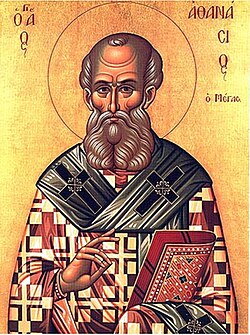 Saint Athanasius the Great.
 Saint Cyril of Alexandria.
 Saints Athanasius and Cyril of Alexandria
(Menologion of Basil II) Virgin-martyr Prisca.
 St. Sergius of Radonezh in front of the coffins of his parents: Venerable Schemamonk Cyril and Schemanun Maria.
 Saint Christophoros Panayiotopoulos ("Papoulakos"), missionary monk.


.jpg)


.jpg)
Notes
- The notation Old Style or (OS) is sometimes used to indicate a date in the Julian Calendar (which is used by churches on the "Old Calendar").
The notation New Style or (NS), indicates a date in the Revised Julian calendar (which is used by churches on the "New Calendar"). - Venerable Ephraimios is recorded in Sinai Codex 150.
- Three holy virgins of the Romagna in Italy who went to Nola in the Campagna in order to escape death, but there too they were accused of being Orthodox, were tortured, taken to Salerno and beheaded.
- A monk at Bangor in Ireland, he followed St. Columbanus to Burgundy in France, where he helped found the monastery of Luxeuil. Later he founded a second monastery in Lure in the Vosges.
- "He was an Englishman of great learning and virtue; and preached the faith, first in Germany; afterwards in Sweden, under the pious king Olas II, who first took the title of king of Sweden; for his predecessors had only been styled kings of Upsal. The good bishop converted many to Christ, till in the year 1028, while he was preaching against the idol Tarstans or Thor, and hewing it down with a hatchet, he was slain by the pagans."[16]
- "In Sweden, the passion of ST. ULFRID, Martyr, who was an Englishman by birth, and went to preach to the pagans of that country. ULFRID, also called Wulfrid, was an Englishman, who, in obedience to a divine inspiration, quitted his native land, to preach the Gospel to the pagans of Sweden. His mission was attended with ample success, and many converts were made to the Faith. In his zeal for the destruction of the kingdom of Satan, in the presence of a multitude of people, he attacked the idol of Thor, and hewed it to pieces with an axe. Upon this, the furious idolaters immediately rushed upon the servant of God, and cruelly put him to death on the spot. They also treated his venerable remains with many insults, and cast them into a marsh, thus leaving them, until in better times Ulfrid was venerated as a Martyr of Christ. The commemoration in the old calendars is on the 18th of January."[17]
- See: (in Russian) ÐиÑилл и ÐаÑÐ¸Ñ Ð Ð°Ð´Ð¾Ð½ÐµÐ¶Ñкие. Ðикипедии. (Russian Wikipedia).
- His glorification was initially proposed by the Metropolis of Kalavryta, of the Church of Greece, with the proposal confirmed by the Greek Holy Synod in May 2023. It was then passed on to the Synod of the Patriarchate of Constantinople. He was glorified by the Ecumenical Patriarchate on August 30, 2024. The official communiqué of the Ecumenical Patriarchate was as follows:
(in Greek) "Î£Ï Î½ÎµÏιζομÎνÏν Ïῶν á¼ÏγαÏιῶν Ïá¿Ï á¼Î³Î¯Î±Ï καί ἹεÏá¾¶Ï Î£Ï Î½ÏÎ´Î¿Ï , αá½Ïη á¼ÏεÏάÏιÏεν á½Î¼Î¿ÏÏνÏÏ á½ ÏÏÏ Î³ÎνηÏαι δεκÏή ἡ εἰÏήγηÏÎ¹Ï Ïá¿Ï á¼Î³Î¹ÏÏάÏÎ·Ï á¼ÎºÎºÎ»Î·ÏÎ¯Î±Ï Ïá¿Ï á¼Î»Î»Î¬Î´Î¿Ï ÏεÏί καÏαÏάξεÏÏ Îµá¼°Ï ÏÏ á¼Î³Î¹Î¿Î»Ïγιον Ïá¿Ï á¼ÎºÎºÎ»Î·ÏÎ¯Î±Ï Ïοῦ μακαÏιÏÏοῦ μοναÏοῦ ΧÏιÏÏοÏÏÏÎ¿Ï Î Î±Î½Î±Î³Î¹ÏÏοÏοÏÎ»Î¿Ï Ïοῦ á¼ÏιλεγομÎÎ½Î¿Ï Î Î±ÏÎ¿Ï Î»Î¬ÎºÎ¿Ï , Ïá¿Ï Î¼Î½Î®Î¼Î·Ï Î±á½Ïοῦ á¼Î¿ÏÏαζομÎÎ½Î·Ï ÎºÎ±Ï᾿ á¼ÏÎ¿Ï Ïήν 18ην á¼¸Î±Î½Î¿Ï Î±ÏÎ¯Î¿Ï ."[31]
- In 1847, at nearly eighty years of age, the monk Christophoros Panayiotopoulos ("Papoulakos") c. 1770â1861, undertook a popular preaching mission in the villages of Achaea to revitalize the spiritual conditions of the people which were slowly becoming westernized with an Enlightenment ideology, affecting the sociological make up of the newborn Greek state within a decade.[32] Ultimately Papoulakos helped bring the Greek people back to their roots in Orthodoxy and the Christian ideal, for which he suffered much persecution from both the Church and State and died in exile, and is today renowned as a great ascetic and hero of modern Greece.
"Moving as he did amongst the people and seeing the consequences of the Bavarian government's policies, his preaching turned to contemporary politics. He fiercely denounced the autocephaly and the abolition of ancient metropolitan sees, which left the people shepherd-less. He condemned the dissolution of monasteries, foreign missionaries, and the non-Orthodox schools they had established and the exclusion of the sacred Scriptures (i.e., the Septuagint) from the schools. Behind these acts Papoulakos saw a clear aim: 'It is their purpose to ruin our religion.' And he lists the guilty: the English who controlled the state with their loan; the foreigners, the 'Luthero-Calvinists,' Bavarians and missionaries who were swamping Greece; Kairis, 'who had lit the match;' Pharmakidis, 'who had poured out the poison;' the Synod which had meekly accepted the foreigners' schemes and which Papoulakos calls 'polluted, diabolical, sealed with Armannsperg's seal.' "[32]
- See: (in Greek) ÎÎ³Î¹Î¿Ï Î§ÏιÏÏοÏÏÏÎ¿Ï Î Î±ÏÎ¿Ï Î»Î¬ÎºÎ¿Ï. ÎικιÏαίδεια. (Greek Wikipedia).