Kartik Naach
Dance musical
From Wikipedia, the free encyclopedia
Kartik Naach (Newar: कात्तिक प्याखं) is a Newar language musical theatre performed in the month of Kartik (October or November) in Nepal.[1] It was started in 1641 AD by King Siddhi Narsingh Malla.[2][3][4] The play is performed in Kartik Dabali, Patan Durbar Square every year.[3][5]
.jpg)
Actors performing Kartik naach | |
| Native name | Kārtik Pyākhan |
|---|---|
| Genre | Religious |
| Year | 1641 CE |
| Origin | Kingdom of Lalitpur |
It is usually presented for two to 27 days with 17 tales of Hindu god Vishnu.[3][4] Originally it was shown for two days, but Narsingh Malla's son Srinivas Malla added seven days, and Narsingh Malla's grandson Yog Narendra Malla added 15.[4]
Background
The play was preserved by Kartik Naach Prabandhan Samiti, but the Kartik Nach Preservation Committee (KNPC) has been preserving it since 2013.[3] The play usually starts with dancers in colourful clothes portraying Hindu deities including Barahi, Ganesh, Shiva, and Krishna.[4] The dancers also wear festoons around their necks.[4] It is performed by Newar people and in 2015, there were "45 musicians and 10 helpers" performing.[4]
It is also performed near the golden window in Patan and the window is opened only at the play. Legends say that it was built to honour the King Siddhi Narsingh Malla.[6][7] Most of the dances and music is thought to have been composed by Narsingh Malla, but there have been minor changes to it.[8] Hari Man Shrestha, previously a director of KNPC, has penned a book on the play.[8]
The April 2015 Nepal earthquake critically damaged Patan Durbar Square.[citation needed] Seven months later, Kartik Naach was performed for 10 nights, while it was still damaged.[citation needed] Xinhua News Agency wrote, "Despite the tragedy, thousands of Nepali people, young and old, trooped to the temple to watch the open-air presentation of the historical dance-drama to the accompaniment of folk music".[citation needed] In 2018, Lalitpur had distributed 200,000 Nepalese rupees to the play.[2]
Gallery
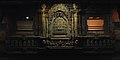 The golden window that is opened once a year.
 Newar musicians performing
_(cropped).jpg)
_(cropped).jpg)
