Keikyu 1500 series
From Wikipedia, the free encyclopedia
| Keikyu 1500 series | |
|---|---|
 6-car set 1537 in July 2021 | |
| Manufacturer | Tokyu Car Corporation, Kawasaki Heavy Industries |
| Constructed | 1985–1991 |
| Entered service | 1985 |
| Refurbished | 2002– |
| Scrapped | 2022– |
| Number built | 166 vehicles (28 sets) |
| Number in service | 138 vehicles (22 sets) |
| Number scrapped | 28 vehicles (6 sets) |
| Formation | 4/6/8 cars per trainset |
| Fleet numbers |
|
| Operators | Keikyu |
| Specifications | |
| Car body construction | Aluminium, steel (sets 1501 to 1517) |
| Car length | 18,000 mm (59 ft 1 in) |
| Width | 2,830 mm (9 ft 3 in) |
| Doors | 3 pairs per side |
| Maximum speed | 120 km/h (75 mph)[1] |
| Traction system | Field chopper Variable frequency (GTO/IGBT) |
| Electric system(s) | 1,500 V DC Overhead catenary |
| Current collection | Pantograph |
| Multiple working | 600 series, N1000 series, 2100 series |
| Track gauge | 1,435 mm (4 ft 8+1⁄2 in) |
The Keikyu 1500 series (京急1500形) is an electric multiple unit (EMU) train type operated by private railway operator Keikyu on commuter services in the Tokyo area of Japan since 1985.[1]
The eight-car sets are primarily used on limited-stop "Rapid Limited Express" and "Limited Express" services on the Keikyu Main Line, including through-running services to and from the Toei Asakusa Line and the Keisei Oshiage Line.[1] The four- and six-car sets are mostly used on all-stations "Local" services.[1] The 1500 series sets can be used in multiple with other Keikyu EMU types, including the 600 series, N1000 series, 2000 series, and 2100 series.[1]
Formations

As of March 2023, the fleet consists of 138 vehicles formed as six-car, and eight-car sets, as follows.[2]
4-car sets 1501 to 1525
| Designation | M1c | M2 | M1 | M2c |
|---|---|---|---|---|
| Numbering | 15xx | 15xx | 15xx | 15xx |
- The "M1c" and "M1" cars are each fitted with one lozenge-type pantograph.[2]
- Sets 1501 to 1517 have steel bodies, all of which are now retired as of March 2023.[3] All other sets have aluminum bodies. [2]
6-car sets 1529 to 1549, 1561 to 1593
15 six-car formed by adding two 1900 trailer cars to four-car sets. Sets 1561 to 1593 were originally numbered 1601 to 1649.[citation needed]
| Designation | M1c | M2 | Tu | Ts | M1 | M2c |
|---|---|---|---|---|---|---|
| Numbering | 1xxx | 1xxx | 19xx | 19xx | 1xxx | 1xxx |
- The "M1c" cars are fitted with one lozenge-type pantograph, and the "M1" cars are fitted with two.[2]
8-car sets 1701 to 1731
5 eight-car sets formed by adding two 1900 trailer cars to six-car sets.
| Designation | M1c | M2 | Tu | Ts | M1 | M2 | M1 | M2c |
|---|---|---|---|---|---|---|---|---|
| Numbering | 17xx | 17xx | 19xx | 19xx | 17xx | 17xx | 17xx | 17xx |
- The "M1c" and end "M1" cars are each fitted with one lozenge-type pantograph, and the centre "M1" cars are fitted with two.[2]
Interior
Passenger accommodation consists of longitudinal bench seating throughout.[1]
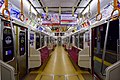 Interior view

History

The 1500 series fleet was built between 1985 and 1991.[1] The first five four-car sets delivered had steel bodies, while all subsequent sets had aluminium bodies with door pocket windows discontinued.[1] Sets built from 1990 onward used VVVF control.[1]
A programme of life-extension refurbishment commenced in 2002. This involved adding new air-conditioning units, removing the original door pocket windows of the steel bodied cars, and adding front-end skirts.[1]
On 24 September 2012, set 1701 derailed between Oppama Station and Keikyu Taura Station. It was since retired and was replaced by Keikyu N1000 set 1169.[citation needed]
Withdrawal
As part of Keikyu's investment plan for fiscal 2022, withdrawals of the four-car steel-bodied sets commenced in May 2022 with the introduction of new 4-car stainless steel N1000-1890 series sets.[3]


