Keikyu 2000 series
From Wikipedia, the free encyclopedia
| Keikyu 2000 series | |
|---|---|
 8-car set 2011 in November 2017 | |
| In service | December 1982–2018 |
| Manufacturer | Tokyu Car Corporation, Kawasaki Heavy Industries |
| Replaced | Keikyu 700 series (1956) |
| Refurbished | 1998 |
| Scrapped | 2012–2018 |
| Number built | 72 vehicles (12 sets) |
| Number in service | None |
| Number scrapped | 36 vehicles (7 sets) |
| Formation | 4/8 cars per trainset |
| Fleet numbers |
|
| Operators | Keikyu |
| Specifications | |
| Car body construction | Steel |
| Maximum speed | 120 km/h (75 mph) |
| Traction system | Toyo Denki resistor control with field chopper control (electric camshaft) |
| Traction motors | Toyo Denki and Mitsubishi Electric DC compound motor |
| Electric system(s) | 1,500 V DC |
| Current collector(s) | overhead wire |
| Braking system(s) | Regenerative braking |
| Track gauge | 1,435 mm (4 ft 8+1⁄2 in) |
| Notes/references | |
 | |
The Keikyu 2000 series (京急2000形) was an electric multiple unit (EMU) train type operated by the private railway operator Keikyu on commuter services in the Tokyo area of Japan from 1982 until 2018. Originally introduced to replace the earlier 600 series sets on limited-stop Limited Express (快特, Kaitoku) services, they were rebuilt with an additional pair of doors per side and longitudinal seating from 1998 for reassignment to regular commuter services.[1]
8-car sets
As of 1 April 2016[update], the fleet consisted of five eight-car sets and one four-car set (classified 2400 series).[2] The last remaining four-car set was withdrawn from service in October 2016.[3]
The eight-car sets are formed as follows, with six motored (M) cars and two trailer (T) cars.[2]
| Designation | M1c | M2 | M3 | Tu | Ts | M1 | M2 | M3c |
|---|---|---|---|---|---|---|---|---|
| Numbering | 20x1 | 20x2 | 20x3 | 20x4 | 20x5 | 20x6 | 20x7 | 20x8 |
- The "x" in the car numbers corresponds to the set number.
- The two "M2" cars are each fitted with two lozenge-type pantographs.[2]
4-car sets
The four-car sets were formed as follows, with three motored (M) cars and one trailer (T) car.[2]
| Designation | M1c | M2 | T | M3c |
|---|---|---|---|---|
| Numbering | 24x1 | 24x2 | 24x3 | 24x4 |
- The "x" in the car numbers corresponded to the set number.
- The "M2" cars were fitted with two lozenge-type pantographs.[2]
Liveries
When delivered, the sets were initially painted in vermillion red with white around the side windows. From 1998, when converted to regular commuter use, they were repainted into all-over vermillion red with a white bodyside stripe.[1]
From January 2013, set 2011 was repainted into the original livery of vermillion with white window surrounds to mark the 30th anniversary of the 2000 series. It remained in this livery for approximately two years.[4]
 Original livery in August 2000
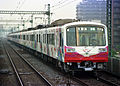 "Mirai" promotional livery in May 1988
 Later commuter style livery in July 2006
 Set 2011 repainted into its original style livery in February 2013


Interior
 Original 2-door configuration with transverse seating in August 2000
 Later 3-door commuter configuration with longitudinal seating in September 2010


