Linear optics
From Wikipedia, the free encyclopedia
Linear optics is a sub-field of optics, consisting of linear systems, and is the opposite of nonlinear optics. Linear optics includes most applications of lenses, mirrors, waveplates, diffraction gratings, and many other common optical components and systems.[1]
If an optical system is linear, it has the following properties (among others):
- If monochromatic light enters an unchanging linear-optical system, the output will be at the same frequency. For example, if red light enters a lens, it will still be red when it exits the lens.
- The superposition principle is valid for linear-optical systems. For example, if a mirror transforms light input A into output B, and input C into output D, then an input consisting of A and C simultaneously give an output of B and D simultaneously.
- Relatedly, if the input light is made more intense, then the output light is made more intense but otherwise unchanged.
These properties are violated in nonlinear optics, which frequently involves high-power pulsed lasers. Also, many material interactions including absorption and fluorescence are not part of linear optics.[1]
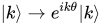
As an example, and using the Dirac bracket notations (see bra-ket notations), the transformation is linear, while the transformation is non-linear. In the above examples, is an integer representing the number of photons. The transformation in the first example is linear in the number of photons, while in the second example it is not.[clarification needed] This specific nonlinear transformation plays an important role in optical quantum computing.


Linear versus nonlinear optical devices (examples)
Phase shifters and beam splitters are examples of devices commonly used in linear optics.
In contrast, frequency-mixing processes, the optical Kerr effect, cross-phase modulation, and Raman amplification, are a few examples of nonlinear effects in optics.
