Abkhazians
Northwest Caucasian ethnic group native to Abkhazia
From Wikipedia, the free encyclopedia
The Abkhaz people,[b] sometimes referred to as the Abkhazians, are a Northwest Caucasian ethnic group mainly living in Abkhazia — a region on the northeastern coast of the Black Sea which is internationally recognized as part of Georgia but is de facto outside of its control.[16] A large Abkhaz diaspora population also resides in Turkey, Egypt, Syria and Russia.

 | |
| Regions with significant populations | |
 Abkhazia[a] Abkhazia[a] | 122,175 (2011 census)[1] |
 Turkey Turkey | 30,000–500,000[2][3][4][5] |
 Egypt Egypt | 15,000[6] |
 Syria Syria | c. 10,000[7] |
 Russia Russia | 8,177 (2021 census)[8] |
 Germany Germany | 5,100[citation needed] |
 Jordan Jordan | c. 4,000[9] |
 Ukraine Ukraine | 1,458 (2001)[10] |
 Georgia Georgia | 864 (2014)[11] |
 Netherlands Netherlands | 800[12] |
 Latvia Latvia | 22 – 29 (2021)[13][14] |
| Languages | |
| Abkhaz (native), Russian, Georgian, Turkish | |
| Religion | |
| Majority Sunni Islam (in Turkey), Minority Abkhazian Orthodox Christianity (in Abkhazia) or with Abkhaz native faith minority[15] | |
| Related ethnic groups | |
| Abazins, Circassians, Ubykhs | |
History
Some scholars say the ancient Heniochi tribe were the progenitors of the Abkhaz.[17] This warlike people came into contact with Ancient Greeks through the Greek colonies of Dioskourias and Pitiuntas.[17] In the Roman period, the Abasgoi/Abasgi are mentioned as inhabiting the region.[17] These Abasgoi (Abkhaz) were described by Procopius as warlike, worshippers of three deities.[17]
.jpg)

The Abasgi, living in modern Abkhazia, were part of the Lazian Empire (also known as Egrisi, a state in the territory of western Georgia). Their monarch was appointed by the Laz king, contingent upon the approval of the Byzantine emperor.[18] After the decline of the Kingdom of Egrisi, Abasgian prince Leon I acquired Egrisi with the Byzantine support in the 7th century. [19] After expanding to the western Georgia, Abasgia was transformed into the kingdom with a capital in Kutaisi. The kingdom soon adopted the Georgian language instead of Greek. In 978, Abkhazia united with the eastern Georgian kingdom through dynastic sucession, which resulted in the formation of the Kingdom of Georgia.[20]
Towards the end of the 17th century, the region became a theatre of widespread slave trade and piracy. According to a controversial theory developed by Pavle Ingorokva in the 1950s, at that time a number of the Northwest Caucasian pagan Abaza tribes migrated from the north and blended with the local ethnic elements, significantly changing the region's demographic situation. These views were described as ethnocentric and having little historical support.[21][22]
The region came under the under the sway of the Ottoman Empire in the 16th century and the population was gradually Islamized in the 16-17th centuries.[23]

The Russian conquest of Abkhazia from the 1810s to the 1860s was accompanied by a massive expulsion of Muslim Abkhaz to the Ottoman Empire (the Christian Abkhaz were largely spared from the deporations) and the introduction of a strong Russification policy. As a result, the Abkhaz diaspora is currently estimated to measure at least twice the number of Abkhaz that reside in Abkhazia. The largest part of the diaspora now lives in Turkey, with estimates ranging from 100,000 to 500,000, with smaller groups in Syria (5,000 – 10,000) and Jordan. In recent years, some of these have emigrated to the West, principally to Germany (5,000), Netherlands, Switzerland, Belgium, France, United Kingdom, Austria and the United States (mainly to New Jersey).[24][25] The teaching of the Russian language to the Abkhaz replaced Georgian with Russian as the second language for the Abkhaz, leading to the alienation of Abkhazians from Georgians despite their common historical heritage with the Georgians.[25] The policy of Russification in Georgia included fostering minority languages, such as Abkhaz, through the creation of alphabets[c] for and the preparation of elementary textbooks in these languages to obviate the use of Georgian as the language of culture and the vehicle of everyday literacy.[26]
Some Abkhazians fought for Greece and worked for the Greek authorities during the Greco-Turkish War. After its end, thousands of Abkhazians, especially from Adapazarı, Düzce, Hendek and Bolu, fled to Greece in order to avoid ethnic persecution by the Turks.[27]
.jpg)
The 1992–1993 War in Abkhazia followed by the ethnic cleansing of Georgians in Abkhazia left the Abkhaz an ethnic plurality of ca. 45%, with Russians, Armenians, Georgians, Greeks, and Jews comprising most of the remainder of the population of Abkhazia. The 2003 census established the total number of Abkhaz in Abkhazia at 94,606.[1] However, the exact demographic figures for the region are disputed and alternative figures are available.[28] The de facto Abkhaz president Sergey Bagapsh suggested, in 2005, that less than 70,000 ethnic Abkhaz lived in Abkhazia.[29]
At the time of the 2011 Census, 122,175 Abkhaz were living in Abkhazia. They were 50.8% of the total population of the republic.[30]
In the course of the Syrian uprising, a number of Abkhaz living in Syria immigrated to Abkhazia.[7] By mid-April 2013, approximately 200 Syrians of Abkhaz descent had arrived in Abkhazia.[31][32] A further 150 were due to arrive by the end of April.[31] The Abkhazian leadership has stated that it would continue the repatriation of Abkhaz living abroad.[32] As of August 2013, 531 Abkhaz had arrived from Syria according to the Abkhazian government.[33]
Ethnology
The Abkhaz language belongs to the isolate Northwest Caucasian language family, also known as Abkhaz–Adyghe or Pontic family, which groups the dialectic continuum spoken by the Abaza–Abkhaz (Abazgi) and Adyghe ("Circassians" in English).[34] Abkhazians are closely ethnically related to Circassians.[35]
Subgroups
There are also three subgroups of the Abkhaz people. The Bzyb (Бзыԥ, Bzyph) reside in the Bzyb River region, and speak their own dialect.[36] The Abzhui (Абжьыуа, Abzhwa) live in the Kodori River region, and also speak their own dialect, which the Abkhaz literary language is based upon.[36] Finally, there are the Samurzakan who reside in the southeast of Abkhazia.[36]
Economy
The typical economy is strong on the breeding of cattle, beekeeping, viticulture, and agriculture.[36]
Religion
.jpg)
The Abkhaz people are principally divided into Abkhazian Orthodox Christian (the Abkhazian Orthodox Church is not recognized by any of the world Orthodox churches, but the territory is recognized as the Eparchy of Bichvinta and Tskhum-Abkhazia of the Georgian Orthodox Church) and Sunni Muslim (Hanafi) communities,[36] (prevalent in Abkhazia and Turkey respectively) but the indigenous non-Abrahamic beliefs have always been strong.[37] Although Christianity made its first appearance in the realm of their Circassian neighbours in the first century AD via the travels and preaching of the Saint Andrew,[38] and became the dominant religion of Circassians in the 3rd to 4th centuries, Christianity became the dominant religion of Abkhazians in the 6th century during the reign of Byzantine emperor Justinian I, and continued to be followed under the kings of Georgia in the High Middle Ages. The Ottomans introduced Islam in the 16th century and the region became largely Muslim gradually until the 1860s.[39]
Diaspora

Many Muslim Circassians, Abkhaz and Chechens migrated to the Ottoman Empire following revolts against Russian rule.[40] It is believed that the Abkhaz community in Turkey is larger than that of Abkhazia itself.[40] Some 250 Abkhaz-Abaza villages are estimated throughout Turkey.[40] According to Andrew Dalby, Abkhazian-speakers might number more than 100,000 in Turkey,[41] however, the 1963 census only recorded 4,700 native speakers and 8,000 secondary speakers.[42] Most Abkhaz speakers in Turkey have assimilated into Turkish society.[43] In Egypt, the largest Circassian clan in the country, the Abaza family, originated from Abkhazia and is "deeply rooted in Egyptian society... [and] in the history of the country".[44] It also contributed to Egyptian and Arabic cultural literary, intellectual, and political life starting with the reign of Muhammad Ali Pasha in Egypt and continuing to the modern day.[45][46][47][48]
Genetics
Gallery

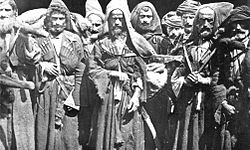 Abkhazs in the mid-19th century

Notable people
Literature
- Alexey Gogua (1932-2025), writer
- Dmitry Gulia (1874–1960), Abkhazian Soviet writer and poet
- Fazil Iskander (1929–2016), writer
- Bagrat Shinkuba (1917–2004), writer, poet
- Aziz Pasha Abaza (1898 – 1973) poet
- Fekry Pasha Abaza (1895 – 1979) a journalist, writer and democratic political activist
- Tharwat Abaza (1927 – 2002) novelist and journalist
Politics
- Aslan Bzhania (born 1963), Abkhaz politician
- Alexander Ankvab (born 1952), Abkhaz politician
- Anzor Kudba (born 1939), member of Supreme Council of the Republic of Georgia from 1990 to 1992
- Aslan Smirba (born 1959), mayor of Batumi from 1997 to 1999 and member of the Parliament of Georgia from 1999 to 2004
- Gennadi Gagulia (1948–2018), Abkhazian politician
- Hayreddin Pasha (1820–1890), Ottoman politician
- Mirab Kishmaria (born 1961), Abkhaz politician and army general
- Nestor Lakoba (1893–1936), Abkhaz communist leader
- Rauf Orbay (1881–1964), Turkish politician
- Raul Khajimba (born 1958), Abkhazian politician
- Rauf Orbay (1881–1964), Turkish naval officer and diplomat
- Shaaban Abash (1890–1943), rider in the Circassian cavalry regiment of the Caucasian native division during WWI
- Sergei Bagapsh (1949–2011), President of Abkhazia
- Vladimir Arshba (1959–2018), Abkhaz soldier and politician
- Vladislav Ardzinba (1945–2010), first de facto president of Abkhazia
- Abaza family a diaspora family that produced a large number of politicians
Other
- Mikhail, Prince of Abkhazia (1806–1866)
- Hala Gorani, American journalist[58]
- Rushdy Abaza Arabic-language actor