Maharam algebra
From Wikipedia, the free encyclopedia
In mathematics, a Maharam algebra is a complete Boolean algebra with a continuous submeasure (defined below). They were introduced by Dorothy Maharam in 1947.[1]
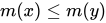
A continuous submeasure or Maharam submeasure on a Boolean algebra is a real-valued function m such that
- and if .
- If , then .
- .
- If is a decreasing sequence with greatest lower bound 0, then the sequence has limit 0.






A Maharam algebra is a complete Boolean algebra with a continuous submeasure.