May 15 (Eastern Orthodox liturgics)
Day in the Eastern Orthodox liturgical calendar
From Wikipedia, the free encyclopedia
May 14 - Eastern Orthodox Church calendar - May 16

All fixed commemorations below celebrated on May 28 by Orthodox Churches on the Old Calendar.[note 1]
For May 15th, Orthodox Churches on the Old Calendar commemorate the Saints listed on May 2.
Saints
- The Seven Apostolic Men, Martyr Bishops, ordained in Rome by Saints Peter and Paul, and sent to evangelize Spain (1st century):[1][2][3][4][5]
- Saint Achillius (Achillios), Bishop of Larissa (330)[1][6][7]
- Saint Pachomius the Great, founder of cenobitic monasticism (348)[1][8][9]
- Saint Silvanus of Tabennisi, disciple of Saint Pachomius the Great (in the Thebaid) (4th century)[10]
- Saint Pyrrhus of Breti, one of Thirteen Assyrian Fathers (6th century)[11]
- Saint Barbarus the Myrrh-gusher of Greece (c. 820â 829)[1][12]
Pre-Schism Western saints
- Martyrs Cassius, Victorinus, Maximus, and their companions, in the Auvergne, Clermont in France (c. 264)[3][4][note 2]
- Saint Eutychius of Ferento, Bishop, Martyr (270)[13]
- Martyr Simplicius of Olbia, Bishop, in Sardinia (c. 284â305)[3][4][14]
- Virgin recluse Caesarea of Otranto.[4][15]
- Saint Liberator, Bishop, Martyr.[16][note 3][note 4]
- Saint Reticius, bishop of Autun (4th century)[16]
- Saint Hilary of Galeata (Hilary of Tuscany), founder of the monastery called Galeata, later known as Sant'Ilaro (Sant'Ellero di Galeata) (558)[4][17]
- Saint Colmán of Oughaval (Colman mac Ua Laoighse, Colman Mc O'Laoighse), a disciple of St Columba and St Fintan of Clonenagh (6th century)[4][note 5]
- Virgin-martyr Dymphna of Geel, Flanders, and Hieromartyr Gerebern,[18] Presbyter (c. 650)[1][3][4][19][20]
- Saint Waldalenus, founder of Bèze Abbey in France (7th century)[4]
- Saint Bercthun (Bertin), a disciple of St John of Beverley and first Abbot of Beverley in England (733)[4][21]
- Saint Bertha of Bingen (c. 757), and her son Saint Rupert of Bingen (732)[4]
- Saint Witesind of Córdoba, martyr (855)[22]
- Saint Hallvard Vebjørnsson of Husaby, Norway (1043)[1][23] (see also: May 14 - West)
Post-Schism Orthodox saints
- Saint Panegyrios of Cyprus (Panigerios, Panegyrius), Wonderworker of Malounta.[24][25][26][note 6]
- Saint Anastasia of Latra.[27]
- Saint Isaiah of Rostov, Bishop and Wonderworker (1090)[1][28][29]
- Saint Isaiah of the Kiev Caves, Wonderworker (1115)[1][30][31]
- Saint Andrew the Hermit, of Mt. Kalana, Epirus, Wonderworker (c. 1237â1271)[1][32]
- Saint Pachomius of Nerekhta, Abbot (1384),[1][33][34][note 7] and Saint Silvanus of Nerekhta (14th century)[1][23]
- Saint Cali of Anatolia (14th century)[27]
- Saint Euphrosynus of Pskov (Eleazar), Abbot and Wonderworker (1481)[1][35][36]
- Saint Pachomius of Keno Lake Monastery (1525)[40][note 9]
- Saint Demetrius of Moscow the Wonderworker, Slain Crown Prince (1591)[1][41][42]
- Saint James of Putna, Metropolitan of Moldavia (1778)[43]
- Saint Elias (Chebotarev) of Verkhoturye, Schemamonk (1900)[44]
- Saint Arethas (Katargin) of Valaam and Verkhoturye, Archimandrite (1903)[1][23][45]
New martyrs and confessors
- New Hieromartyrs:
Other commemorations
- Discovery of the revered icon of Kamoulianos "Acheiropoieta" ("made without human hands").[49][note 11]
- Translation of the sacred relics of the Holy Apostle Titus of Crete, from Venice (which had taken the relics in 1669), back to the Greek Orthodox Archdiocese of Crete (1966)[50]
- Uncovering of the relics (1846) of Saint Tikhon, Bishop of Voronezh, wonderworker of Zadonsk (1783)[51][note 12]
- Uncovering of the relics (1991) of Saint Arsenius of Konevits (1447)[1][52][note 13]
- Uncovering of the relics (2012) of Saint Elias (Ganzha) of Makeevka (1946)[53]
Icon gallery

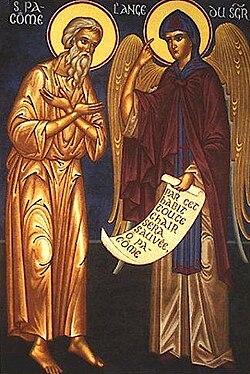 St. Pachomius the Great.
 Sts. Achillius of Larissa and Pachomius the Great.
 St. Cassius of Clermont.
 Tomb of Saint Hilary of Galeata.
 Virgin-martyr Dymphna of Geel, Flanders.
 St. Bertha of Bingen.
 Saint Hallvard Vebjørnsson of Husaby, Norway.
 St. Isaiah of Rostov.
 St. Pachomius of Nerekhta.
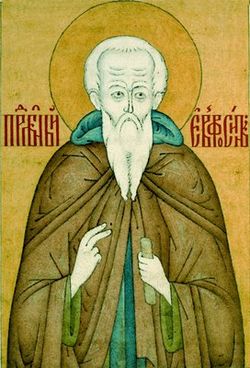 St. Euphrosynus of Pskov.
 St. Dmitry of Uglich.
_-_Achillios.jpg)
.jpg)


.jpg)


Notes
- The notation Old Style or (OS) is sometimes used to indicate a date in the Julian Calendar (which is used by churches on the "Old Calendar").
The notation New Style or (NS), indicates a date in the Revised Julian calendar (which is used by churches on the "New Calendar"). - See: (in Italian) San Liberatore. Wikipedia. (Italian Wikipedia).
- The exact origins and significance of Saint Liberator remain unclear. He lived in an indefinite period and in an unspecified territory of the Roman Empire, and was a victim of anti-Christian persecution.
Although the Latin name 'Liberator' , is the same as the Greek word 'Eleutherius' â which could suggest a possible conflation with Greek Saints named Eleutherius â nevertheless the origins of Saint Liberator are not explicitly detailed in the available sources. - "He practised ascesis in the village of Malounta, in the diocese of Leucosia in Cyprus."[25]
It is unknown when Saint Panegyrios lived, but from his Divine Service it seems that he may have lived during the period of the Arab raids (c. 7th-12th centuries), when different parts of Cyprus had come under Arab rule, at different periods. He taught the Christian way to the Christians and discouraged them from converting to Islam by telling them that Islam as a religion was a delusion. - See: (in Russian) ÐÐ°Ñ Ð¾Ð¼Ð¸Ð¹ ÐеÑÐµÑ ÑÑкий. Ðикипедии. (Russian Wikipedia).
- See also: September 8.
- See also: January 31 - Slavic.
- See: (in Russian) ÐÐ°Ñ Ð¾Ð¼Ð¸Ð¹ (ÐедÑов). Ðикипедии. (Russian Wikipedia).
- The commemoration of this feast is included in the Codex Athous Lavrensis (8th/9th century)
- See: (in Russian) ÐÑÑений ÐоневÑкий. Ðикипедии. (Russian Wikipedia).