May 16 (Eastern Orthodox liturgics)
Day in the Eastern Orthodox liturgical calendar
From Wikipedia, the free encyclopedia
May 15 - Eastern Orthodox Church calendar - May 17

All fixed commemorations below celebrated on May 29 by Orthodox Churches on the Old Calendar.[note 1]
For May 16th, Orthodox Churches on the Old Calendar commemorate the Saints listed on May 3.
Saints
- Hieromartyr Alexander of Jerusalem, Archbishop (251)[1][2][note 2]
- Saint Papylinus the Martyr, by the sword.[4][5]
- Martyrs Bachtisius, Isaac and Symeon of Persia (339)[1][6][note 3]
- Saint Theodore the Sanctified of Tabennisi, disciple of Saint Pachomios the Great (367)[1][7]
- Martyrs Abda (Audas) and Abdjesus (Audiesus), successive bishops of Beth-Kashkar, and 38 other martyrs in the Persian Empire, under Ardashir II (376), including:[1][8][9][note 4]
- 16 priests, 9 deacons, 6 monks, and 7 unnamed virgins, in Persia.
- Saint Neadius (Neadios), Bishop and Wonderworker.[5][10][note 5]
- Saint Bardas, founder of the monastery of the Forerunner in Petra, Constantinople (5th-6th century)[1][12]
- Martyrdom of the 44 Holy Sabaite fathers, monk-martyrs of the Great Lavra of St. Sabbas the Sanctified, massacred by the Bedouins (614)[1][9][13][14][note 6][note 7]
- Martyr Peter of Blachernae (761)[1][5][16][note 8]
- Saint Thomas I, Patriarch of Jerusalem (820)[1][5]
- Saint George of Mitylene, Bishop (821 or 842)[1][17][note 9]
- Saint Nicholas Mystikos, Patriarch of Constantinople (925)[1][19]
Pre-Schism Western saints
- Saint Fort (Fort de Bordeaux), first Bishop of Bordeaux in France, venerated as a martyr (c. 1st century?)[20][21][note 10]
- Saint Peregrinus, Bishop of Terni (138)[20][22]
- Saint Peregrine of Auxerre, martyr, the first bishop of Auxerre and the builder of its first cathedral (261 or 304)[9][20][23]
- Martyrs Felix and Gennadius, at Uzalis in Africa.[9][20][24]
- Martyrs Vitus, Modestus, and Crescentia at Lucania (c. 303)[1]
- Saint Hilary, Bishop of Pavia, one of the bishops in the north of Italy who fought against Arianism (376)[20]
- Saint Possidius, Bishop of Calama in Numidia in North Africa, a friend of Saint Augustine of Hippo (c. 370 - c. 440)[9][20]
- Saint Primael, ascetic, from Britain, he went to Brittany and became a hermit near Quimper (c. 450)[20]
- Blessed child-saint Musa of Rome (5th century)[1][note 11]
- Saint Carannog (Carantog, Caimach, Carnath), Welsh prince who aided St Patrick in the enlightenment of Ireland (5th century)[20][25]
- Saint Fidolus (Phal), Abbot at Isle-Aumont, south of Troyes (c. 540 - 549)[9][20][26][27]
- Saint Germerius, Bishop of Toulouse in France for fifty years (560)[20]
- Saint Brendan the Navigator, abbot of Clonfert (c. 577)[1][9][20][28][29]
- Saint Domnolus, Bishop of Le Mans (581)[9][20][30]
- Saint Carantoc, an abbot who founded the church of Llangrannog in Wales (6th century)[20][31][32][note 12]
- Saint Honoratus of Amiens, the seventh Bishop of Amiens (c. 600)[9][20][33]
- Saint Annobert (Alnobert), a monk at Almenêches, consecrated Bishop of Séez in France (c. 689)[20]
- Saint Franchy (Francovæcus), a monk at St Martin de la Bretonnière in France, later a hermit in the Nivernais, Diocese of Nevers (7th century)[20][note 13]
Post-Schism Orthodox saints
- Saints Cassian (1537) and Laurence (1548), disciples of Venerable Cornelius of Komel, Abbots of Komel ("Korneliev" Monastery), Vologda.[1][34]
- New Hieromartyr Teodor (NestoroviÄ) of VrÅ¡ac, Bishop of VrÅ¡ac in Banat, Serbia (1594)[1][35]
- New Martyr Nicholas of Metsovo, at Trikala, whose relics are at Meteora (1617)[1][36][37]
New martyrs and confessors
Other commemorations
- Foundation of the church of Saint Euphemia, near the Neorion (port facilities), by the Dolmabahçe Palace of Constantinople.[43]
- Uncovering of the relics (1545) of Saint Ephraim, Abbot of Perekop, Wonderworker of Novgorod (1492)[1][44][note 17]
- Commemoration of Saint Macarius (Notaras) of Corinth (1805) in the village of Myloi, Samos island.[45][note 18]
Icon gallery

 St. Theodore the Sanctified of Tabennisi.
 Skulls of monks killed by the Persians in 614 AD in Mar Saba, Kidron Valley, Palestine.
 Patriarch Nicholas Mystikos.
 Tomb of Saint-Fort, Basilica of Saint-Seurin, Bordeaux.
 The martyrdom of Vitus, Modestus, and Crescentia.
 Martyrdom of Saint Vitus.
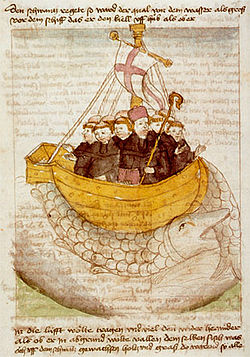 St. Brendan of Clonfert.
 St. Domnolus, Bishop of Le Mans, stained glass.
 St. Carantoc's Church, Crantock.
 Tympanum of the southern door of the Cathedral of Amiens, showing the life of Saint Honoratus of Amiens, including his appointment as bishop, and translation of his relics.
 New Hieromartyr Teodor (NestoroviÄ) of VrÅ¡ac, Bishop of VrÅ¡ac.
 Venerable Hieromonk Matthew of Yaransk, the Wonderworker.
 New Martyr Vukasin of Klepci.
 Reliquary of St. Euphemia, Hagios Georgios (Patriarchate) Church, Istanbul.


.jpg)


Notes
- The notation Old Style or (OS) is sometimes used to indicate a date in the Julian Calendar (which is used by churches on the "Old Calendar").
The notation New Style or (NS), indicates a date in the Revised Julian calendar (which is used by churches on the "New Calendar"). - Also commemorated on December 12.[3]
- It is well known that under the reign Shapur (309-379), Ardashir II had served as governor-King of Adiabene, where he had reportedly persecuted Christians.
- His memory is preserved in a poem by St. Joseph the Hymnographer (9th century) - (Parisian Codex 1575, sheet 846).[11]
- See: (in Russian) ÐÑÑеники лавÑÑ Ð¡Ð°Ð²Ð²Ñ ÐÑвÑÑенного. Ðикипедии. (Russian Wikipedia).
- It appears that Saint Peter was an ascetic in the city of Petra. Later he was buried in a church at Blachernae.
- See: (in French) Saint Fort. Wikipédia. (French Wikipedia).
- See: (in Russian) ÐÑза РимлÑнÑнÑ. Ðикипедии. (Russian Wikipedia).
- He is linked with Crantock in Cornwall and Carhampton in Somerset in England and was also venerated in Brittany.
- The former church of Saint-Martin-de-la-Bretonnière is located in Sainte-Marie, Nièvre, France, and today is occupied by the (abandoned) cemetery of the members of the Rapine family.
- He is also commemorated on October 8 on the celebration of the "Synaxis of the Saints of Vyatka".[40]
Saint Matthew was born in the city of Vyatka (now Kirov); in 1891 he became a monk at the Monastery of St. Alexander Nevsky, and was tonsured with the name Matthew; here he practiced asceticism, obedience, and unceasing prayer, and God blessed him as a Wonderworker. He reposed in peace in 1927. - See: (in Russian) ÐаÑÑей ЯÑанÑкий. Ðикипедии. (Russian Wikipedia).
- See also: (in Serbian): СÑаÑÐ°Ñ ÐÑкаÑин. Serbian Wikipedia.
- His feast day is on September 26.