May 18 (Eastern Orthodox liturgics)
Day in the Eastern Orthodox liturgical calendar
From Wikipedia, the free encyclopedia
May 17âEastern Orthodox Church calendarâMay 19

All fixed commemorations below are celebrated on May 31 by Orthodox Churches on the Old Calendar.[note 1]
For May 18th, Orthodox Churches on the Old Calendar commemorate the Saints listed on May 5.
Saints
- Martyrs Peter of Lampsacus, Andrew, Paul, Dionysius, and Christina, at Euridinos, under Decius (c. 249 - 251)[1][2][note 2]
- Martyrs Heraclius, Paulinus, and Benedimus of Athens (250)[1][2][3][note 3]
- Martyr Euphrasia of Nicaea (c. 303)[1][4]
- Martyr Galactia.[5]
- Martyr Julian, by being dragged through thorns.[6][7]
- Martyr Theodotus of Ancyra,[1][8][9][10] and with him seven virgin-martyrs:
- Martyr Dioscorus, in Cynopolis of Egypt (305)[8][13]
- Martyrs Symeon, Isaac, and Bachtisius of Persia (339)[1][note 5]
- Hieromartyr Potamon (Palæmon), Bishop of Heraclea in Egypt,[note 6] and Confessor (340)[1][8][14][15]
- The holy clergy and lay martyrs massacred under Emperor Valens (364â378)[16][note 7]
- Martyrs David and Tarechan, of Georgia (693)[1][17]
- Patriarch Stephen the New of Constantinople (893)[1][18]
- Saint Anastaso (Anastasia) of Leukadion (or Laucation), near the Bithinian sea-shore.[1][19]
- Saint Martinian of Areovinthus (Areobindus, Areovinchus), monk of the church of the Theotokos of the Areovinthus quarter, Constantinople.[1][7][20]
- Hosios Stephanos the Chorabyte[21]
Pre-Schism Western saints
- Martyr Venantius of Camerino (250)[8][22][23][24]
- Hieromartyr Felix, Bishop of Spoleto, in Umbria (304)[8][23][25][26]
- Hieromartyr Pope John I of Rome (526)[8][23]
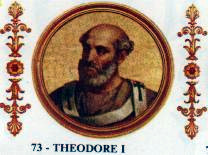
- Hieromartyr Pope Theodore I of Rome, who was burned alive (649)[1][7][27]
- Martyr Merililaun of Rheims (Merolilaun), a pilgrim murdered near Rheims and venerated as a martyr (8th century)[23][28]
- Saint Feredarius (Feradach mac Cormaic), Abbot of Iona (c. 880)[23]
- Saint Elgiva (Ãlgifu), Widow of King Edmund, Abbess of Shaftesbury (944)[1][23][29][note 8]
Post-Schism Orthodox saints
Other commemorations
- Commemoration of the Holy Fathers of the Seven Ecumenical Councils.[1]
- Translation of the relics (1030) of Saint Mildred of Thanet (Mildthryth), Abbess of Minster-in-Thanet (8th century)[39]
- Repose of Blessed Philip (Khorev), founder of the Gethsemane Caves Skete of St. Sergius Lavra (1869)[1][note 12]
Icon gallery
 Martyrs Heraclius, Paulinus, and Benedimus of Athens.
 Martyr Theodotus of Ancyra.
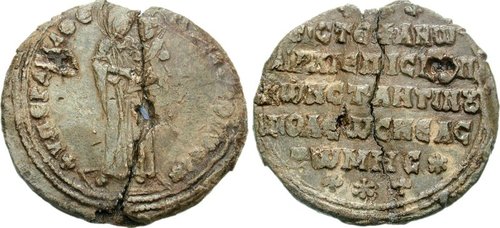 Seal of "Stephen, Patriarch of Constantinople and New Rome"
(i.e. either of Stephen I or II). St. Venantius of Camerino is hung upside-down over a fire, and then thrown to the lions.
 St. John Gashkevich, Archpriest of Korma.
 New Hieromartyr Damian (Damjan) Strbac, Jr.


Notes
- The notation Old Style or (OS) is sometimes used to indicate a date in the Julian Calendar (which is used by churches on the "Old Calendar").
The notation New Style or (NS), indicates a date in the Revised Julian calendar (which is used by churches on the "New Calendar"). - See: (in Russian) ÐÑаклий, Ðавлин и Ðенедим. Ðикипедии. (Russian Wikipedia).
- Heracleopolis Parva, or Sethroë, in Lower Egypt, identified with the site of Tell Belim.
- "ELGIVA was the wife of King Edmund, and mother of his successors, Edwig and the great Edgar. She was a woman of many virtues, and greatly venerated for her piety and supernatural gifts. She abounded in alms-deeds and every good work, her sweetness and piety were obvious to all who beheld her, and she had an utter contempt of vain ornaments and dress. Elgiva had moreover the gift of prophecy in a remarkable degree, and by her prudent counsel was a main support to her illustrious son, Edgar, who held her in the highest respect. Through her liberality, the Monastery of Shaftesbury was rebuilt or enlarged, and in that sanctuary her sacred relics reposed. The name of the Saint in the ancient English language was Ãlgifu, Elgiva or Algyva being the Latin form adopted by the chroniclers."[30]
- See: (in Russian) ÐакаÑий (ÐлÑÑ Ð°ÑÑв). Ðикипедии. (Russian Wikipedia).
- See: (in Russian) Ðоанн ÐоÑмÑнÑкий. Ðикипедии. (Russian Wikipedia).
- See: (in Serbian) ÐамÑан ШÑÑбаÑ. ÐикипедиÑе (Serbian Wikipedia).
- See: (in Russian) Филипп (ХоÑев). Ðикипедии. (Russian Wikipedia).