Messier 43
Emission nebula in the constellation Orion
From Wikipedia, the free encyclopedia
Messier 43 or M43, also known as De Mairan's Nebula and NGC 1982, is a star-forming nebula with a prominent H II region in the equatorial constellation of Orion. It was discovered by the French scientist Jean-Jacques d'Ortous de Mairan some time before 1731,[3] then catalogued by Charles Messier in 1769.[a] It is physically part of the Orion Nebula (Messier 42), separate from that main nebula by a dense lane of dust known as the northeast dark lane.[5] It is part of the much larger Orion molecular cloud complex.

| Emission nebula | |
|---|---|
| H II region | |
Hubble Space Telescope view of M43 | |
| Observation data: J2000 epoch | |
| Right ascension | 05h 35m 31.8s[1] |
| Declination | −05° 17′ 57″[1] |
| Distance | 1,300 ± 160 ly (400 ± 50 pc) ly |
| Apparent magnitude (V) | 9.0[2] |
| Apparent dimensions (V) | 20′ × 15′[3] |
| Constellation | Orion |
| Notable features | NU Orionis |
| Designations | De Mairan's Nebula, M43, NGC 1982[4] |
The main ionizing star in this nebula is the quadruple star system NU Orionis (HD 37061), the focus of the H II region, 1,360 ± 30 ly (417.0 ± 9.2 pc) away.[6] This star system is not hot enough to produce significant amounts of [O III] emission, unlike the Trapezium in the Orion Nebula.[7]
The H II region is a roundish volume of ionized hydrogen. It has a diameter of about 4.5′, at its distance meaning it measures 2.1 ly (0.65 pc). The net (meaning omitting the star) hydrogen alpha luminosity of this region is (3.0±1.1)×1035 erg s−1; equivalent to 78 L☉. There is a dark lane crossing the whole west-centre strip from north to south, known as the M43 dark lane, which forming a swirling belt extension to the south links to Orion's northeast dark lane. All of these resemble a mixture of smoke rising from a chimney and in watercolour broad and fine dark brushstrokes, at many wavelengths.
Gallery
 Emission nebula Messier 43 to the northeast of the well-known M42 Orion Nebula
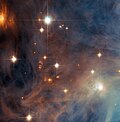 Infrared view of (part of) De Mairan's Nebula (M43)
![In this false color image, M43 visibly lacks [O III] emission (blue) present throughout the rest of the Orion Nebula.](//upload.wikimedia.org/wikipedia/commons/thumb/a/ac/M43_lacking_O-III_emission.jpg/120px-M43_lacking_O-III_emission.jpg) In this false color image, M43 visibly lacks [O III] emission (blue) present throughout the rest of the Orion Nebula.
In this false color image, M43 visibly lacks [O III] emission (blue) present throughout the rest of the Orion Nebula.


![In this false color image, M43 visibly lacks [O III] emission (blue) present throughout the rest of the Orion Nebula.](#/media/File:M43_lacking_O-III_emission.jpg)


