Portal:Astronomy
Wikipedia portal for content related to Astronomy
From Wikipedia, the free encyclopedia

Introduction

Astronomy is a natural science that studies celestial objects and the phenomena that occur in the cosmos. It uses mathematics, physics, and chemistry to explain their origin and their overall evolution. Objects of interest include planets, moons, stars, nebulae, galaxies, meteoroids, asteroids, and comets. Relevant phenomena include supernova explosions, gamma ray bursts, quasars, blazars, pulsars, and cosmic microwave background radiation. More generally, astronomy studies everything that originates beyond Earth's atmosphere. Cosmology is the branch of astronomy that studies the universe as a whole.
Astronomy is one of the oldest natural sciences. The early civilizations in recorded history made methodical observations of the night sky. These include the Egyptians, Babylonians, Greeks, Indians, Chinese, Maya, and many ancient indigenous peoples of the Americas. In the past, astronomy included disciplines as diverse as astrometry, celestial navigation, observational astronomy, and the making of calendars.
Astronomy is one of the few sciences in which amateurs play an active role. This is especially true for the discovery and observation of transient events. Amateur astronomers have helped with many important discoveries, such as finding new comets. (Full article...)
General images -
 Ultra HD photography taken at La Silla Observatory (from Observational astronomy)
 The main platform at La Silla hosts a huge range of telescopes with which astronomers can explore the Universe. (from Observational astronomy)
 Sunset at the equinox from the prehistoric site of Pizzo Vento at Fondachelli Fantina, Sicily (from History of astronomy)
 The inflationary theory as an augmentation to the Big Bang theory was first proposed by Alan Guth of MIT. Inflation solves the 'horizon problem' by making the early universe much more compact than was assumed in the standard model. Given such smaller size, causal contact (i.e., thermal communication) would have been possible among all regions of the early universe. The image was an adaptation from various generic charts depicting the growth of the size of the observable universe, for both the standard model and inflationary model respectively, of the Big Bang theory. (from Physical cosmology)
 Sir Patrick Moore was one of the world's leading popularisers of astronomy. (from Amateur astronomy)
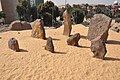 Megaliths from Nabta Playa, constructed by Neolithic populations, located in Aswan, Upper Egypt. Excavations of the megalith structures were completed in 2008. (from History of astronomy)
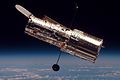 The Hubble Space Telescope (from History of astronomy)
 Artist conception of the Big Bang cosmological model, the most widely accepted out of all in physical cosmology (neither time nor size to scale) (from Physical cosmology)
 Map of the Milky Way Galaxy, with the constellations that cross the galactic plane in each direction and the known prominent components annotated including main arms, spurs, bar, nucleus/bulge, notable nebulae and globular clusters (from History of astronomy)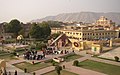
 An image of the Cat's Paw Nebula created combining the work of professional and amateur astronomers. The image is the combination of the 2.2-metre MPG/ESO telescope of the La Silla Observatory in Chile and a 0.4-meter amateur telescope. (from Amateur astronomy)
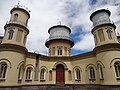 One of the Oldest Observatories in South America is the Quito Astronomical Observatory, founded in 1873 and located 12 minutes south of the Equator in Quito, Ecuador. The Quito Astronomical Observatory is the National Observatory of Ecuador and is located in the Historic Center of Quito and is managed by the National Polytechnic School. (from Observational astronomy)
 Portrait of William Herschel, 1785 (from History of astronomy)
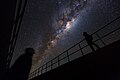 Places like Paranal Observatory offer crystal clear skies for observing astronomical objects with or without instruments. (from Amateur astronomy)
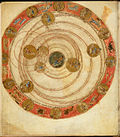 9th-century diagram of the positions of the seven planets on 18 March 816, from the Leiden Aratea (from History of astronomy)
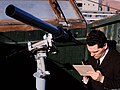 Amateur astronomer recording observations of the sun. (from Amateur astronomy)
 This image contains two side-by-side pictures of the night sky comparing the effects of light pollution on the visibility of celestial objects. (from Amateur astronomy)
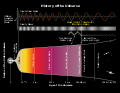 History of the Universe – gravitational waves are hypothesized to arise from cosmic inflation, a rapidly accelerated expansion just after the Big Bang (from Physical cosmology)
 An amateur astrophotography setup with an automated guide system connected to a laptop (from Observational astronomy)
 A voting session is conducted in 2006 International Astronomical Union's general assembly for determining a new definition of a planet (from Astronomer)
 Babylonian tablet in the British Museum recording Halley's Comet in 164 BC (from History of astronomy)
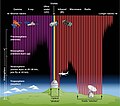 Overview of types of observational astronomy by observed wavelengths and their observability. (from Observational astronomy)
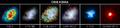 The Crab Nebula as seen in various wavelengths (from Observational astronomy)
 A map of the southern celestial hemisphere, also by Bayer (from History of astronomy)
 Comparison of CMB (Cosmic microwave background) results from satellites COBE, WMAP and Planck documenting a progress in 1989–2013 (from History of astronomy)
 A map of the northern celestial hemisphere from Johann Bayer's 1661 edition of Uranometria, the first atlas to feature star charts covering the entire celestial sphere (from History of astronomy)
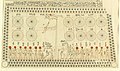 Segment of the astronomical ceiling of Senenmut's Tomb (circa 1479–1458 BC), depicting constellations, protective deities, and twenty-four segmented wheels for the hours of the day and the months of the year (from History of astronomy)
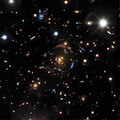 An example of a gravitational lens found in the DESI Legacy Surveys data. There are four sets of lensed images in DESI-090.9854-35.9683, corresponding to four distinct background galaxies—from the outermost giant red arc to the innermost bright blue arc, arranged in four concentric circles. All of them are gravitationally warped—or lensed—by the orange galaxy at the very center. Dark matter is expected to produce gravitational lensing also. (from Physical cosmology)
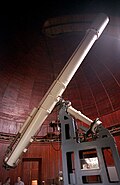 50 cm refracting telescope at Nice Observatory (from Observational astronomy)
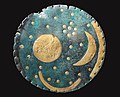 The Nebra sky disk, Germany, 1800–1600 BC (from History of astronomy)
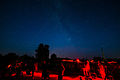
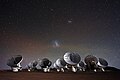 ALMA is the world's most powerful telescope for studying the Universe at submillimeter and millimeter wavelengths. (from Observational astronomy)
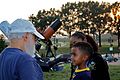 Amateur astronomy groups are often involved in outreach to introduce astronomy to the general public (from Amateur astronomy)


.jpg)


_(cropped).jpg)

_(cropped).jpg)

.jpg)


.jpg)
 Featured article -

The nebular hypothesis is the most widely accepted model in the field of cosmogony to explain the formation and evolution of the Solar System (as well as other planetary systems). It suggests the Solar System is formed from gas and dust orbiting the Sun which clumped up together to form the planets. The theory was developed by Immanuel Kant and published in his Universal Natural History and Theory of the Heavens (1755) and then modified in 1796 by Pierre Laplace. Originally applied to the Solar System, the process of planetary system formation is now thought to be at work throughout the universe. The widely accepted modern variant of the nebular theory is the solar nebular disk model (SNDM) or solar nebular model. It offered explanations for a variety of properties of the Solar System, including the nearly circular and coplanar orbits of the planets, and their motion in the same direction as the Sun's rotation. Some elements of the original nebular theory are echoed in modern theories of planetary formation, but most elements have been superseded.
According to the nebular theory, stars form in massive and dense clouds of molecular hydrogen—giant molecular clouds (GMC). These clouds are gravitationally unstable, and matter coalesces within them to smaller denser clumps, which then rotate, collapse, and form stars. Star formation is a complex process, which always produces a gaseous protoplanetary disk (proplyd) around the young star. This may give birth to planets in certain circumstances, which are not well known. Thus the formation of planetary systems is thought to be a natural result of star formation. A Sun-like star usually takes approximately 1 million years to form, with the protoplanetary disk evolving into a planetary system over the next 10–100 million years. (Full article...)
Did you know -
- ... that Caroline Moore was 14 years old when she discovered supernova 2008ha?
- ... that although Charles Messier discovered the galaxy M91 in 1781, it was added to his catalogue only two centuries later?
- ... that the fall of the Neuschwanstein meteorite in 2002 was observed by the European Fireball Network and outdoor witnesses through most of Central Europe?
- ... that AG Pegasi has been described as the slowest nova ever recorded?
More Did you know (auto generated)

- ... that the majority of extrasolar planets in fiction are inhabited by native species?
- ... that Kim Ye-ji's performance in the 10 meter air pistol at the 2024 Summer Olympics led her to be dubbed the "coolest person on the planet"?
- ... that some exoplanets are evaporating catastrophically?
- ... that in many works of fiction, the asteroid belt is the remnants of a destroyed planet?
- ... that Na drugą planetę, published in 1895 as one of the earliest Polish science-fiction novels, was later criticized by communist-era censors for its perceived "adoration for America"?
- ... that Michael Collins has been called "one of the best clarinettists walking the planet" by The Times?
WikiProjects


Selected image -

The Crab Pulsar (PSR B0531+21) is a relatively young neutron star. The star is the central star in the Crab Nebula, a remnant of the supernova SN 1054, which was widely observed on Earth in the year 1054.
Astronomy News
- 3 March 2026 –
- Astronomers announce the discovery 1,900 light-years from Earth of TIC 120362137, the tightest known quadruple star system, using data from NASA's Transiting Exoplanet Survey Satellite. (Space.com)
- 10 December 2025 – Brazil–China relations
- Brazil and China begin constructing a joint laboratory for radio astronomic technology with the Federal University of Campina Grande and the Federal University of Paraíba to support space research as both countries work on the BINGO radio telescope. (Reuters)
May anniversaries
- 1 May 1959 – The former Beltsville Center is renamed to Goddard Space Flight Center in honor of Dr. Robert H. Goddard, rocket pioneer who achieved first launch of a liquid-fueled rocket
- 4 May 1967 – Lunar Orbiter 4 is launched to perform a photographic survey of lunar surface features
- 7 May 1975 – Explorer 53 (SAS-C), a NASA X-ray astronomy space telescope, is launched from the San Marco Range in Kenya, Africa
- 7 May 1997 – English-language French science fiction action film, The Fifth Element is released showing passenger inter-constellation vehicles, spacefighter craft, and various non-human creatures
- 14 May 1935 – The planetarium at Griffith Observatory in Los Angeles, California opens
- 14 May 1973 – The first American space station, Skylab, is launched
- 18 May 1969 – The Apollo 10 human spaceflight is launched, testing all aspects of the lunar landing mission, except the actual lunar landing
- 20 May 1978 – Pioneer Venus is launched from Cape Canaveral, Florida becoming the first spacecraft placed in orbit around Venus
- 30 May 1971 – Mariner 9 robotic space probe is launched becoming the first spacecraft to orbit Mars
Space-related Portals


Astronomical events
All times UT unless otherwise specified. Portal:Astronomy/Events/May 2026
Topics
Subcategories
Things you can do
|
Here are some Open Tasks :
Astronomy featured article candidates:
Astronomy articles for which peer review has been requested:
|
Wikibooks

These books may be in various stages of development. See also the related Science and Mathematics bookshelves.
- Astronomy
- GAT: A Glossary of Astronomical Terms
- Introduction to Astrophysics
- General relativity
- Observing the Sky from 30°S
- Observing the Sky from 40°N
Wikijunior
Associated Wikimedia
The following Wikimedia Foundation sister projects provide more on this subject:
-
 Commons
Free media repository -
 Wikidata
Free knowledge base -
 Wikiquote
Collection of quotations -
 Wikisource
Free-content library -
 Wikiversity
Free learning tools -
 Wiktionary
Dictionary and thesaurus


