Near the corner, the flow can be assumed to be Stokes flow. Describing the two-dimensional planar problem by the cylindrical coordinates  with velocity components
  defined by a stream function such that
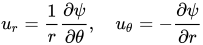
the governing equation can be shown to be simply the biharmonic equation  . The equation has to be solved with homogeneous boundary conditions (conditions taken for two walls separated by angle
  )
)

The Taylor scraping flow is similar to this problem but driven inhomogeneous boundary condition. The solution is obtained by the eigenfunction expansion,[5]
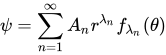
where  are constants and the real part of the eigenvalues are always greater than unity. The eigenvalues
  will be function of the angle
  , but regardless eigenfunctions can be written down for any
  ,
,

For antisymmetrical solution, the eigenfunction is even and hence  and the boundary conditions demand
  . The equations admits no real root when
  °. These complex eigenvalues indeed correspond to the moffatt eddies. The complex eigenvalue if given by
  where
where
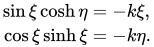
Here 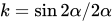 .
.